

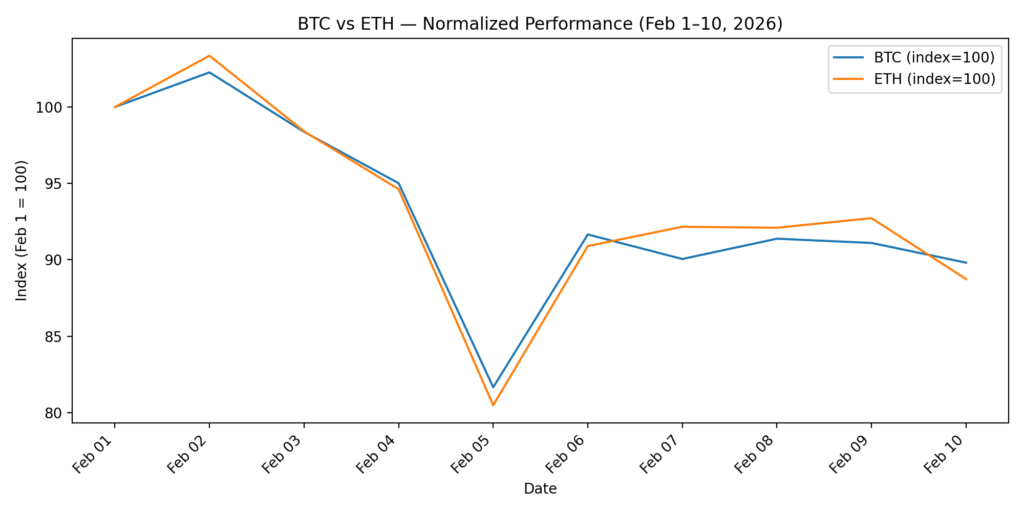
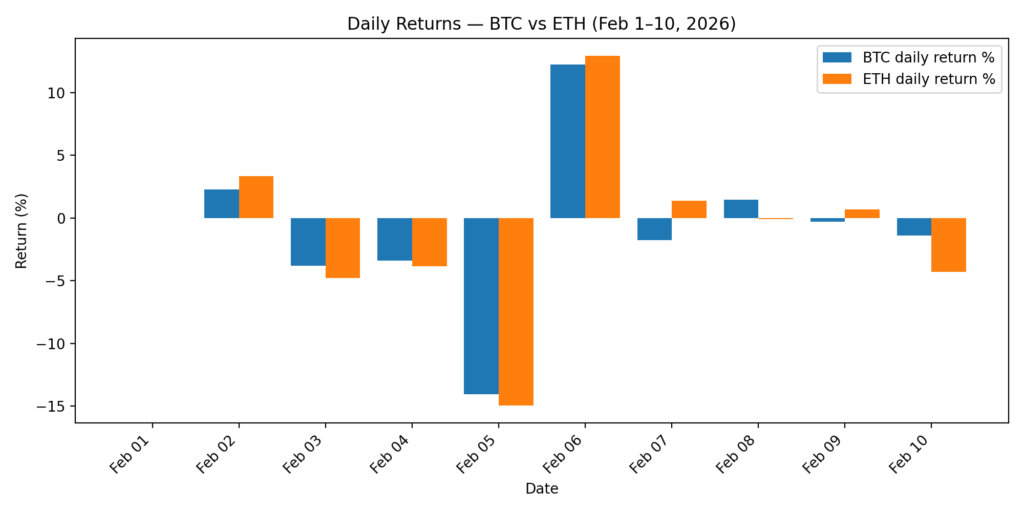
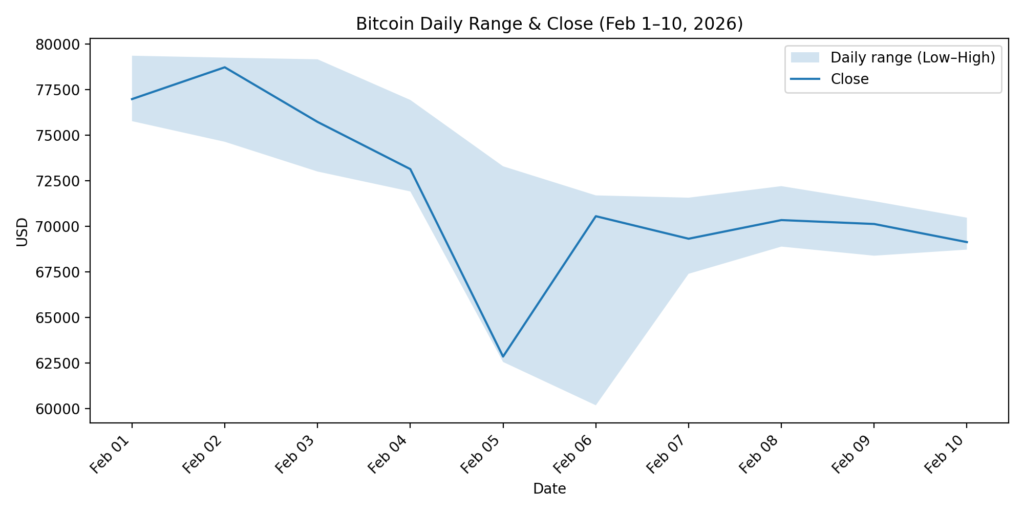
This window was a classic flush + reflex bounce. BTC and ETH sold off hard into Feb 5, bounced aggressively on Feb 6, then consolidated near ~$70k BTC with ETF flows stabilizing into Feb 9.
Key takeaways
BTC: ~-10.19% over Feb 1→Feb 10; intraperiod high/low range ~31.85%.
ETH: ~-11.26% over Feb 1→Feb 10; intraperiod range ~41.00%.
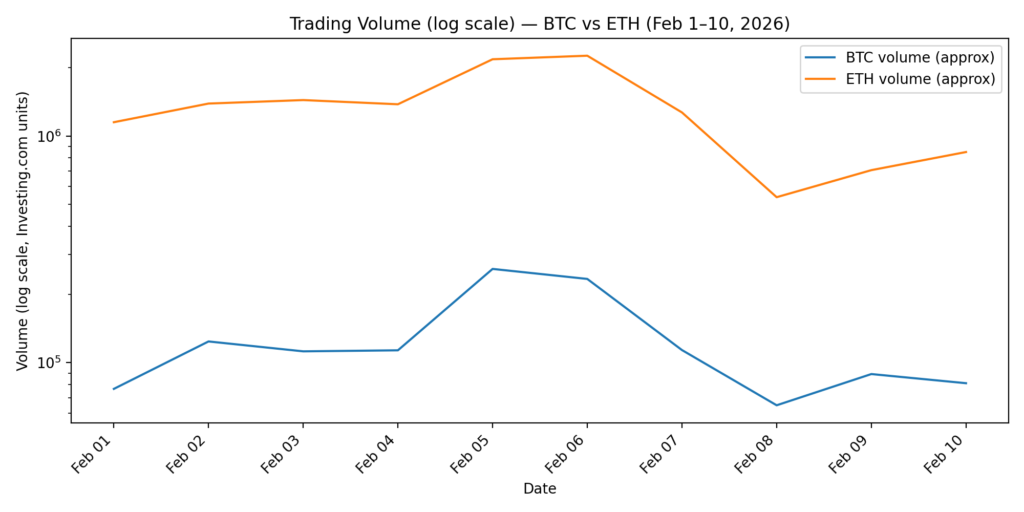
“Capitulation” day: Feb 5 saw a sharp slide with heavy volume and risk off headlines.
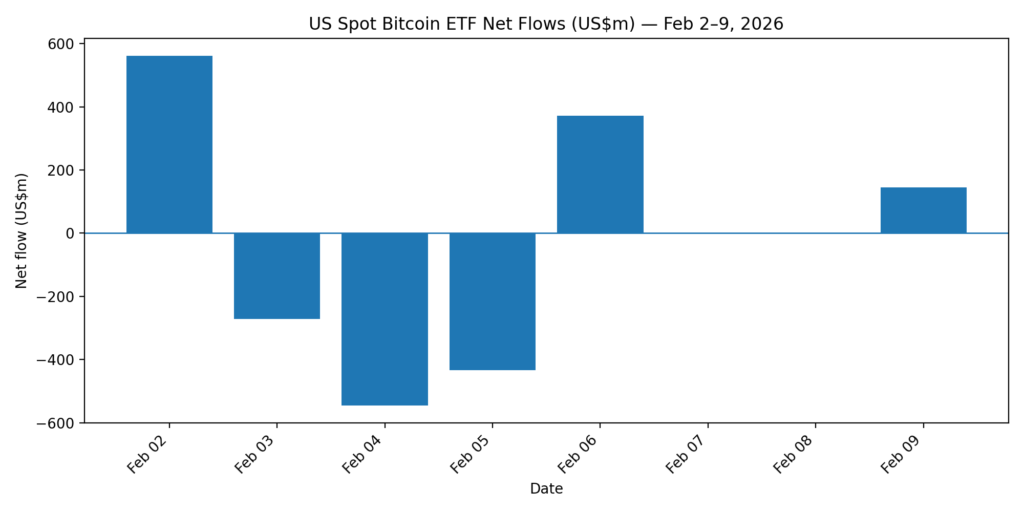
ETF flows: net flows flipped from deep outflows Feb 3–5 to inflows Feb 6, Feb 9.
Liquidity backdrop: stablecoin market cap stayed depressed under ~$205B, keeping rallies more fragile than inevitable.
Market snapshot (prices and daily momentum)
Data source: Investing.com historical data for BTC/USD and ETH/USD (daily OHLC).
| Date | BTC Close | BTC % | ETH Close | ETH % |
|---|---|---|---|---|
| Feb 01, 2026 | 76,976.1 | -2.22 | 2,269.75 | -7.35 |
| Feb 02, 2026 | 78,720.6 | +2.27 | 2,345.93 | +3.36 |
| Feb 03, 2026 | 75,724.8 | -3.81 | 2,233.65 | -4.79 |
| Feb 04, 2026 | 73,137.0 | -3.42 | 2,147.63 | -3.85 |
| Feb 05, 2026 | 62,857.9 | -14.05 | 1,826.72 | -14.94 |
| Feb 06, 2026 | 70,555.7 | +12.25 | 2,063.22 | +12.95 |
| Feb 07, 2026 | 69,319.5 | -1.75 | 2,091.88 | +1.39 |
| Feb 08, 2026 | 70,342.0 | +1.48 | 2,090.37 | -0.07 |
| Feb 09, 2026 | 70,127.9 | -0.30 | 2,104.66 | +0.68 |
| Feb 10, 2026 | 69,134.8 | -1.42 | 2,014.13 | -4.30 |
What actually happened (the clean narrative)
Phase A — Drift lower (Feb 1–4)
The market started the month already fragile: lower highs, declining risk appetite, and liquidity constraints. BTC slid from ~77k to ~73k, while ETH underperformed larger daily swings.
Phase B — Capitulation impulse (Feb 5)
Feb 5 was the stress test: a sharp drop in BTC and ETH, with high volume, consistent with forced deleveraging mechanics (margin calls, liquidations, collateral haircuts). Reuters framed it in a broader risk-off / liquidity context including ETF outflows and macro/policy uncertainty.
Phase C — Reflex bounce (Feb 6)
Feb 6 delivered the textbook snapback +12% day for BTC and ETH closes. Two reasons usually dominate these rebounds:
sellers get exhausted, and
marginal demand spot + systematic rebalancing returns once volatility peaks.
ETF data also shows a turn to net inflows on Feb 6.
Phase D — Consolidation (Feb 7–10)
BTC stabilized near the ~$70k band, while ETH held ~2.0–2.1k but showed renewed weakness on Feb 10. Lower participation/volume became part of the story as the market tried to find fair value after the shock.
Bitcoin deep dive (BTC)
Performance and risk metrics (Feb 1–10)
Period return: ~-10.19%
High → Low range: ~31.85%
Max close to close drawdown inside window: ~-20.15%
(Computed from the same daily dataset.)
Levels traders cared about behavioral map, not prophecy
Based on the period’s printed highs/lows:
Support zone: ~$60k–$65k (wick lows, panic prints, bounce origin)
Pivot zone: ~$69k–$71k (current consolidation band)
Resistance zone: ~$72k–$79k (multiple failed recoveries / prior distribution)
Ethereum deep dive (ETH)
ETH’s move mirrored BTC structurally, but with higher beta:
Bigger down days during stress Feb 1 and Feb 5
Strong bounce on Feb 6, then chop, then renewed weakness on Feb 10
This is typical when liquidity and risk tolerance compress; ETH often becomes the levered version of BTC sentiment.
Practical level map from printed extremes:
Support: ~$1.75k–$1.85k
Pivot: ~$2.0k–$2.1k
Resistance: ~$2.15k–$2.35k and higher at ~$2.47k peak in window
Institutional pulse: US spot Bitcoin ETF flows
ETF flow data Farside lines up with the market’s flush then stabilize pattern:
Feb 2: +$561.8m
Feb 3–5: heavy outflows (notably Feb 4: -$544.9m)
Feb 6: +$371.1m (stabilization)
Feb 9: +$144.9m (follow-through)
| Date | US Spot BTC ETF Net Flow (US$m) |
|---|---|
| Feb 02, 2026 | +561.8 |
| Feb 03, 2026 | -272.0 |
| Feb 04, 2026 | -544.9 |
| Feb 05, 2026 | -434.1 |
| Feb 06, 2026 | +371.1 |
| Feb 09, 2026 | +144.9 |
Liquidity and “why rallies feel harder” in this regime
One simple macro liquidity proxy in crypto is stablecoin supply. When stablecoin market cap contracts or stagnates, it often corresponds to:
less marginal bid,
thinner order books,
more violent moves on both downswings and bounces.
During this period, stablecoins remained below ~$205B market cap per DeFiLlama, consistent with a tighter liquidity environment.
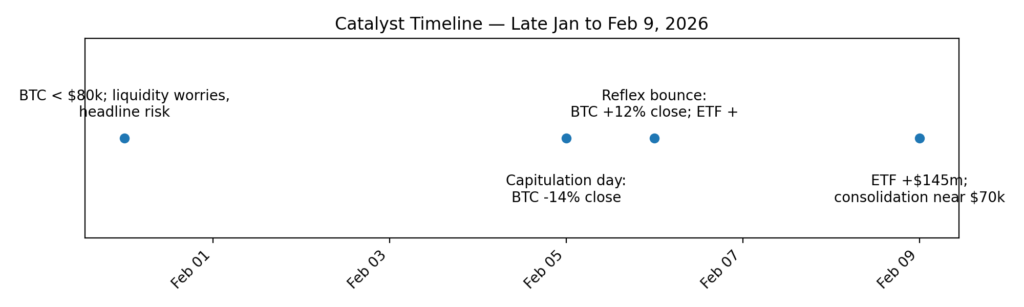
Visual timeline (for readers who don’t want paragraphs)
What to watch next (Feb 11 onward)
Not predictions, just the dashboard that matters in this tape:
ETF flow trend: does the market keep printing net inflows after the bounce?
Volatility normalization: are daily ranges compressing meaningfully vs Feb 5–6?
$70k BTC as a pivot: holding above it reduces sell the rip reflexes; losing it reopens the $60k–$65k zone.
Liquidity proxy: stablecoin supply trend, expanding = more oxygen.
Conclusion
Feb 1–10 looked less like a new bull leg and more like a market repricing under tight liquidity: sharp downside impulses, violent mean reversion, then cautious consolidation. The actionable insight isn’t a magical number, it’s the process: watch flows, volatility, and liquidity together, because any single signal in isolation gets you confidently wrong.
If you want this type of read every week, plus data driven breakdowns you can plug into your own decision making, follow NeuralArB, that’s where I publish the tighter dashboards (flows/volatility/liquidity), quick scenario maps, and the what changed since last update notes.
💬 Frequently Asked Questions (FAQ)
Why did Bitcoin drop so hard on Feb 5, 2026?
A mix of risk off sentiment, liquidity stress, and forced deleveraging dynamics; major outlets also pointed to ETF outflows and macro/policy uncertainty as part of the backdrop.
Did ETFs matter this week?
Flows flipped from large outflows Feb 3–5 to inflows Feb 6 and Feb 9, consistent with “capitulation → stabilization.”
Did Ethereum behave differently than Bitcoin?
Directionally similar, but ETH showed higher percentage swings down more during stress, bounced hard, then weakened again on Feb 10.
What’s the cleanest summary of Feb 1–10?
Selloff → capitulation → reflex bounce → consolidation near BTC ~$70k.
Stay Connected:
Related Analysis:
How High-Frequency Trading (HFT) (Impacts Crypto Arbitrage)
- Reinforcement Learning in Dynamic Markets (AI trading strategies)
- Crypto Arbitrage 101 (beginner’s guide to arbitrage)
Data Sources:
- CoinGecko – Real-time price data and market cap
- Yahoo Finance – Historical price data
- CoinDesk – Liquidation data
- Reuters – Market analysis
- Binance – Upcoming catalysts
Disclaimer: This analysis is for educational purposes. Arbitrage trading involves substantial risk, including custody risk, regulatory risk, and execution risk. Past performance is not indicative of future results. Never risk capital you cannot afford to lose. Consult qualified financial and legal advisors before trading.