

Crypto Market Update (Jan 26–31, 2026): BTC Breaks $80K Support, ETH Underperforms

Crypto Market Update — January 26–31, 2026

The week in 60 seconds


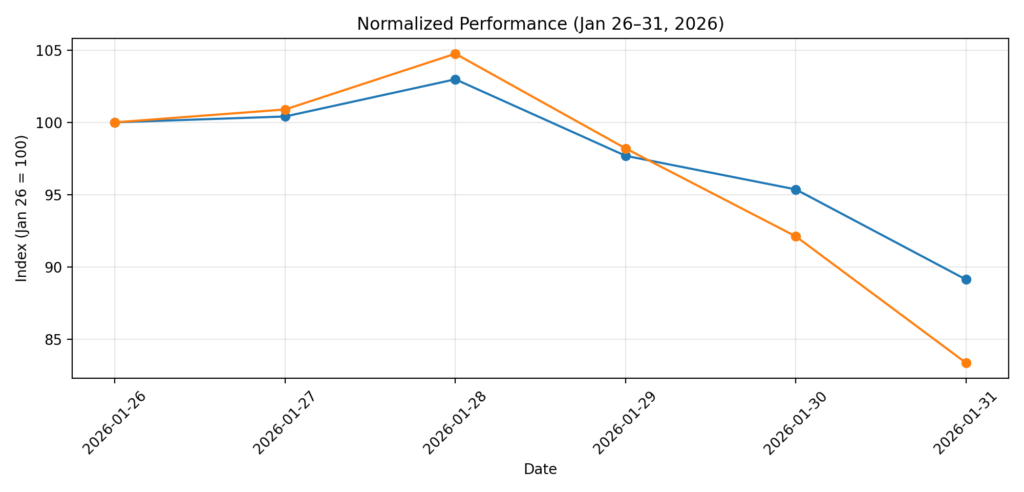
    • BTC: 88,331 → 78,726 -10.87% with a max drawdown ~-13.45% from the week’s peak.

    • ETH: 2,930 → 2,443 -16.64% with a max drawdown ~-20.42% from the week’s peak.

    • Macro stayed “steady” on paper: Federal Reserve held the fed funds range at 3.5%–3.75% on Jan 28.

    • Liquidity cues worsened: top stablecoins combined market cap USDT+USDC fell to ~$257.9B; NeuralArB flagged broader stablecoin market cap contraction.

    • Spot BTC ETFs saw a large outflow day $817M amid risk off and deleveraging narratives.

    • BTC’s late week flush below $80K was linked in market commentary to liquidity concerns and leadership uncertainty at the Fed.

Bitcoin vs Ethereum performance Jan 26–31 2026 normalized chart
Crypto january 26-31 2026


Daily market snapshot BTC & ETH


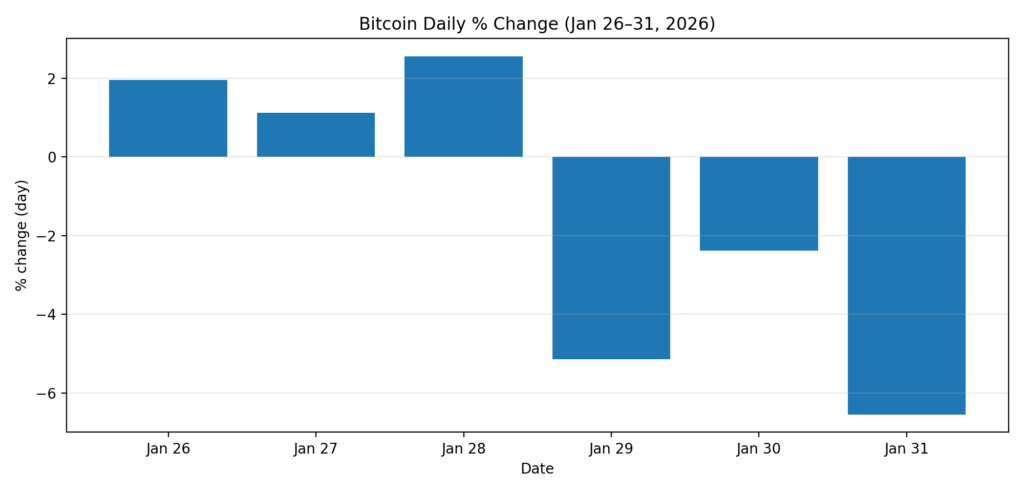
Close to close performance table


Date (2026)BTC CloseBTC %ETH CloseETH %
Jan 2688,331.3+1.95%2,930.13+3.96%
Jan 2788,688.2+1.12%2,956.21+1.95%
Jan 2890,960.0+2.56%3,069.15+3.82%
Jan 2986,286.0-5.14%2,877.25-6.25%
Jan 3084,234.0-2.38%2,698.98-6.20%
Jan 3178,726.5-6.54%2,442.58-9.51%

Source: Investing historical data tables.

BTC key levels


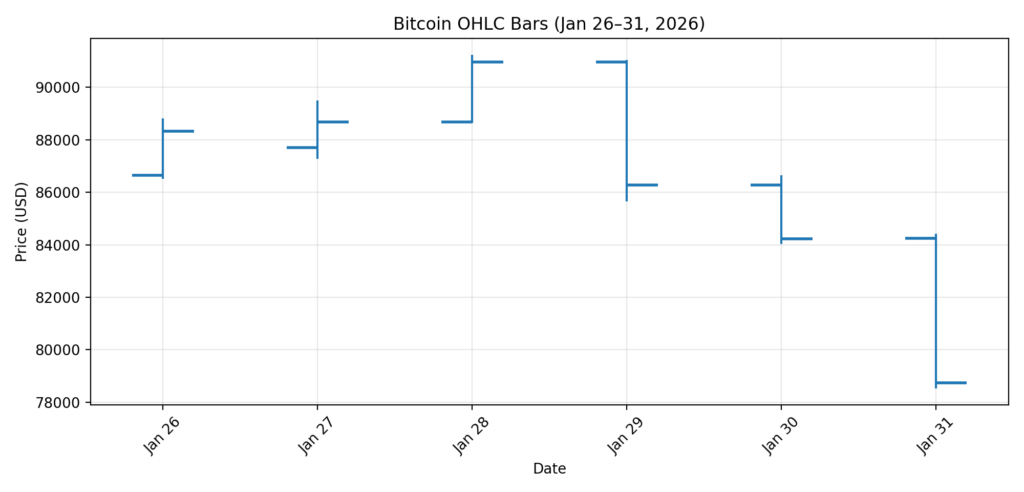
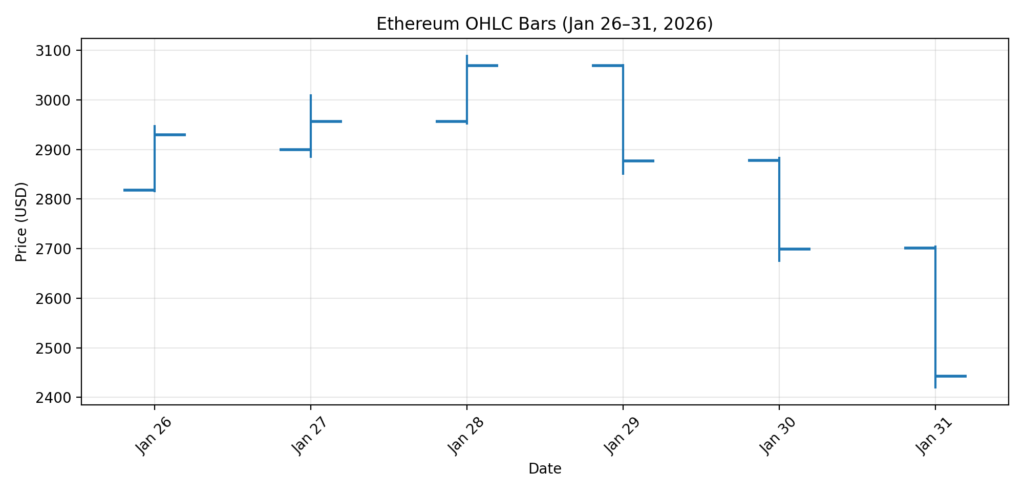
Full OHLC for traders who care about wicks


DateBTC O / H / L / CETH O / H / L / C
Jan 2686,644 / 88,811 / 86,521 / 88,3312,818 / 2,949 / 2,814 / 2,930
Jan 2787,702 / 89,508 / 87,274 / 88,6882,900 / 3,012 / 2,883 / 2,956
Jan 2888,687 / 91,237 / 88,645 / 90,9602,956 / 3,091 / 2,950 / 3,069
Jan 2990,960 / 91,053 / 85,653 / 86,2863,069 / 3,072 / 2,849 / 2,877
Jan 3086,286 / 86,653 / 84,034 / 84,2342,878 / 2,885 / 2,673 / 2,699
Jan 3184,253 / 84,413 / 78,524 / 78,7272,701 / 2,706 / 2,418 / 2,443
BTC ohlc bars
ETH ohlc bars


What actually drove the sell-off?


1) Rates unchanged didn’t mean risk back on


On Jan 28, the Fed held the policy rate range at 3.5%–3.75% with two dissenters preferring a 25 bp cut.
Markets can still sell off into a hold if positioning is crowded, liquidity is thinning, or forward expectations shift.


2) Liquidity signals: stablecoins shrank instead of parking on-chain


A notable tell this week was stablecoin contraction rather than rotation within crypto:

    • USDT+USDC combined market value fell to ~$257.9B, with USDC leading the decline.

    • Santiment reported the top 12 stablecoins’ market cap down $2.24B over ~10 days, framing it as capital exiting risk markets rather than waiting in stablecoin sidelines.

This matters because stablecoins are the transactional liquidity that tends to show up fastest when dip buyers step in.


3) ETF flow pressure: forced deleveraging vibes


On Jan 30 reporting, Decrypt cited $817M net outflows from U.S. spot Bitcoin ETFs, led by BlackRock’s IBIT.
The same piece linked the move to macro uncertainty, basis trade deleveraging, and a broader risk off tone that also touched equities including Microsoft guidance commentary.


4) Late-week catalyst: BTC through $80K amid “liquidity fears”


In market coverage, BTC dropping below $80K was framed around liquidity concerns and uncertainty about the next Fed chair including references to Kevin Warsh.
Whether you buy that narrative or not, the price action says what it says: once supports broke, the week ended in a classic cascade.


Bitcoin (BTC) technical recap: levels that mattered

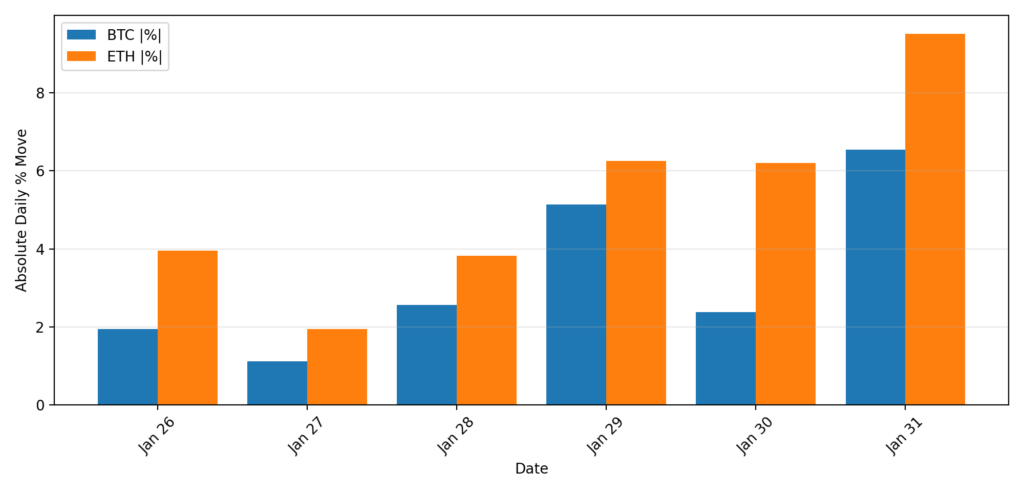
BTC daily change
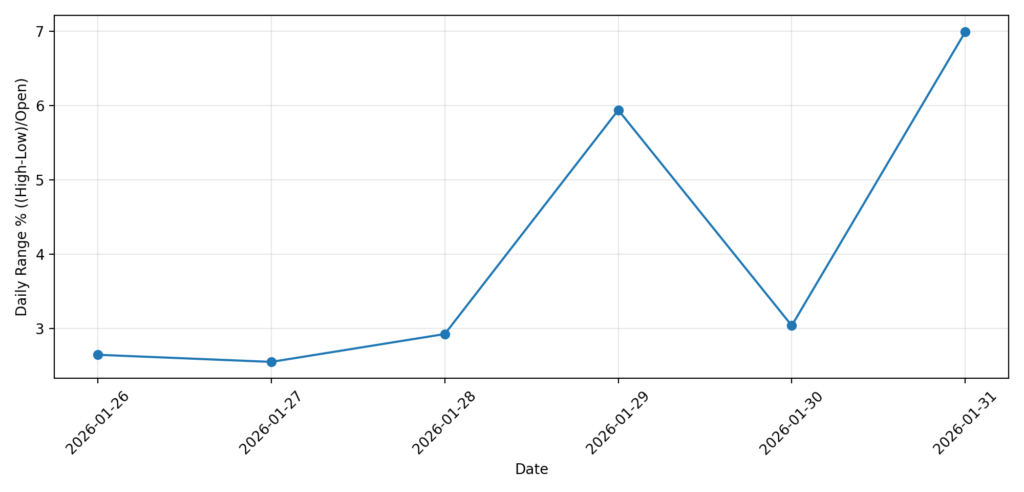
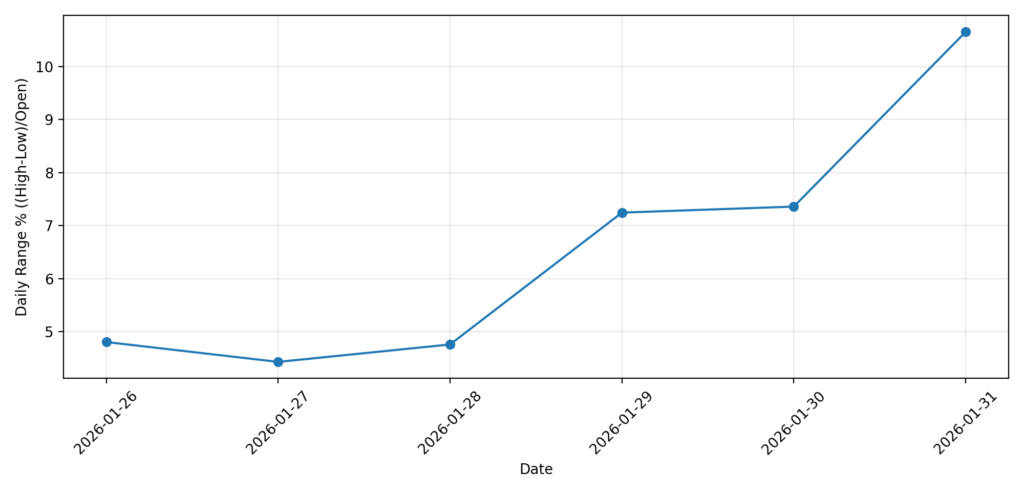
BTC daily range pct

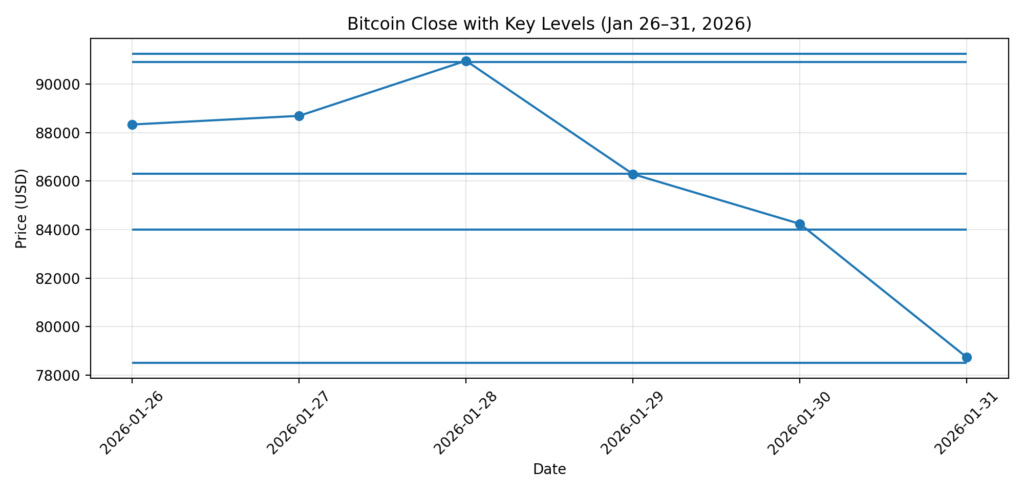
Weekly return: -10.87% (88,331 → 78,727).


Key levels derived from the week’s range:

    • Support zone: ~78,500–79,000 (week low area).

    • Resistance zone: ~90,900–91,250 (week peak / rejection area).

    • Pivot: ~84,000–86,300 (Jan 30 close area + prior breakdown day).

Read-through:

    • The week formed a rally → sharp reversal → continuation lower structure.

    • If price reclaims the pivot 84–86K and holds, the move can downgrade from breakdown to sweep + reclaim.

    • If it fails below ~80K on retests, that’s where dead cat bounce memes get minted.


Ethereum (ETH) recap: why it bled harder

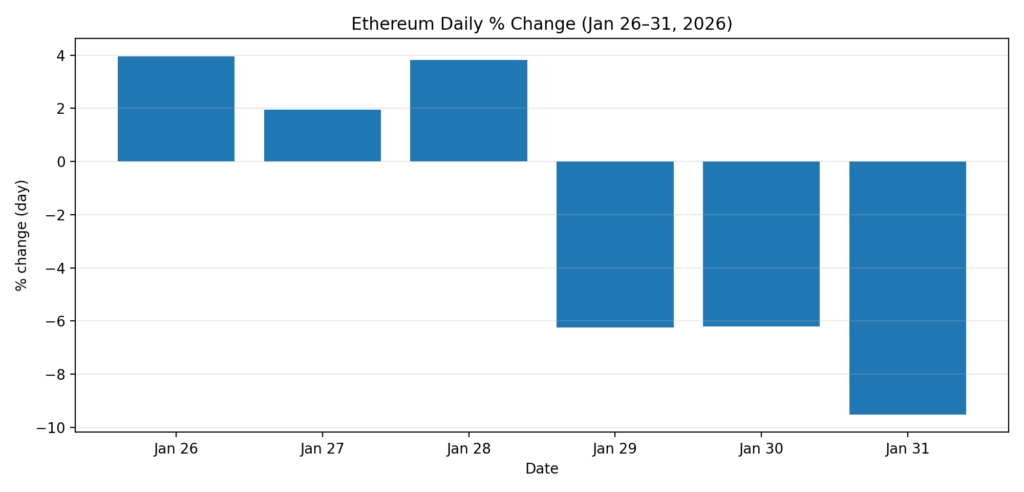
ETH daily change

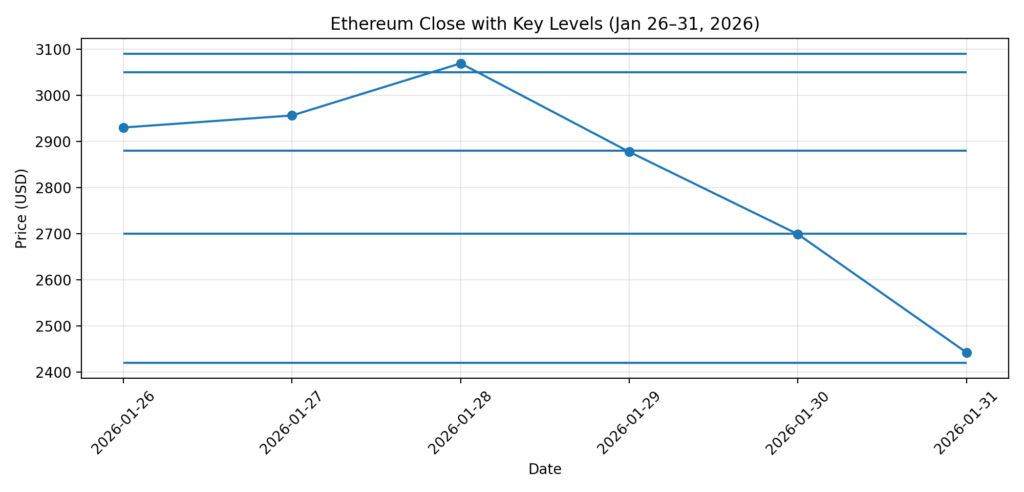
Weekly return: -16.64% (2,930 → 2,443).


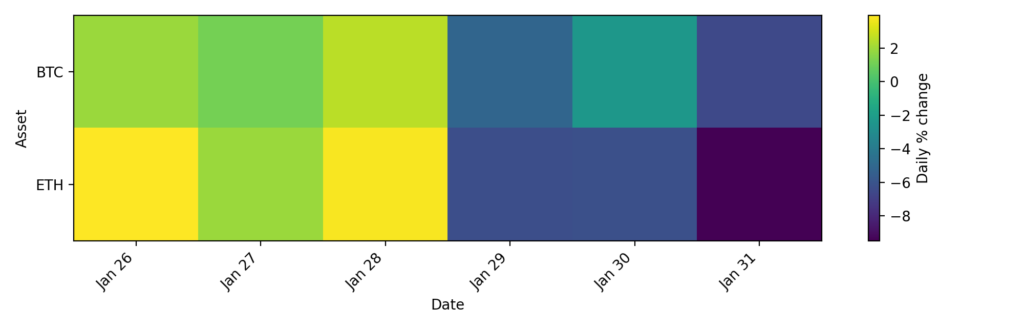
ETH underperformed BTC in the risk off impulse consistent with historical behavior when liquidity tightens ETH beta tends to be higher.


Key levels:

    • Support: ~2,420–2,450 (week low area).

    • Resistance: ~3,050–3,090 (week peak).

    • Pivot: ~2,700–2,880 (breakdown region).


Positioning & sentiment: the slow leak behind the cliff

daily returns heatmap

Long term holders resumed distribution


A CoinDesk reposted analysis on MEXC’s news feed cited ~143,000 BTC sold by long term holders over ~30 days Glassnode based framing.
That doesn’t cause a single day dump, but it’s a meaningful headwind when short term liquidity disappears.


Why stablecoin + ETF + LTH distribution is a nasty combo

    • Stablecoin contraction: fewer chips at the table.

    • ETF outflows: mechanical selling + sentiment damage.

    • Long term distribution: reduced structural bid.

When all three align, rebounds tend to be slower and more fragile.


What to watch next week (early Feb 2026)


Liquidity gauges

    • Stablecoin market cap trend: does it stop falling?

    • ETF flow stabilization: do large outflow days cool off?

Macro headline risk

    • Fed leadership / policy narrative: the market is clearly sensitive to it right now.

Price structure

    • BTC: reclaim/hold 84–86K vs reject and roll.

    • ETH: can it reclaim ~2.7K, or does it stay heavy below?


Practical playbook (not financial advice)


If you trade short term

    • Treat rallies into prior breakdown zones as prove it moves.

    • Reduce leverage assumptions when liquidity indicators are contracting stablecoins/ETF flows.

If you swing trade

    • Demand confirmation: reclaim + hold above pivots (BTC ~84–86K, ETH ~2.7–2.9K) before upgrading bias.

    • Plan invalidation first; entries second.

If you’re long term

    • Weeks like this are where discipline beats prediction.

    • If you DCA, pre define your schedule and don’t let a red candle rewrite it.


Conclusion


Jan 26–31 was a textbook reminder that headline stability rates held can coexist with liquidity deterioration and when liquidity thins, price tends to move fast, not politely.

If you want to track these shifts systematically stablecoin trend, ETF flow regime, volatility spikes, key level breaks without living on 12 tabs, bake it into a repeatable routine: daily signals, clear thresholds, and fewer emotional trades.

That’s exactly how I use NeuralArB: an AI driven market brief that prioritizes risk context (liquidity + positioning) before chasing narratives. If you want the next update delivered as a clean what changed / what matters / key levels format, follow NeuralArB and plug it into your daily checklist.


💬 Frequently Asked Questions (FAQ)

Why did Bitcoin fall below $80K in late January 2026?

Coverage linked the move to liquidity concerns, ETF outflows, and uncertainty around Fed leadership, coinciding with a sharp risk-off week.

ETH typically shows higher beta during liquidity stress; this week’s drawdown also followed a sharper multi day selloff after the Jan 28 peak.

Stablecoin market cap contraction capital leaving crypto rather than waiting in stablecoins often weakens rebound strength.


📱 Stay Connected:

  • Twitter/X for real-time market alerts
  • Telegram community for live trading discussions

🔗 Related Analysis:


Data Sources:

Disclaimer: This analysis is for educational purposes. Arbitrage trading involves substantial risk, including custody risk, regulatory risk, and execution risk. Past performance is not indicative of future results. Never risk capital you cannot afford to lose. Consult qualified financial and legal advisors before trading.

Max Takeda

Max Takeda is the Chief Technology Officer at NeuralArB, where he leads the company’s technology vision, overseeing the development and implementation of cutting-edge AI algorithms and blockchain solutions that power crypto arbitrage trading efficiency. With a strong background in software engineering, artificial intelligence, and distributed ledger technology, Max combines technical expertise with strategic thinking to drive NeuralArB's mission to revolutionize the cryptocurrency trading space. Connect with Max on Twitter: @MaxTakeda91

Crypto Market Update (Jan 26–31, 2026): BTC Breaks $80K Support, ETH Underperforms

Crypto Market Update — January 26–31, 2026

The week in 60 seconds


    • BTC: 88,331 → 78,726 -10.87% with a max drawdown ~-13.45% from the week’s peak.

    • ETH: 2,930 → 2,443 -16.64% with a max drawdown ~-20.42% from the week’s peak.

    • Macro stayed “steady” on paper: Federal Reserve held the fed funds range at 3.5%–3.75% on Jan 28.

    • Liquidity cues worsened: top stablecoins combined market cap USDT+USDC fell to ~$257.9B; NeuralArB flagged broader stablecoin market cap contraction.

    • Spot BTC ETFs saw a large outflow day $817M amid risk off and deleveraging narratives.

    • BTC’s late week flush below $80K was linked in market commentary to liquidity concerns and leadership uncertainty at the Fed.

Bitcoin vs Ethereum performance Jan 26–31 2026 normalized chart
Crypto january 26-31 2026


Daily market snapshot BTC & ETH


Close to close performance table


Date (2026)BTC CloseBTC %ETH CloseETH %
Jan 2688,331.3+1.95%2,930.13+3.96%
Jan 2788,688.2+1.12%2,956.21+1.95%
Jan 2890,960.0+2.56%3,069.15+3.82%
Jan 2986,286.0-5.14%2,877.25-6.25%
Jan 3084,234.0-2.38%2,698.98-6.20%
Jan 3178,726.5-6.54%2,442.58-9.51%

Source: Investing historical data tables.

BTC key levels


Full OHLC for traders who care about wicks


DateBTC O / H / L / CETH O / H / L / C
Jan 2686,644 / 88,811 / 86,521 / 88,3312,818 / 2,949 / 2,814 / 2,930
Jan 2787,702 / 89,508 / 87,274 / 88,6882,900 / 3,012 / 2,883 / 2,956
Jan 2888,687 / 91,237 / 88,645 / 90,9602,956 / 3,091 / 2,950 / 3,069
Jan 2990,960 / 91,053 / 85,653 / 86,2863,069 / 3,072 / 2,849 / 2,877
Jan 3086,286 / 86,653 / 84,034 / 84,2342,878 / 2,885 / 2,673 / 2,699
Jan 3184,253 / 84,413 / 78,524 / 78,7272,701 / 2,706 / 2,418 / 2,443
BTC ohlc bars
ETH ohlc bars


What actually drove the sell-off?


1) Rates unchanged didn’t mean risk back on


On Jan 28, the Fed held the policy rate range at 3.5%–3.75% with two dissenters preferring a 25 bp cut.
Markets can still sell off into a hold if positioning is crowded, liquidity is thinning, or forward expectations shift.


2) Liquidity signals: stablecoins shrank instead of parking on-chain


A notable tell this week was stablecoin contraction rather than rotation within crypto:

    • USDT+USDC combined market value fell to ~$257.9B, with USDC leading the decline.

    • Santiment reported the top 12 stablecoins’ market cap down $2.24B over ~10 days, framing it as capital exiting risk markets rather than waiting in stablecoin sidelines.

This matters because stablecoins are the transactional liquidity that tends to show up fastest when dip buyers step in.


3) ETF flow pressure: forced deleveraging vibes


On Jan 30 reporting, Decrypt cited $817M net outflows from U.S. spot Bitcoin ETFs, led by BlackRock’s IBIT.
The same piece linked the move to macro uncertainty, basis trade deleveraging, and a broader risk off tone that also touched equities including Microsoft guidance commentary.


4) Late-week catalyst: BTC through $80K amid “liquidity fears”


In market coverage, BTC dropping below $80K was framed around liquidity concerns and uncertainty about the next Fed chair including references to Kevin Warsh.
Whether you buy that narrative or not, the price action says what it says: once supports broke, the week ended in a classic cascade.


Bitcoin (BTC) technical recap: levels that mattered

BTC daily change
BTC daily range pct

Weekly return: -10.87% (88,331 → 78,727).


Key levels derived from the week’s range:

    • Support zone: ~78,500–79,000 (week low area).

    • Resistance zone: ~90,900–91,250 (week peak / rejection area).

    • Pivot: ~84,000–86,300 (Jan 30 close area + prior breakdown day).

Read-through:

    • The week formed a rally → sharp reversal → continuation lower structure.

    • If price reclaims the pivot 84–86K and holds, the move can downgrade from breakdown to sweep + reclaim.

    • If it fails below ~80K on retests, that’s where dead cat bounce memes get minted.


Ethereum (ETH) recap: why it bled harder

ETH daily change

Weekly return: -16.64% (2,930 → 2,443).


ETH underperformed BTC in the risk off impulse consistent with historical behavior when liquidity tightens ETH beta tends to be higher.


Key levels:

    • Support: ~2,420–2,450 (week low area).

    • Resistance: ~3,050–3,090 (week peak).

    • Pivot: ~2,700–2,880 (breakdown region).


Positioning & sentiment: the slow leak behind the cliff

daily returns heatmap

Long term holders resumed distribution


A CoinDesk reposted analysis on MEXC’s news feed cited ~143,000 BTC sold by long term holders over ~30 days Glassnode based framing.
That doesn’t cause a single day dump, but it’s a meaningful headwind when short term liquidity disappears.


Why stablecoin + ETF + LTH distribution is a nasty combo

    • Stablecoin contraction: fewer chips at the table.

    • ETF outflows: mechanical selling + sentiment damage.

    • Long term distribution: reduced structural bid.

When all three align, rebounds tend to be slower and more fragile.


What to watch next week (early Feb 2026)


Liquidity gauges

    • Stablecoin market cap trend: does it stop falling?

    • ETF flow stabilization: do large outflow days cool off?

Macro headline risk

    • Fed leadership / policy narrative: the market is clearly sensitive to it right now.

Price structure

    • BTC: reclaim/hold 84–86K vs reject and roll.

    • ETH: can it reclaim ~2.7K, or does it stay heavy below?


Practical playbook (not financial advice)


If you trade short term

    • Treat rallies into prior breakdown zones as prove it moves.

    • Reduce leverage assumptions when liquidity indicators are contracting stablecoins/ETF flows.

If you swing trade

    • Demand confirmation: reclaim + hold above pivots (BTC ~84–86K, ETH ~2.7–2.9K) before upgrading bias.

    • Plan invalidation first; entries second.

If you’re long term

    • Weeks like this are where discipline beats prediction.

    • If you DCA, pre define your schedule and don’t let a red candle rewrite it.


Conclusion


Jan 26–31 was a textbook reminder that headline stability rates held can coexist with liquidity deterioration and when liquidity thins, price tends to move fast, not politely.

If you want to track these shifts systematically stablecoin trend, ETF flow regime, volatility spikes, key level breaks without living on 12 tabs, bake it into a repeatable routine: daily signals, clear thresholds, and fewer emotional trades.

That’s exactly how I use NeuralArB: an AI driven market brief that prioritizes risk context (liquidity + positioning) before chasing narratives. If you want the next update delivered as a clean what changed / what matters / key levels format, follow NeuralArB and plug it into your daily checklist.


💬 Frequently Asked Questions (FAQ)

Why did Bitcoin fall below $80K in late January 2026?

Coverage linked the move to liquidity concerns, ETF outflows, and uncertainty around Fed leadership, coinciding with a sharp risk-off week.

ETH typically shows higher beta during liquidity stress; this week’s drawdown also followed a sharper multi day selloff after the Jan 28 peak.

Stablecoin market cap contraction capital leaving crypto rather than waiting in stablecoins often weakens rebound strength.


📱 Stay Connected:

  • Twitter/X for real-time market alerts
  • Telegram community for live trading discussions

🔗 Related Analysis:


Data Sources:

Disclaimer: This analysis is for educational purposes. Arbitrage trading involves substantial risk, including custody risk, regulatory risk, and execution risk. Past performance is not indicative of future results. Never risk capital you cannot afford to lose. Consult qualified financial and legal advisors before trading.

Max Takeda

Max Takeda is the Chief Technology Officer at NeuralArB, where he leads the company’s technology vision, overseeing the development and implementation of cutting-edge AI algorithms and blockchain solutions that power crypto arbitrage trading efficiency. With a strong background in software engineering, artificial intelligence, and distributed ledger technology, Max combines technical expertise with strategic thinking to drive NeuralArB's mission to revolutionize the cryptocurrency trading space. Connect with Max on Twitter: @MaxTakeda91

Crypto Market Update (Jan 26–31, 2026): BTC Breaks $80K Support, ETH Underperforms

Crypto Market Update — January 26–31, 2026

The week in 60 seconds


    • BTC: 88,331 → 78,726 -10.87% with a max drawdown ~-13.45% from the week’s peak.

    • ETH: 2,930 → 2,443 -16.64% with a max drawdown ~-20.42% from the week’s peak.

    • Macro stayed “steady” on paper: Federal Reserve held the fed funds range at 3.5%–3.75% on Jan 28.

    • Liquidity cues worsened: top stablecoins combined market cap USDT+USDC fell to ~$257.9B; NeuralArB flagged broader stablecoin market cap contraction.

    • Spot BTC ETFs saw a large outflow day $817M amid risk off and deleveraging narratives.

    • BTC’s late week flush below $80K was linked in market commentary to liquidity concerns and leadership uncertainty at the Fed.

Bitcoin vs Ethereum performance Jan 26–31 2026 normalized chart
Crypto january 26-31 2026


Daily market snapshot BTC & ETH


Close to close performance table


Date (2026)BTC CloseBTC %ETH CloseETH %
Jan 2688,331.3+1.95%2,930.13+3.96%
Jan 2788,688.2+1.12%2,956.21+1.95%
Jan 2890,960.0+2.56%3,069.15+3.82%
Jan 2986,286.0-5.14%2,877.25-6.25%
Jan 3084,234.0-2.38%2,698.98-6.20%
Jan 3178,726.5-6.54%2,442.58-9.51%

Source: Investing historical data tables.

BTC key levels


Full OHLC for traders who care about wicks


DateBTC O / H / L / CETH O / H / L / C
Jan 2686,644 / 88,811 / 86,521 / 88,3312,818 / 2,949 / 2,814 / 2,930
Jan 2787,702 / 89,508 / 87,274 / 88,6882,900 / 3,012 / 2,883 / 2,956
Jan 2888,687 / 91,237 / 88,645 / 90,9602,956 / 3,091 / 2,950 / 3,069
Jan 2990,960 / 91,053 / 85,653 / 86,2863,069 / 3,072 / 2,849 / 2,877
Jan 3086,286 / 86,653 / 84,034 / 84,2342,878 / 2,885 / 2,673 / 2,699
Jan 3184,253 / 84,413 / 78,524 / 78,7272,701 / 2,706 / 2,418 / 2,443
BTC ohlc bars
ETH ohlc bars


What actually drove the sell-off?


1) Rates unchanged didn’t mean risk back on


On Jan 28, the Fed held the policy rate range at 3.5%–3.75% with two dissenters preferring a 25 bp cut.
Markets can still sell off into a hold if positioning is crowded, liquidity is thinning, or forward expectations shift.


2) Liquidity signals: stablecoins shrank instead of parking on-chain


A notable tell this week was stablecoin contraction rather than rotation within crypto:

    • USDT+USDC combined market value fell to ~$257.9B, with USDC leading the decline.

    • Santiment reported the top 12 stablecoins’ market cap down $2.24B over ~10 days, framing it as capital exiting risk markets rather than waiting in stablecoin sidelines.

This matters because stablecoins are the transactional liquidity that tends to show up fastest when dip buyers step in.


3) ETF flow pressure: forced deleveraging vibes


On Jan 30 reporting, Decrypt cited $817M net outflows from U.S. spot Bitcoin ETFs, led by BlackRock’s IBIT.
The same piece linked the move to macro uncertainty, basis trade deleveraging, and a broader risk off tone that also touched equities including Microsoft guidance commentary.


4) Late-week catalyst: BTC through $80K amid “liquidity fears”


In market coverage, BTC dropping below $80K was framed around liquidity concerns and uncertainty about the next Fed chair including references to Kevin Warsh.
Whether you buy that narrative or not, the price action says what it says: once supports broke, the week ended in a classic cascade.


Bitcoin (BTC) technical recap: levels that mattered

BTC daily change
BTC daily range pct

Weekly return: -10.87% (88,331 → 78,727).


Key levels derived from the week’s range:

    • Support zone: ~78,500–79,000 (week low area).

    • Resistance zone: ~90,900–91,250 (week peak / rejection area).

    • Pivot: ~84,000–86,300 (Jan 30 close area + prior breakdown day).

Read-through:

    • The week formed a rally → sharp reversal → continuation lower structure.

    • If price reclaims the pivot 84–86K and holds, the move can downgrade from breakdown to sweep + reclaim.

    • If it fails below ~80K on retests, that’s where dead cat bounce memes get minted.


Ethereum (ETH) recap: why it bled harder

ETH daily change

Weekly return: -16.64% (2,930 → 2,443).


ETH underperformed BTC in the risk off impulse consistent with historical behavior when liquidity tightens ETH beta tends to be higher.


Key levels:

    • Support: ~2,420–2,450 (week low area).

    • Resistance: ~3,050–3,090 (week peak).

    • Pivot: ~2,700–2,880 (breakdown region).


Positioning & sentiment: the slow leak behind the cliff

daily returns heatmap

Long term holders resumed distribution


A CoinDesk reposted analysis on MEXC’s news feed cited ~143,000 BTC sold by long term holders over ~30 days Glassnode based framing.
That doesn’t cause a single day dump, but it’s a meaningful headwind when short term liquidity disappears.


Why stablecoin + ETF + LTH distribution is a nasty combo

    • Stablecoin contraction: fewer chips at the table.

    • ETF outflows: mechanical selling + sentiment damage.

    • Long term distribution: reduced structural bid.

When all three align, rebounds tend to be slower and more fragile.


What to watch next week (early Feb 2026)


Liquidity gauges

    • Stablecoin market cap trend: does it stop falling?

    • ETF flow stabilization: do large outflow days cool off?

Macro headline risk

    • Fed leadership / policy narrative: the market is clearly sensitive to it right now.

Price structure

    • BTC: reclaim/hold 84–86K vs reject and roll.

    • ETH: can it reclaim ~2.7K, or does it stay heavy below?


Practical playbook (not financial advice)


If you trade short term

    • Treat rallies into prior breakdown zones as prove it moves.

    • Reduce leverage assumptions when liquidity indicators are contracting stablecoins/ETF flows.

If you swing trade

    • Demand confirmation: reclaim + hold above pivots (BTC ~84–86K, ETH ~2.7–2.9K) before upgrading bias.

    • Plan invalidation first; entries second.

If you’re long term

    • Weeks like this are where discipline beats prediction.

    • If you DCA, pre define your schedule and don’t let a red candle rewrite it.


Conclusion


Jan 26–31 was a textbook reminder that headline stability rates held can coexist with liquidity deterioration and when liquidity thins, price tends to move fast, not politely.

If you want to track these shifts systematically stablecoin trend, ETF flow regime, volatility spikes, key level breaks without living on 12 tabs, bake it into a repeatable routine: daily signals, clear thresholds, and fewer emotional trades.

That’s exactly how I use NeuralArB: an AI driven market brief that prioritizes risk context (liquidity + positioning) before chasing narratives. If you want the next update delivered as a clean what changed / what matters / key levels format, follow NeuralArB and plug it into your daily checklist.


💬 Frequently Asked Questions (FAQ)

Why did Bitcoin fall below $80K in late January 2026?

Coverage linked the move to liquidity concerns, ETF outflows, and uncertainty around Fed leadership, coinciding with a sharp risk-off week.

ETH typically shows higher beta during liquidity stress; this week’s drawdown also followed a sharper multi day selloff after the Jan 28 peak.

Stablecoin market cap contraction capital leaving crypto rather than waiting in stablecoins often weakens rebound strength.


📱 Stay Connected:

  • Twitter/X for real-time market alerts
  • Telegram community for live trading discussions

🔗 Related Analysis:


Data Sources:

Disclaimer: This analysis is for educational purposes. Arbitrage trading involves substantial risk, including custody risk, regulatory risk, and execution risk. Past performance is not indicative of future results. Never risk capital you cannot afford to lose. Consult qualified financial and legal advisors before trading.

Max Takeda

Max Takeda is the Chief Technology Officer at NeuralArB, where he leads the company’s technology vision, overseeing the development and implementation of cutting-edge AI algorithms and blockchain solutions that power crypto arbitrage trading efficiency. With a strong background in software engineering, artificial intelligence, and distributed ledger technology, Max combines technical expertise with strategic thinking to drive NeuralArB's mission to revolutionize the cryptocurrency trading space. Connect with Max on Twitter: @MaxTakeda91

Still have questions, contact us:

© 2026 NAB CONSULTANCY LTD. All right reserved.

These materials are for general information purposes only and are not investment advice or a recommendation or solicitation to buy, sell or hold any cryptoasset or to engage in any specific trading strategy. Some crypto products and markets are unregulated, and you may not be protected by government compensation and/or regulatory protection schemes. The unpredictable nature of the cryptoasset markets can lead to loss of funds. Tax may be payable on any return and/or on any increase in the value of your cryptoassets and you should seek independent advice on your taxation position.

All trademarks, logos, and brand names are the property of their respective owners. All company, product, and service names used in this website are for identification purposes only. Use of these names, trademarks, and brands does not imply endorsement.

NAB does not provide investment or brokerage services. All cryptocurrency spot, margin, and futures products are offered by third-party platforms. Products and services availability varies by country.

Past performance, whether actual or indicated by historical or simulated tests of strategies, is no guarantee of future performance or success. There is a possibility that you may sustain a loss equal to or greater than your entire investment regardless of which asset class you trade (i.e. cryptocurrency); therefore, you should not invest or risk money that you cannot afford to lose. Online trading is not suitable for all investors. Before trading any asset class, customers should review NFA and CFTC advisories, and other relevant disclosures. System access, trade placement, and execution may be delayed or fail due to market volatility and volume, quote delays, system and software errors, Internet traffic, outages and other unforeseen factors.

Still have questions, contact us:

© 2026 NAB CONSULTANCY LTD. All right reserved.

These materials are for general information purposes only and are not investment advice or a recommendation or solicitation to buy, sell or hold any cryptoasset or to engage in any specific trading strategy. Some crypto products and markets are unregulated, and you may not be protected by government compensation and/or regulatory protection schemes. The unpredictable nature of the cryptoasset markets can lead to loss of funds. Tax may be payable on any return and/or on any increase in the value of your cryptoassets and you should seek independent advice on your taxation position.

All trademarks, logos, and brand names are the property of their respective owners. All company, product, and service names used in this website are for identification purposes only. Use of these names, trademarks, and brands does not imply endorsement.

NAB does not provide investment or brokerage services. All cryptocurrency spot, margin, and futures products are offered by third-party platforms. Products and services availability varies by country.

Past performance, whether actual or indicated by historical or simulated tests of strategies, is no guarantee of future performance or success. There is a possibility that you may sustain a loss equal to or greater than your entire investment regardless of which asset class you trade (i.e. cryptocurrency); therefore, you should not invest or risk money that you cannot afford to lose. Online trading is not suitable for all investors. Before trading any asset class, customers should review NFA and CFTC advisories, and other relevant disclosures. System access, trade placement, and execution may be delayed or fail due to market volatility and volume, quote delays, system and software errors, Internet traffic, outages and other unforeseen factors.

Still have questions, contact us:

© 2026 NAB CONSULTANCY LTD. All right reserved.

These materials are for general information purposes only and are not investment advice or a recommendation or solicitation to buy, sell or hold any cryptoasset or to engage in any specific trading strategy. Some crypto products and markets are unregulated, and you may not be protected by government compensation and/or regulatory protection schemes. The unpredictable nature of the cryptoasset markets can lead to loss of funds. Tax may be payable on any return and/or on any increase in the value of your cryptoassets and you should seek independent advice on your taxation position.

All trademarks, logos, and brand names are the property of their respective owners. All company, product, and service names used in this website are for identification purposes only. Use of these names, trademarks, and brands does not imply endorsement.

NAB does not provide investment or brokerage services. All cryptocurrency spot, margin, and futures products are offered by third-party platforms. Products and services availability varies by country.

Past performance, whether actual or indicated by historical or simulated tests of strategies, is no guarantee of future performance or success. There is a possibility that you may sustain a loss equal to or greater than your entire investment regardless of which asset class you trade (i.e. cryptocurrency); therefore, you should not invest or risk money that you cannot afford to lose. Online trading is not suitable for all investors. Before trading any asset class, customers should review NFA and CFTC advisories, and other relevant disclosures. System access, trade placement, and execution may be delayed or fail due to market volatility and volume, quote delays, system and software errors, Internet traffic, outages and other unforeseen factors.

btc address
bc1ql27m5pygdxpmnvjzkamaj88mwphwl8q6n9n06l

Only use this insured address for BTC on the Bitcoin network. Do not send Ordinals. Lost funds cannot be recovered.