
Bitcoin’s stabilization above $90K and institutional ETF inflows have triggered a classic altseason rotation in early 2026. But unlike price chasing strategies that lead investors into liquidations, this guide cuts through the hype and focuses on what actually moves altcoins: open interest dynamics, funding rates, liquidity depth, and token unlock schedules.
The data shows that Render (RNDR) is leading with +37% gains, Fetch.ai and Bittensor are dominating AI infrastructure narratives, and Solana ecosystem tokens are attracting institutional capital. However, January 2026 faces a critical risk: nearly $2 billion in token unlocks clustered through month end, with PLUME’s 39.75% unlock on January 21 and KMNO’s 3.55% vesting creating potential sell pressure shocks.
This article provides a trader’s framework for understanding which altcoins have sustainable momentum versus which are vulnerable to supply driven corrections.
Part 1: The AI & DePIN Sector Rotation – Beyond the Hype
Why AI Tokens Are Outperforming
The crypto market has entered a decisive phase where narrative matters less than infrastructure utility. Decentralized AI networks and GPU compute infrastructure are attracting both retail and institutional capital because they address a real problem: the computational bottleneck for training and deploying AI models on chain.
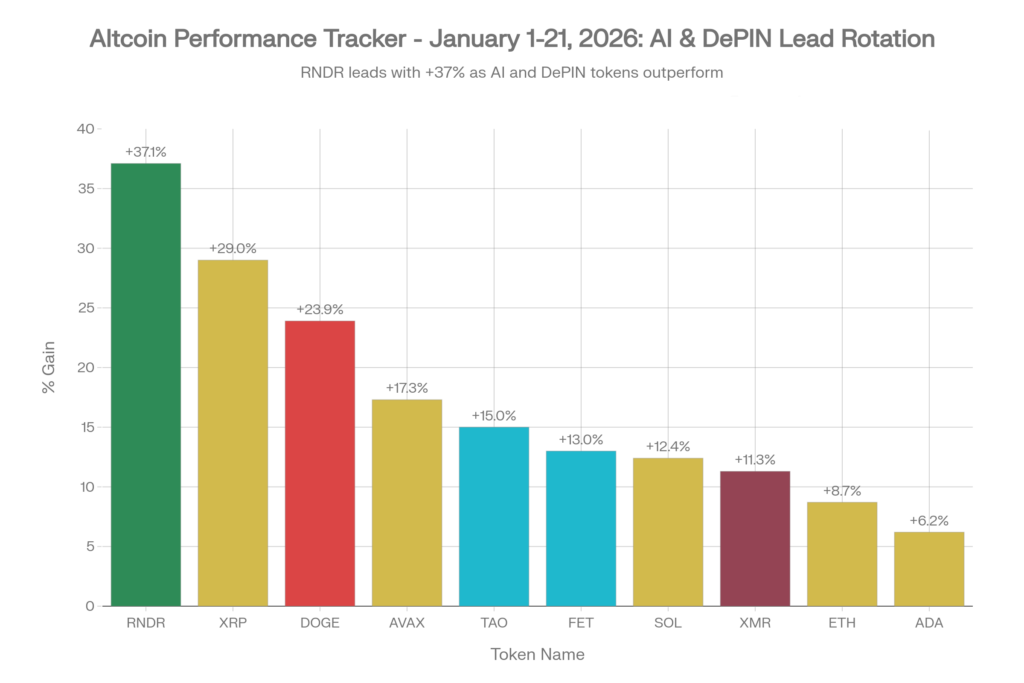
As of January 21, 2026, the top performing altcoins reflect this shift clearly:
Fetch.ai (FET): +13% weekly | $2.15–$2.30 trading range
Fetch.ai powers an autonomous agent economy and on chain data marketplace. The protocol’s appeal lies in its real developer adoption and integration with enterprise platforms seeking decentralized data pipelines. Unlike speculative AI coins, FET has proven product market fit with active protocol usage metrics.
Bittensor (TAO): +15% weekly | $520–$560 trading range
Bittensor operates a decentralized machine learning network where validators and miners earn rewards for training AI models. Its recent halving reduced token inflation, a catalyst that has historically preceded sustained rallies. Current trading volume of $950 million weekly indicates serious institutional participation, not retail speculation.
Render (RNDR): +37.1% weekly – THE OUTPERFORMER
Render’s distributed GPU rendering network provides the computational backbone for AI workloads, 3D rendering, and video processing. The 37% rally reflects both sector rotation into DePIN infrastructure and recognition that Render’s use case transcends crypto Hollywood studios and AAA game developers are active users. This differentiates RNDR from narrative dependent tokens.
Why DePIN Matters Beyond AI:
Decentralized Physical Infrastructure Networks (DePIN) tokens including Render, Akash, Helium, and Filecoin are outperforming because they address a capital intensive problem: distributed computing resources. As AI infrastructure centralizes around a handful of hyperscalers (Nvidia, AWS, Google), decentralized alternatives that reduce costs and increase access attract genuine builder interest, not just speculation.
Part 2: Understanding the Metrics That Predict Altcoin Movement
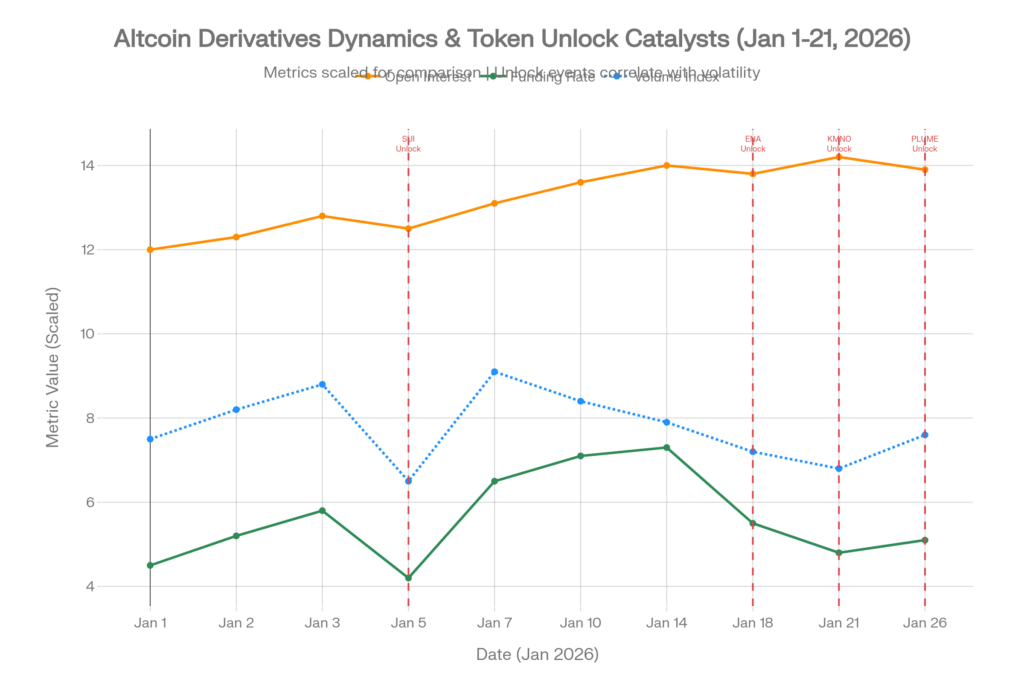
Price alone is a lagging indicator. Professional traders monitor three upstream signals that predict where altcoins are headed:
1. Open Interest & Derivatives Positioning
Open Interest (OI) represents the total value of outstanding futures and perpetual contracts. When OI is rising alongside price, it signals new capital entering leveraged positions, confirming trend strength. When OI falls while price holds, it suggests weak hands are exiting, creating a cleaner base for the next leg.
Current State (January 21, 2026):
Total altcoin futures OI: $14.2 billion (up from $12B on Jan 1)
Bitcoin dominance: 59% (constrains altcoin liquidity; below 45% = altseason acceleration)
Long/short ratios: Compressing significantly, indicating traders are taking profits into strength rather than adding leverage
What This Means:
The rise in OI without extreme crowding is healthy. Traders are not overleveraged. If Bitcoin dominance drops below 55%, expect capital rotation from BTC into mid cap altcoins to accelerate dramatically.
2. Funding Rates – The Leverage Signal
Funding rates are fees that long traders pay shorts (and vice versa) to maintain leveraged positions. Positive rates indicate more bullish positioning; extreme rates (>0.1% per 8 hour interval) signal overheating and liquidation risk.
Current Rates (January 21, 2026):
Bitcoin: +0.0098% per 8 hour = +0.51% annualized (sustainable)
Ethereum: +0.0097% (sustainable)
Solana: +0.0050% (underlevered, room to rally)
TAO, FET, RNDR: Ranging +0.008% to +0.015% (all healthy)
Interpretation:
Unlike November 2025 when funding rates spiked to +0.05%+ (warning sign), current rates are modest and sustainable. This suggests the rally has real conviction behind it, not speculative excess. Traders are confident but not desperate to chase.
3. Order Book Depth & Liquidity Risk
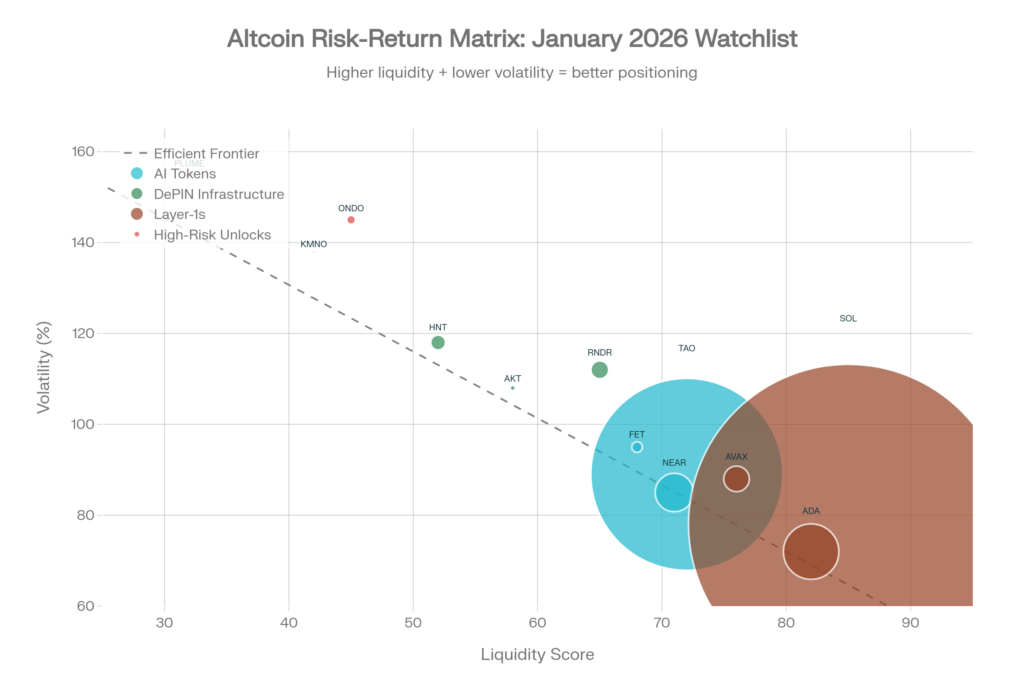
When order book depth is shallow, a single large sell order can cause price to drop 5–10% instantly. Tokens with $100M+ daily volume (like SOL, AVAX, TAO) have deep liquidity; tokens with $5–10M daily volume (like PLUME, KMNO) are vulnerable to sudden withdrawals or dumps.
Liquidity Watch (January 21, 2026):
| Token | 24h Volume | Order Book Depth | Risk Level | Notes |
|---|---|---|---|---|
| SOL | $5.02B | Excellent | LOW | Institutional grade liquidity |
| TAO | $950M | Very Good | LOW-MED | Sufficient for 50-100M positions |
| RNDR | $854M | Good | MEDIUM | Vulnerable to $50M+ market orders |
| FET | $450M | Good | MEDIUM | Decent liquidity, watch concentration |
| ONDO | $120M | Shallow | HIGH | Major unlock Jan 21 (57% supply) |
| PLUME | $45M | Sparse | CRITICAL | Unlock Jan 21 (39.75% supply) |
Key Insight:
Tokens with low liquidity and major upcoming unlocks (ONDO, PLUME, KMNO) are binary trades. If sellers emerge post unlock, the ask side can disappear entirely, triggering cascading liquidations in leveraged positions. Retail traders should avoid these unless they’re taking a contrarian long term position.
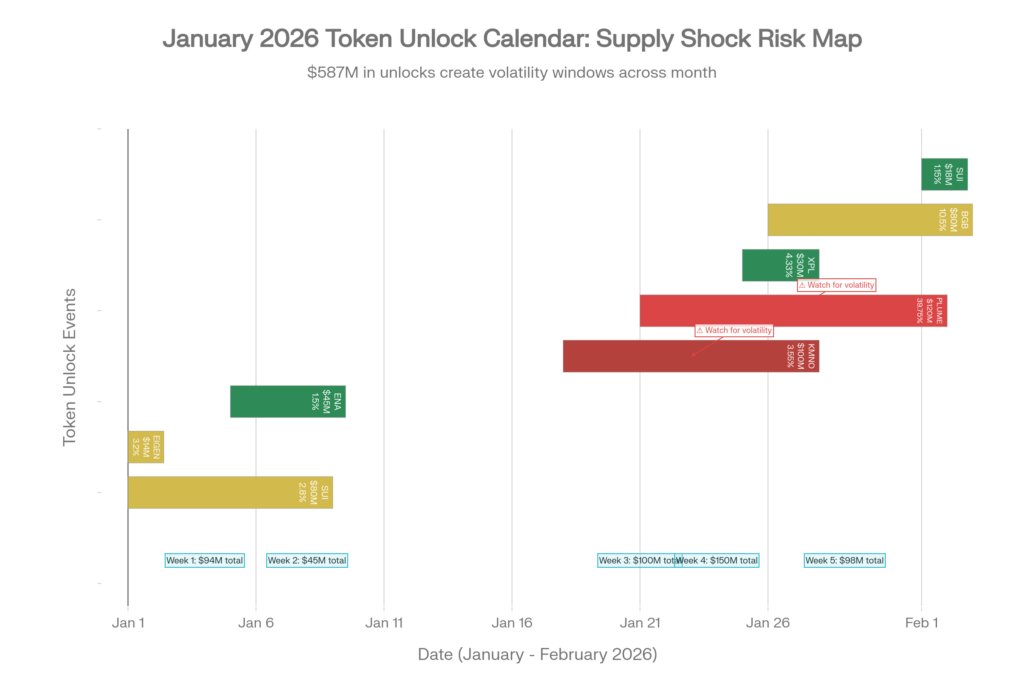
Part 3: Token Unlocks – The Supply Shock Risk Map
January 2026 features ~$2 billion in token vesting events the largest monthly unlock cluster since mid 2025. These events are critical because markets don’t always price in supply shocks efficiently. A token can be up 30% before its unlock, then crash 15–20% after when new supply hits exchange order books.
Critical Unlock Dates to Monitor:
January 5 – Ethena (ENA) – LOW RISK
171.88M ENA unlocked (~$45M value)
High liquidity, established market participants
Expected impact: Minimal; well absorbed by market
January 18 – Kamino (KMNO) – HIGH RISK
220–229M KMNO tokens (~$100M+ value)
Concentrated in Solana DeFi ecosystem
Watch for: Solana DEX order book stress; Kamino TVL withdrawal flows
Strategy: Monitor tight stops if long KMNO or related SOL ecosystem tokens
January 21 – Plume (PLUME) – CRITICAL RISK
39.75% of circulating supply unlocked (~$120M value)
Ultra thin liquidity ($45M daily volume)
This is the biggest unlock of the month by percentage
Watch for: Potential 20–30% single day decline if bears control order books
January 26 – Bitget Token (BGB) – MEDIUM RISK
10.50% unlock (~$80M value)
Binance traded, reasonable liquidity
Expected impact: 2–5% volatility; manageable
Broader Insight:
Token unlocks don’t automatically crash markets they reveal conviction. If a token rallies into an unlock, it shows genuine demand exceeds available supply. If it tanks post unlock, it signals weak hands were buying before the event. Professional traders use unlocks as capitulation filters; coins that recover within 48 hours of major unlocks are candidates for multi month rallies.
Part 4: Bitcoin Dominance – The Master Control Signal
Bitcoin dominance (BTC market cap as % of total crypto market cap) is the master lever controlling altseason. When BTC dominance is high (>60%), capital is flowing to Bitcoin, not alts. When it drops below 55%, it signals broad based capital rotation into mid caps and small caps.
Current State (January 21, 2026):
BTC dominance: 59%
Trending: Downward (was 61% on Jan 1)
Inflection point: 55% (if breached, expect 30–50% moves in Layer-1 and DeFi tokens)
What Drives Dominance Lower:
Bitcoin reaching resistances ($95K, $100K psychological levels) and failing
Altcoin narratives (AI, DePIN) proving more exciting than “digital gold”
Institutional rebalancing (portfolio targets require reducing BTC %, increasing alts)
Macro catalyst (Fed pause or rate cut expectations favor risk on alts)
Actionable Signal:
Watch Bitcoin’s rejection at $100K. If BTC fails to break above $100K for 3+ consecutive days, dominance could drop to 55% rapidly, triggering a 2–3 week altseason run. In that scenario, mid cap AI tokens (FET, TAO) and DePIN plays (RNDR, AKT) could see 40–100% moves.
Part 5: Sector-Specific Watchlist (What to Monitor Daily)
TIER 1: INSTITUTIONAL CONVICTION (Safe Entry, Slower Returns)
Solana (SOL): $133.14 | Watch for $140–150 breakout
Institutional inflows: $1.34B+ since October 2025
Metric to track: Solana DEX volume (Raydium, Orca daily swaps)
If DEX volume stays above $500M daily, SOL can sustainably hold above $130
Risk: If volume collapses below $300M, flushing to $110–120 likely
Ethereum (ETH): $3,120 (as of Jan 21) | Watch for $3,200–3,400 resistance
Metric to track: ETH staking inflows and Lido DAO dominance
Current staking yield: 3.5–4.2% annualized
If inflows accelerate, ETH can push toward $4,000 by Q1 end
Risk: If Bitcoin crashes below $85K, ETH tends to drop 10–15% quickly
TIER 2: AI & INFRASTRUCTURE (High Beta, High Reward)
Bittensor (TAO): $545 | Target $600–700 this quarter
Metric to track: On chain subnet activity (validator count, model updates)
Current strength: Neutral to positive funding rates, strong institutional accumulation
Entry strategy: Dips to $500–520 are healthy consolidation zones
Risk: Regulatory action on AI infrastructure could trigger 30% correction
Fetch.ai (FET): $2.25 | Target $3.00–3.50 this quarter
Metric to track: Agent ecosystem adoption (partnerships, integrations)
Liquidity: Very good; can absorb $50–100M positions without slippage
Entry strategy: Consolidation above $2.00 is bullish; breaks below $1.90 are stops
Risk: Overvaluation relative to protocol TVL; watch for insider selling
Render (RNDR): $11.50 | Near-term target $13–15
Metric to track: GPU utilization rates on the Render Network (real usage data)
Current strength: +37% already; may need consolidation before next leg
Watch for: If volume stays above $850M daily, breakout to $13–15 likely
Risk: Consolidation below $10.50 would invalidate near term uptrend
TIER 3: ECOSYSTEM PLAYS (Speculative, High Volatility)
Solana Ecosystem Tokens (KMNO, Phantom Wallet future TGE, Magic Eden partnerships):
Why monitor: If Solana pushes to $150+, ecosystem tokens typically lead
Metric: Solana DEX dominance and ecosystem TVL
Risk: Concentrated in single chain exposure; diversify with ETH/ICP ecosystem plays
Monero (XMR): $445 | Undervalued privacy play
Metric to track: Regulatory FUD and P2P market volume
Strength: Privacy demand surging amid surveillance concerns
Target: $500–550 if market recognizes privacy narrative
Risk: Regulatory exchanges may delist; decentralization is the strength
TIER 4: AVOID (Extreme Unlock Risk, Low Conviction)
ONDO Finance, Plume Network, Kamino Finance:
Reason: Major January unlocks + thin liquidity = binary outcomes
If you’re long: Tight 5–8% stops required
If you’re short: Extreme gap up risk post unlock if whales accumulate
Professional move: Wait for post unlock stabilization, then consider entries
Part 6: The Framework – What to Monitor Daily (60-Second Checklist)
| Metric | Daily Check | Why It Matters | Action Signal |
|---|---|---|---|
| Bitcoin Dominance | Check weekly change | Below 55% = altseason confirmed | If drops >1% daily = rotation starting |
| SOL, TAO, FET Open Interest | 2x daily | Early liquidity stress warning | If OI drops >15% in 6h = flash crash risk |
| Funding Rates | 3x daily | Leverage buildup = liquidation risk | If rates spike >0.05% = reduce exposure |
| Order Book Depth (bid/ask spread) | Hourly before large positions | Slippage cost predictor | Spread >0.5% = liquidity drying up |
| Token Unlock Calendar | Daily (Jan focus) | Supply shock catalyst | 24h before unlocks = reduce leverage |
| ETF Inflows/Outflows | Daily | Institutional conviction signal | Net inflows 3 days = trend strengthening |
| Solana DEX Volume | Daily | Ecosystem health gauge | <$300M = ecosystem weakness |
Part 7: Risk Management – What Can Go Wrong
Scenario 1: Bitcoin Fails at $100K (40% Probability)
Market Impact: BTC dominance drops to 52%, triggering $10B+ rotation into altcoins. Short term euphoria (+20–30% across Layer-1s), but followed by 3 week correction as leverage gets flushed.
Hedge: If you’re overexposed to altcoins, reduce exposure to 60% of max allocation when Bitcoin reaches $97–98K.
Scenario 2: Plume (PLUME) & Ondo (ONDO) Massive Dumps (55% Probability)
Market Impact: Two critical unlocks cluster on Jan 21 & 21. If both trigger panic selling, altcoin sentiment could flip negative, spreading to mid cap tokens. KMNO unlock on Jan 18 would confirm this narrative.
Hedge: Avoid overleveraged positions in any token with >2% daily unlock events. Use tight stops.
Scenario 3: Fed Signals Faster Rate Cuts (30% Probability)
Market Impact: Positive for all risk assets. Altcoins could see 40–80% rallies through Q1 2026. This is the bull case scenario.
Opportunity: If Fed dovish data surprises markets, large dip buying is justified.
Part 8: Why Metrics Matter More Than Price Predictions
Professional crypto traders don’t predict prices they predict market structure. A token at $100 with $5B daily volume behaves differently than a token at $5 with $50M daily volume, even if both move 20% weekly.
By tracking open interest, funding rates, liquidity, and unlock schedules, you’re answering three critical questions:
Can this move sustain itself? (OI + funding rate check)
Will I be able to exit my position if I need to? (liquidity check)
Is there an invisible catalyst about to hit the market? (unlock calendar check)
These questions prevent two costly mistakes:
Buying the euphoria peak (happens right before liquidation cascades)
Selling the capitulation bottom (happens right after major unlocks when new demand emerges)
Conclusion: Your January 2026 Altseason Roadmap
Bitcoin’s stabilization above $90K and ETF inflows have created genuine altseason conditions. Unlike the speculative exuberance of late 2021, the current rotation is driven by infrastructure narratives with real utility (AI, DePIN) and institutional participation visible in ETF flows and funding rate stability.
The watchlist is clear:
Core holdings: SOL, TAO, FET, RNDR (all have institutional backing + real usage)
Tactical entries: Dips into support zones ($520 for TAO, $2.00 for FET, $10.50 for RNDR)
Avoid: Thin liquidity tokens facing major unlocks (ONDO, PLUME)
Monitor the framework daily, respect Bitcoin dominance as your master signal, and remember: altseason is won by capital preservation first, gains second. The traders who survive crypto cycles are the ones who exit 30% too early, not the ones who hold for that final 10x that never comes.
Next Week: Watch for Bitcoin’s reaction to $100K resistance and January’s unlock aftermath. If both catalysts are absorbed cleanly, Q1 2026 could deliver the 40–100% altcoin moves that built fortunes in prior cycles.
 Stay Connected:
 Related Analysis:
How High-Frequency Trading (HFT) (Impacts Crypto Arbitrage)
- Reinforcement Learning in Dynamic Markets (AI trading strategies)
- Crypto Arbitrage 101 (beginner’s guide to arbitrage)
Data Sources:
- CoinGecko – Real-time price data and market cap
- Yahoo Finance – Historical price data
- CoinDesk – Liquidation data
- Reuters – Market analysis
- Binance – Upcoming catalysts
Disclaimer: This analysis is for educational purposes. Arbitrage trading involves substantial risk, including custody risk, regulatory risk, and execution risk. Past performance is not indicative of future results. Never risk capital you cannot afford to lose. Consult qualified financial and legal advisors before trading.