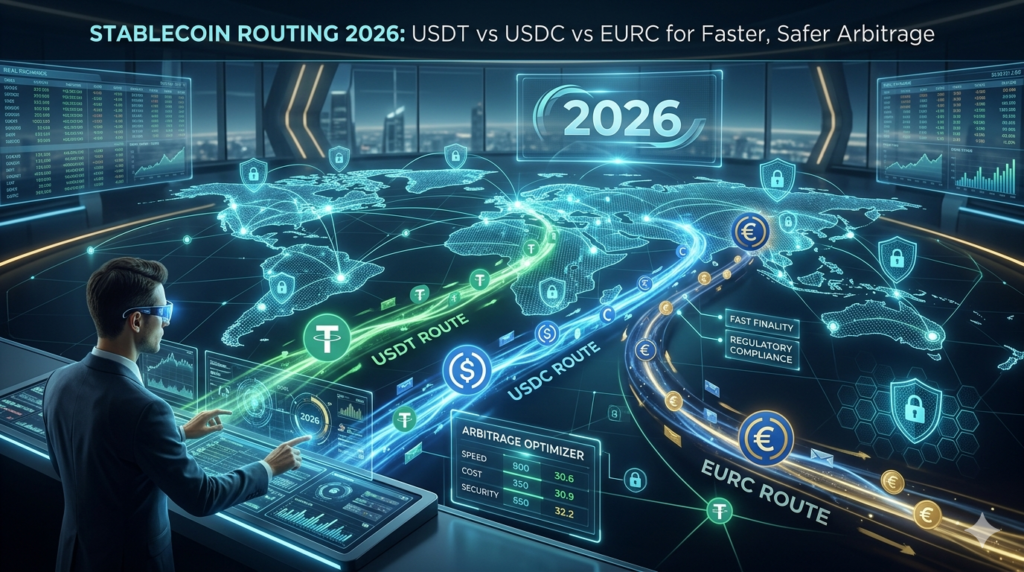
Stablecoin Routing in 2026: USDT vs USDC vs EURC for Faster, Safer Arbitrage

stablecoin routing arbitrage 2026


Introduction: Why Your Stablecoin Choice Is Now a Strategic Decision


In 2026, choosing the wrong stablecoin to route your arbitrage strategy isn’t just inefficient — in Europe, it can be illegal.


The global stablecoin market has crossed $350 billion in total circulation, with stablecoin transaction volume growing 72% year-over-year to a staggering $33 trillion in annual throughput — now directly rivaling major card payment networks. Behind every profitable arbitrage trade lies a critical, often overlooked variable: which stablecoin you route through, and on which blockchain network.


Three stablecoins dominate the arbitrage landscape in 2026:

    • USDT (Tether) — the undisputed global liquidity king with a $183.6 billion market cap and over $100 billion in average daily trading volume
    • USDC (USD Coin by Circle) — the compliance champion at $79.6 billion, accelerating rapidly as institutional adoption deepens
    • EURC (Euro Coin by Circle) — the emerging dark horse, surging 455% to $445 million in circulating supply and opening entirely new EUR denominated arbitrage corridors

But 2026 has introduced a fourth dimension that no arbitrageur can ignore: regulatory compliance. The European Union’s Markets in Crypto-Assets (MiCA) regulation is now fully in force, and it is fundamentally reshaping which stablecoins are safe to use on regulated European exchanges.


This article breaks down everything you need to know about stablecoin routing for arbitrage in 2026: speed benchmarks, fee comparisons, liquidity depth, MiCA compliance status, and how AI-powered platforms like NeuralArB are using real time routing intelligence to gain a measurable trading edge.


1. The 2026 Stablecoin Landscape – Who Dominates and Why


The stablecoin market in 2026 is not a level playing field. Three layers of dominance have emerged, each serving different arbitrage needs.


USDT remains the backbone of global crypto liquidity. With a $183.6 billion market cap (February 2026), it surpasses Bitcoin and Ethereum in daily trading volume — averaging over $100 billion per day, with a single day peak of $219.2 billion on February 5, 2026. It maintains an exceptionally tight peg deviation of just ±0.34%, and it dominates derivatives, futures, and CEX spot markets globally. On TRON alone, USDT carries over 50% of all on-chain stablecoin volume.


USDC has reached $79.6 billion and is approaching analyst projections of $85–95 billion by end of 2026, driven by institutional adoption from BlackRock, JPMorgan infrastructure, and the expansion of Circle’s Cross-Chain Transfer Protocol (CCTP) to over 20 blockchain networks. Circle’s possession of an Electronic Money Institution (EMI) license in France — making USDC and EURC fully MiCA-authorized — is its defining competitive advantage in 2026.


EURC is the real surprise of 2026. Circulating supply surged from just €70 million in early 2024 to €388.7 million (~$445 million) by March 2026 — a 455% increase. While it represents only 0.35% of the total stablecoin market, its growth is accelerating as MiCA enforcement begins delisting USDT from EU-regulated exchanges. The EUR/USD rate at ~1.14–1.15 in early 2026 adds a forex dimension to EURC-based arbitrage that creates entirely new trading opportunities.

USDT dominates at $183.6B, USDC at $79.6B, EURC the fastest-growing at $445M
Figure 1: Stablecoin Market Cap Comparison Q1 2026 | Source: CoinMarketCap, Stablecoin Insider, NeuralArB Research


2. What Is Stablecoin Routing? The Hidden Edge in Crypto Arbitrage


What is stablecoin routing in arbitrage? Stablecoin routing refers to the strategic selection of which stablecoin (USDT, USDC, EURC) and which blockchain network (TRON, Solana, Ethereum, Arbitrum) to use as the settlement asset between exchanges or DeFi positions — optimized for maximum speed, minimum cost, and regulatory compliance.

Most traders focus on where to arbitrage. The elite focus on how to route the capital. Here’s why it matters:


1. Settlement Speed — The time between executing a trade on Exchange A and having settled capital ready on Exchange B. A 2 second routing advantage can mean the difference between capturing a spread and watching it evaporate. USDC on Solana settles in ~0.4 seconds. USDT on Ethereum takes ~15 seconds.


2. Transaction Fees — Every fee eats into your spread. At scale, the difference between routing via Solana ($0.00025) vs Ethereum ($1–5) on 1,000 daily trades is $4,975 in daily savings. That’s the equivalent of a free arbitrage bot.


3. Liquidity Depth — How much capital you can move without causing slippage. USDT has Very High liquidity globally; EURC is Low-Medium and requires careful position sizing.


4. Slippage — The deviation from expected price on large orders. USDC and USDT both maintain tight slippage on deep markets; EURC risks mid to high slippage on large trades due to shallow order books.


5. Regulatory Compliance — In 2026, operating on MiCA regulated EU exchanges with a non-compliant stablecoin exposes firms to minimum fines of €5 million for serious infringements.


6. Chain Availability — EURC is only available on Avalanche, Ethereum, Solana, and Stellar; USDT is on 15+ chains; USDC’s CCTP spans 20+ networks.


In 2026, NeuralArB’s AI routing engine analyzes all six factors simultaneously, across all chain stablecoin combinations, in under 50 milliseconds — far faster than any human can evaluate.

🚀 Start Routing Smarter Today


NeuralArB’s AI automatically selects the optimal stablecoin route for every arbitrage trade — faster execution, lower fees, full MiCA compliance built in. Join thousands of traders already using AI-powered arbitrage to outperform.


3. USDT — The Global Liquidity King (With a European Shadow)


Market Cap: $183.6B | Daily Volume: $100B+ avg | Peg Stability: ±0.34%


USDT is, by almost every metric, the most powerful tool in the arbitrage trader’s arsenal. No other stablecoin comes close in terms of exchange availability, trading pair depth, or raw trading volume. On February 5, 2026, USDT processed $219.2 billion in a single day — more than most national stock exchanges handle in a week.


Best USDT Routing Options for Arbitrage


TRON (TRC-20) — The Cost King

    • Finality: 1–2 minutes
    • Avg fee: ~$0.001 (among the lowest of any major network)
    • TPS cap: ~2,000
    • USDT dominates TRON’s settlement layer — the network processes billions in USDT daily and is the default routing choice for emerging market CEX arbitrage (Southeast Asia, Africa, Latin America)
    • Note: TRON slashed network fees by 60% in a recent governance vote, making it even more competitive

Solana — The Speed King

    • Finality: ~0.4 seconds
    • Avg fee: $0.00025 per transaction
    • TPS capacity: up to 65,000
    • Ideal for high-frequency arbitrage bots where milliseconds matter
    • Circle issues $500M+ USDC weekly on Solana; USDT has growing Solana liquidity too

Ethereum (ERC-20) — The Institutional Route

    • Finality: ~15 seconds
    • Avg fee: $1–5 depending on gas conditions
    • Best for large value, low-frequency institutional settlements where security and auditability outweigh cost

USDT’s 2026 Risk Factor: MiCA Non-Compliance


Here is where USDT’s dominance faces a structural challenge. Tether has not obtained an Electronic Money Institution (EMI) license under MiCA. As a result, USDT faces active delisting pressure from EU regulated exchanges. For arbitrageurs operating in Europe or on EU-licensed platforms, continuing to route via USDT creates regulatory exposure that could result in:


    • Exchange account restrictions or termination
    • Fines of up to 3% of annual turnover for professional firms
    • Legal uncertainty around settlement finality of delisted assets

The strategic implication: USDT remains the optimal route for non EU exchange legs (Asian CEXs, global OTC desks, emerging market platforms). But for any leg touching a MiCA regulated European exchange, USDC or EURC is now the required routing asset.

Solana routes for all three stablecoins offer the lowest fees at $0.00025 per tx; Ethereum is 12,000× more expensive
Figure 2: Transaction Fee Comparison by Stablecoin & Network — 2026 (log scale). Solana offers the lowest fees across all three stablecoins at $0.00025/tx.


4. USDC — The Compliance Champion Accelerating Fast


Market Cap: $79.6B | MiCA Status: ✅ Fully Compliant | CCTP Chains: 20+


USDC has transformed from Circle’s regulated alternative to USDT into the primary stablecoin of the institutional and regulatory compliant arbitrage world. Its trajectory in 2026 is upward across every metric.


Why USDC Is Dominating Regulated Arbitrage


Circle’s MiCA License is the critical differentiator. Circle’s French EMI license authorizes both USDC and EURC for use across all 27 EU member states. Every EU regulated exchange listing USDC is compliant with MiCA. As USDT faces delisting pressure in Europe, USDC is absorbing that volume.


CCTP (Cross-Chain Transfer Protocol) means USDC can flow natively across 20+ blockchain networks without wrapping or bridging friction, reducing routing latency and counterparty risk dramatically.


Institutional infrastructure: BlackRock uses USDC for tokenized fund settlements. JPMorgan’s infrastructure processes $1B+ daily through similar settlement rails. In January 2026, Gusto launched USDC payroll pilots for 400,000 businesses on Solana — representing real world settlement demand that deepens USDC liquidity organically.


Best USDC Routing Options for Arbitrage


Solana — Top Score: 9.5/10

    • Finality: ~0.4 seconds
    • Avg fee: $0.00025
    • TPS: up to 65,000
    • Circle minted $500M USDC on Solana in a single transaction in early 2026
    • Best for: AI-agent arbitrage, high-frequency cross-exchange strategies, MiCA-compliant global routing

Arbitrum — Top Score: 9.0/10

    • Finality: ~0.25 seconds (fastest finality available)
    • Avg fee: $0.01–0.05
    • TPS: ~40,000
    • Deep DeFi liquidity (GMX, Camelot, Radiant)
    • Best for: DeFi arbitrage, L2-native strategies, yield generating treasury arbitrage

Ethereum — Score: 7.5/10

    • Finality: ~15 seconds
    • Avg fee: $1–5
    • Deep Aave, Uniswap, Compound liquidity
    • Best for: institutional grade settlements, RWA collateral, large capital moves where compliance documentation matters

Peg stability advantage: USDC maintains a tighter peg deviation of ±0.10% compared to USDT’s ±0.34%, reducing basis risk for arbitrageurs using USDC as a settlement bridge.
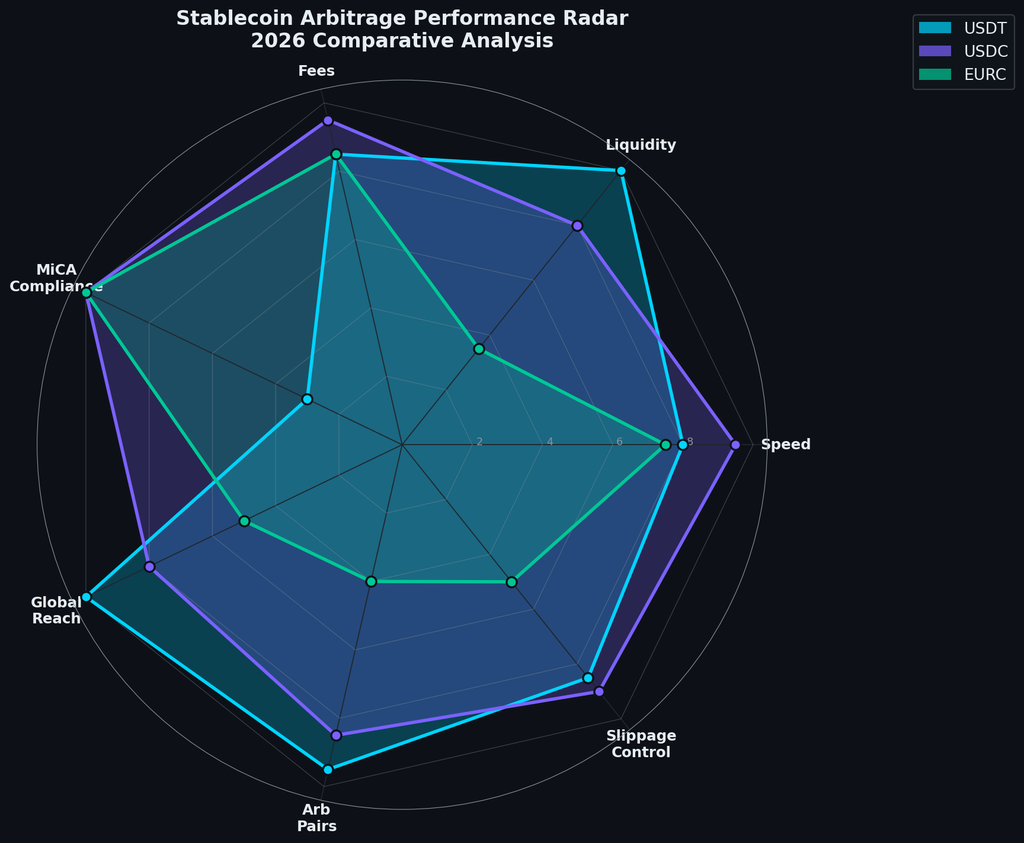
USDT leads in Liquidity and Global Reach; USDC dominates in Speed + MiCA Compliance; EURC scores highest on compliance but lowest on liquidity
Figure 3: Stablecoin Arbitrage Performance Radar - USDC leads in Speed + MiCA Compliance. USDT leads in Liquidity + Global Reach. EURC has strong compliance but is constrained by thin liquidity.


5. EURC — The European Arbitrage Wildcard


Market Cap: ~$445M | MiCA Status: ✅ Fully Compliant | Peg: 1:1 EUR


EURC is 2026’s most strategically interesting stablecoin for arbitrage traders, not because of its current size, but because of what it enables and where it is heading.


What Makes EURC Different


Circle’s euro-backed stablecoin is always redeemable 1:1 for euros, issued by Circle’s MiCA licensed entity in France. Unlike USDT or USDC, EURC introduces a foreign exchange dimension into the arbitrage equation. With EUR/USD trading at ~1.14–1.15 in Q1 2026, EURC’s USD-denominated price reflects both its euro peg and prevailing FX rates.


This creates a two-layer arbitrage opportunity:

    1. Classic exchange arbitrage — price spreads between exchanges quoting EURC
    2. EUR/USD corridor arbitrage — exploiting divergences between EURC/USDC pairs across platforms that reflect real time FX rate differences

The Growth Story: 455% in 18 Months


EURC’s circulating supply surged from €70 million in early 2024 to €388.7 million (~$445 million) by March 2026 — driven entirely by MiCA enforcement creating demand for euro-denominated compliant settlement assets.


The trajectory is clear: as USDT delisting from EU exchanges creates a vacuum in euro-denominated trading pairs, EURC is the primary beneficiary. A consortium of major European banks (Qivalis) has announced plans for a competing MiCA-compliant euro stablecoin in H2 2026, which could both validate and fragment the euro stablecoin market.

EURC surged 455% from €70M → $445M — MiCA enforcement is the key accelerator
Figure 4: EURC surged 455% in circulating supply between early 2024 and March 2026, with acceleration visible post-MiCA implementation.

EURC Arbitrage Opportunities


Chains available: Avalanche, Ethereum, Solana, Stellar

    • Solana route (recommended): $0.00025 fee, 0.4s finality — same speed as USDC but with EUR exposure
    • Avalanche: $0.05–0.20 fees, 1–2 second finality, 4,500 TPS  solid for EU-regional arbitrage
    • Ethereum: Deep institutional liquidity but $1–5 fees limit frequency

The key risk: EURC represents only 0.35% of the total stablecoin market. This thin liquidity creates higher slippage on large orders, wider bid-ask spreads, and potential temporary peg deviations during volatile periods. EU arbitrageurs should size EURC positions proportionally and use USDC as overflow routing on the same strategies.


Best use cases: European exchange cross-pair arbitrage, EUR/USD forex spread capture, MiCA-compliant strategies that need euro-denominated settlement, EURC/USDC triangular arbitrage.


6. Head-to-Head — The Complete Stablecoin Routing Matrix
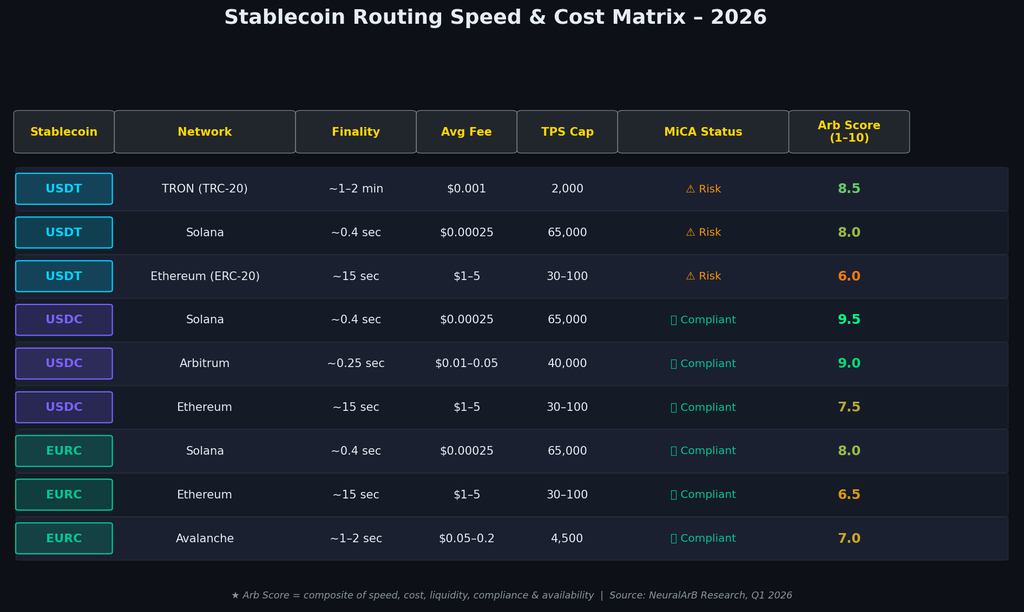
USDC-Solana leads with a 9.5/10 Arb Score; USDT-TRON tops non-MiCA routes
Figure 5: Complete Stablecoin Routing Matrix - 9 combinations ranked by composite Arbitrage Score
StablecoinNetworkFinalityAvg FeeTPS CapMiCA StatusArb Score
USDTTRON (TRC-20)~1–2 min$0.0012,000⚠️ Risk8.5/10
USDTSolana~0.4 sec$0.0002565,000⚠️ Risk8.0/10
USDTEthereum (ERC-20)~15 sec$1–530–100⚠️ Risk6.0/10
USDCSolana~0.4 sec$0.0002565,000✅ Compliant9.5/10
USDCArbitrum~0.25 sec$0.01–0.0540,000✅ Compliant9.0/10
USDCEthereum~15 sec$1–530–100✅ Compliant7.5/10
EURCSolana~0.4 sec$0.0002565,000✅ Compliant8.0/10
EURCAvalanche~1–2 sec$0.05–0.204,500✅ Compliant7.0/10
EURCEthereum~15 sec$1–530–100✅ Compliant6.5/10

Arb Score = composite rating of speed, cost, liquidity depth, MiCA compliance, and trading pair availability. Source: NeuralArB Research, Q1 2026.


7. Downloadable Market Data


Get the raw data used in this report for your own analysis. Includes 13 data columns: finality, fees, TPS, market cap, volume, MiCA status, best for use case, arb score, liquidity score, slippage risk, peg stability.


8. How MiCA 2026 Is Reshaping Stablecoin Routing for EU Arbitrage Traders


July 1, 2026 is the most important date in European crypto regulation this decade. That is when full MiCA enforcement comes into effect for all CASPs (Crypto Asset Service Providers) and it is already reshaping which stablecoins professional arbitrageurs can safely use.


The USDT Problem in Europe


Tether has not obtained the Electronic Money Institution (EMI) license required under MiCA for stablecoin issuers. The consequences for EU arbitrage traders are already visible: multiple EU-regulated exchanges have begun delisting USDT trading pairs. From July 2026 onward, professional firms operating on MiCA-licensed exchanges face real compliance exposure if USDT remains their primary routing asset.


As NeuralArB’s own MiCA 2026 Report concluded: “Arbitrage traders should prepare for a shift in base pairs from USDT to USDC or Euro-backed stablecoins (EURC) on European platforms.”

The USDC and EURC Advantage


Circle’s MiCA compliance is now a structural competitive moat for traders operating in Europe. USDC and EURC are the only major stablecoins from a MiCA-licensed issuer, and they remain fully listed on all EU-regulated exchanges.


MiCA Compliance Impact Table


CategoryRequirementDeadlinePriority
LicensingCASP authorization from national regulatorJuly 2026🔴 Critical
AML/KYCTravel Rule (TFR) complianceActive🔴 Critical
StablecoinsVerify CASP authorization for USDT/USDCActive🔴 Critical
Bot/AutomationActivity logging + audit trailJune 2026🟠 High
ReportingDAC8 transaction data reportingJan 2026🔴 Critical
Market IntegrityAnti-manipulation systemsActive🔴 Critical
 

Your EU-Compliant Routing Strategy (4 Steps)


    1. Replace USDT with USDC for all arbitrage legs touching EU-regulated exchanges
    2. Use USDC-Solana as your primary fast route — fastest compliant settlement at $0.00025/tx
    3. Integrate EURC for EUR-denominated pairs — EURC/USDC triangular arbitrage creates new spreads
    4. Retain USDT for non-EU legs — Asian CEXs, emerging market platforms, global OTC remain USDT dominant


9. AI-Powered Routing — The NeuralArB Edge


Here is the fundamental problem with manual stablecoin routing in 2026: the optimal window exists for milliseconds. Human decision time is measured in seconds.


By the time a trader notices that USDC-Arbitrum has lower congestion than USDC-Solana, evaluates the fee delta, checks EURC liquidity on the target exchange, and confirms MiCA compliance status — the spread has closed.


NeuralArB’s AI routing engine solves this. In real time, it simultaneously evaluates:

    • Current gas prices across all supported networks
    • Exchange specific order book depth for each stablecoin
    • Peg deviation signals (a EURC deviation on one exchange is an arbitrage signal, not a risk)
    • MiCA compliance status per exchange per stablecoin
    • Cross-chain bridge latency and historical reliability scores
    • Expected slippage given current trade size vs available liquidity

Example: A EUR/USD arbitrage window opens for 800 milliseconds between a Paris-based exchange and a Singapore CEX — EURC trading slightly above USDC parity on the European venue. NeuralArB routes via EURC-Solana (0.4 sec finality, $0.00025 fee) to buy EURC cheaply in Singapore and sell it at the premium in Paris, net of FX conversion costs — all automated, all MiCA-compliant.

Result: Lower slippage, higher net yield per trade, zero manual compliance monitoring.

🚀 Want NeuralArB to handle your stablecoin routing automatically? Start your free trial at neuralarb.com →


10. Which Stablecoin Route Is Right for You?


Trader ProfileRecommended RouteKey Reason
High-Frequency Global TraderUSDT-Solana or USDC-SolanaSub-second finality, near-zero fees
EU-Based Regulated TraderUSDC-SolanaFastest MiCA-compliant route
EU Forex ArbitrageurEURC/USDC on SolanaFX spread capture + MiCA compliance
Institutional / Large CapitalUSDC-EthereumDeep liquidity, settlement finality
Emerging Markets CEX TraderUSDT-TRONSub-cent fees, global availability
DeFi Arbitrage BotUSDC-ArbitrumFastest L2 finality + deep DeFi pools
Multi-Exchange Global ArbUSDT-TRON (non-EU) + USDC-Solana (EU)Optimized per jurisdiction


💬 Frequently Asked Questions (FAQ)

Which stablecoin is fastest for crypto arbitrage in 2026?

USDC on Solana and USDT on Solana both achieve ~0.4 second finality with fees of just $0.00025 per transaction. USDC on Arbitrum is marginally faster at ~0.25 seconds. For raw arbitrage speed, Solana-based routing wins decisively in 2026. For compliance-safe speed in Europe, USDC-Solana is the clear leader.

USDT is not MiCA-authorized in the EU as of 2026. Tether has not obtained the required EMI license under MiCA. Multiple EU-regulated exchanges are delisting USDT. While holding USDT is not individually illegal, professional arbitrage firms operating on MiCA-licensed EU exchanges should transition to USDC or EURC to maintain compliance and avoid potential fines of up to 3% of annual turnover.

EURC (Euro Coin) is Circle’s fully MiCA-compliant euro-backed stablecoin, redeemable 1:1 for euros. Available on Solana, Ethereum, Avalanche, and Stellar. Its importance for arbitrage: it enables EUR/USD corridor trading, opens price spread capture between European and global exchanges, and is the only major euro stablecoin from a MiCA-licensed issuer. Circulating supply grew 455% (€70M → €388.7M) between 2024 and March 2026.

The cheapest options are USDC, USDT, or EURC on Solana at approximately $0.00025 per transaction. USDT on TRON follows at ~$0.001. Both are dramatically cheaper than Ethereum mainnet ($1–5 per transaction). At 1,000 daily trades, Solana routing saves ~$4,975/day vs Ethereum.

MiCA (Markets in Crypto-Assets Regulation) is fully enforced in the EU with a July 1, 2026 deadline for all CASPs. Stablecoins used on EU exchanges must be issued by MiCA-authorized entities. USDT (Tether) is not MiCA-compliant → EU arbitrage traders using USDT on regulated platforms face compliance risk. USDC and EURC are both MiCA-compliant through Circle’s French EMI license → they are the required routing assets for EU-regulated arbitrage in 2026.

For HFT arbitrage bots in 2026: USDC on Solana (9.5/10 Arb Score) — 0.4-second finality, $0.00025 fees, 65,000 TPS capacity, MiCA compliance, and sufficient liquidity for automated strategies. For DeFi-focused bots: USDC on Arbitrum (9.0/10) — 0.25-second finality, $0.01–0.05 fees, deep DeFi pool access.

EURC currently represents only 0.35% of the total stablecoin market (~$445M circulating). This thin liquidity creates: higher slippage on large orders, wider bid ask spreads, and potential temporary peg deviations during volatile markets. EU arbitrageurs should limit individual EURC position sizes, split large orders into smaller batches, and use USDC as overflow routing on the same strategy.

Yes. AI-powered arbitrage platforms like NeuralArB analyze gas prices, liquidity depth, peg deviations, exchange specific regulatory status, and cross-chain bridge latency in real time to automatically select the optimal stablecoin and network for each trade. This eliminates manual decision latency and ensures compliance aware routing, especially critical under MiCA’s 2026 enforcement requirements.


Conclusion: The Routing Decision Is Now Your Strategic Advantage


In 2026, stablecoin routing is no longer a technical afterthought — it is a core competitive variable that separates professional arbitrageurs from retail traders and separates compliant operators from those who will face regulatory consequences.


The landscape is clear:

    • USDT remains the global liquidity king — unmatched in volume, trading pairs, and CEX reach, but carries real and growing regulatory risk on European platforms
    • USDC has emerged as the balanced power player — fast (Solana), cheap (Solana/Arbitrum), MiCA-compliant, and increasingly institutional
    • EURC is the emerging wildcard — opening EUR/USD arbitrage corridors that didn’t meaningfully exist before MiCA, with explosive growth trajectory

The optimal routing strategy is not binary. Elite arbitrage in 2026 uses all three stablecoins in their right context: USDT-TRON for emerging market CEX legs, USDC-Solana as the global fast lane, and EURC-Solana for EU-regulated and forex-adjacent strategies.


If you’re still routing all your capital through a single stablecoin on a single chain, you are leaving money on the table and in Europe, potentially breaking the law.


NeuralArB’s AI routing engine handles all of this automatically, in milliseconds, across all chain-stablecoin combinations — so you focus on strategy, not stablecoin administration.


📱 Stay Connected:

  • Twitter/X for real-time market alerts
  • Telegram community for live trading discussions

🔗 Related Analysis:


Data Sources:

Disclaimer: This analysis is for educational purposes. Arbitrage trading involves substantial risk, including custody risk, regulatory risk, and execution risk. Past performance is not indicative of future results. Never risk capital you cannot afford to lose. Consult qualified financial and legal advisors before trading.

Zhen Patel

Chief Legal Officer at NeuralArB. Web3-native legal strategist. Zhen blends traditional compliance expertise with cutting-edge AI/blockchain frameworks. Ex-regulatory counsel, now steering NeuralArB through the evolving global landscape of digital assets, DeFi law, and AI governance. Passionate about decentralized systems with real-world legal resilience.

Stablecoin Routing in 2026: USDT vs USDC vs EURC for Faster, Safer Arbitrage

stablecoin routing arbitrage 2026


Introduction: Why Your Stablecoin Choice Is Now a Strategic Decision


In 2026, choosing the wrong stablecoin to route your arbitrage strategy isn’t just inefficient — in Europe, it can be illegal.


The global stablecoin market has crossed $350 billion in total circulation, with stablecoin transaction volume growing 72% year-over-year to a staggering $33 trillion in annual throughput — now directly rivaling major card payment networks. Behind every profitable arbitrage trade lies a critical, often overlooked variable: which stablecoin you route through, and on which blockchain network.


Three stablecoins dominate the arbitrage landscape in 2026:

    • USDT (Tether) — the undisputed global liquidity king with a $183.6 billion market cap and over $100 billion in average daily trading volume
    • USDC (USD Coin by Circle) — the compliance champion at $79.6 billion, accelerating rapidly as institutional adoption deepens
    • EURC (Euro Coin by Circle) — the emerging dark horse, surging 455% to $445 million in circulating supply and opening entirely new EUR denominated arbitrage corridors

But 2026 has introduced a fourth dimension that no arbitrageur can ignore: regulatory compliance. The European Union’s Markets in Crypto-Assets (MiCA) regulation is now fully in force, and it is fundamentally reshaping which stablecoins are safe to use on regulated European exchanges.


This article breaks down everything you need to know about stablecoin routing for arbitrage in 2026: speed benchmarks, fee comparisons, liquidity depth, MiCA compliance status, and how AI-powered platforms like NeuralArB are using real time routing intelligence to gain a measurable trading edge.


1. The 2026 Stablecoin Landscape – Who Dominates and Why


The stablecoin market in 2026 is not a level playing field. Three layers of dominance have emerged, each serving different arbitrage needs.


USDT remains the backbone of global crypto liquidity. With a $183.6 billion market cap (February 2026), it surpasses Bitcoin and Ethereum in daily trading volume — averaging over $100 billion per day, with a single day peak of $219.2 billion on February 5, 2026. It maintains an exceptionally tight peg deviation of just ±0.34%, and it dominates derivatives, futures, and CEX spot markets globally. On TRON alone, USDT carries over 50% of all on-chain stablecoin volume.


USDC has reached $79.6 billion and is approaching analyst projections of $85–95 billion by end of 2026, driven by institutional adoption from BlackRock, JPMorgan infrastructure, and the expansion of Circle’s Cross-Chain Transfer Protocol (CCTP) to over 20 blockchain networks. Circle’s possession of an Electronic Money Institution (EMI) license in France — making USDC and EURC fully MiCA-authorized — is its defining competitive advantage in 2026.


EURC is the real surprise of 2026. Circulating supply surged from just €70 million in early 2024 to €388.7 million (~$445 million) by March 2026 — a 455% increase. While it represents only 0.35% of the total stablecoin market, its growth is accelerating as MiCA enforcement begins delisting USDT from EU-regulated exchanges. The EUR/USD rate at ~1.14–1.15 in early 2026 adds a forex dimension to EURC-based arbitrage that creates entirely new trading opportunities.

USDT dominates at $183.6B, USDC at $79.6B, EURC the fastest-growing at $445M
Figure 1: Stablecoin Market Cap Comparison Q1 2026 | Source: CoinMarketCap, Stablecoin Insider, NeuralArB Research


2. What Is Stablecoin Routing? The Hidden Edge in Crypto Arbitrage


What is stablecoin routing in arbitrage? Stablecoin routing refers to the strategic selection of which stablecoin (USDT, USDC, EURC) and which blockchain network (TRON, Solana, Ethereum, Arbitrum) to use as the settlement asset between exchanges or DeFi positions — optimized for maximum speed, minimum cost, and regulatory compliance.

Most traders focus on where to arbitrage. The elite focus on how to route the capital. Here’s why it matters:


1. Settlement Speed — The time between executing a trade on Exchange A and having settled capital ready on Exchange B. A 2 second routing advantage can mean the difference between capturing a spread and watching it evaporate. USDC on Solana settles in ~0.4 seconds. USDT on Ethereum takes ~15 seconds.


2. Transaction Fees — Every fee eats into your spread. At scale, the difference between routing via Solana ($0.00025) vs Ethereum ($1–5) on 1,000 daily trades is $4,975 in daily savings. That’s the equivalent of a free arbitrage bot.


3. Liquidity Depth — How much capital you can move without causing slippage. USDT has Very High liquidity globally; EURC is Low-Medium and requires careful position sizing.


4. Slippage — The deviation from expected price on large orders. USDC and USDT both maintain tight slippage on deep markets; EURC risks mid to high slippage on large trades due to shallow order books.


5. Regulatory Compliance — In 2026, operating on MiCA regulated EU exchanges with a non-compliant stablecoin exposes firms to minimum fines of €5 million for serious infringements.


6. Chain Availability — EURC is only available on Avalanche, Ethereum, Solana, and Stellar; USDT is on 15+ chains; USDC’s CCTP spans 20+ networks.


In 2026, NeuralArB’s AI routing engine analyzes all six factors simultaneously, across all chain stablecoin combinations, in under 50 milliseconds — far faster than any human can evaluate.

🚀 Start Routing Smarter Today


NeuralArB’s AI automatically selects the optimal stablecoin route for every arbitrage trade — faster execution, lower fees, full MiCA compliance built in. Join thousands of traders already using AI-powered arbitrage to outperform.


3. USDT — The Global Liquidity King (With a European Shadow)


Market Cap: $183.6B | Daily Volume: $100B+ avg | Peg Stability: ±0.34%


USDT is, by almost every metric, the most powerful tool in the arbitrage trader’s arsenal. No other stablecoin comes close in terms of exchange availability, trading pair depth, or raw trading volume. On February 5, 2026, USDT processed $219.2 billion in a single day — more than most national stock exchanges handle in a week.


Best USDT Routing Options for Arbitrage


TRON (TRC-20) — The Cost King

    • Finality: 1–2 minutes
    • Avg fee: ~$0.001 (among the lowest of any major network)
    • TPS cap: ~2,000
    • USDT dominates TRON’s settlement layer — the network processes billions in USDT daily and is the default routing choice for emerging market CEX arbitrage (Southeast Asia, Africa, Latin America)
    • Note: TRON slashed network fees by 60% in a recent governance vote, making it even more competitive

Solana — The Speed King

    • Finality: ~0.4 seconds
    • Avg fee: $0.00025 per transaction
    • TPS capacity: up to 65,000
    • Ideal for high-frequency arbitrage bots where milliseconds matter
    • Circle issues $500M+ USDC weekly on Solana; USDT has growing Solana liquidity too

Ethereum (ERC-20) — The Institutional Route

    • Finality: ~15 seconds
    • Avg fee: $1–5 depending on gas conditions
    • Best for large value, low-frequency institutional settlements where security and auditability outweigh cost

USDT’s 2026 Risk Factor: MiCA Non-Compliance


Here is where USDT’s dominance faces a structural challenge. Tether has not obtained an Electronic Money Institution (EMI) license under MiCA. As a result, USDT faces active delisting pressure from EU regulated exchanges. For arbitrageurs operating in Europe or on EU-licensed platforms, continuing to route via USDT creates regulatory exposure that could result in:


    • Exchange account restrictions or termination
    • Fines of up to 3% of annual turnover for professional firms
    • Legal uncertainty around settlement finality of delisted assets

The strategic implication: USDT remains the optimal route for non EU exchange legs (Asian CEXs, global OTC desks, emerging market platforms). But for any leg touching a MiCA regulated European exchange, USDC or EURC is now the required routing asset.

Solana routes for all three stablecoins offer the lowest fees at $0.00025 per tx; Ethereum is 12,000× more expensive
Figure 2: Transaction Fee Comparison by Stablecoin & Network — 2026 (log scale). Solana offers the lowest fees across all three stablecoins at $0.00025/tx.


4. USDC — The Compliance Champion Accelerating Fast


Market Cap: $79.6B | MiCA Status: ✅ Fully Compliant | CCTP Chains: 20+


USDC has transformed from Circle’s regulated alternative to USDT into the primary stablecoin of the institutional and regulatory compliant arbitrage world. Its trajectory in 2026 is upward across every metric.


Why USDC Is Dominating Regulated Arbitrage


Circle’s MiCA License is the critical differentiator. Circle’s French EMI license authorizes both USDC and EURC for use across all 27 EU member states. Every EU regulated exchange listing USDC is compliant with MiCA. As USDT faces delisting pressure in Europe, USDC is absorbing that volume.


CCTP (Cross-Chain Transfer Protocol) means USDC can flow natively across 20+ blockchain networks without wrapping or bridging friction, reducing routing latency and counterparty risk dramatically.


Institutional infrastructure: BlackRock uses USDC for tokenized fund settlements. JPMorgan’s infrastructure processes $1B+ daily through similar settlement rails. In January 2026, Gusto launched USDC payroll pilots for 400,000 businesses on Solana — representing real world settlement demand that deepens USDC liquidity organically.


Best USDC Routing Options for Arbitrage


Solana — Top Score: 9.5/10

    • Finality: ~0.4 seconds
    • Avg fee: $0.00025
    • TPS: up to 65,000
    • Circle minted $500M USDC on Solana in a single transaction in early 2026
    • Best for: AI-agent arbitrage, high-frequency cross-exchange strategies, MiCA-compliant global routing

Arbitrum — Top Score: 9.0/10

    • Finality: ~0.25 seconds (fastest finality available)
    • Avg fee: $0.01–0.05
    • TPS: ~40,000
    • Deep DeFi liquidity (GMX, Camelot, Radiant)
    • Best for: DeFi arbitrage, L2-native strategies, yield generating treasury arbitrage

Ethereum — Score: 7.5/10

    • Finality: ~15 seconds
    • Avg fee: $1–5
    • Deep Aave, Uniswap, Compound liquidity
    • Best for: institutional grade settlements, RWA collateral, large capital moves where compliance documentation matters

Peg stability advantage: USDC maintains a tighter peg deviation of ±0.10% compared to USDT’s ±0.34%, reducing basis risk for arbitrageurs using USDC as a settlement bridge.

USDT leads in Liquidity and Global Reach; USDC dominates in Speed + MiCA Compliance; EURC scores highest on compliance but lowest on liquidity
Figure 3: Stablecoin Arbitrage Performance Radar - USDC leads in Speed + MiCA Compliance. USDT leads in Liquidity + Global Reach. EURC has strong compliance but is constrained by thin liquidity.


5. EURC — The European Arbitrage Wildcard


Market Cap: ~$445M | MiCA Status: ✅ Fully Compliant | Peg: 1:1 EUR


EURC is 2026’s most strategically interesting stablecoin for arbitrage traders, not because of its current size, but because of what it enables and where it is heading.


What Makes EURC Different


Circle’s euro-backed stablecoin is always redeemable 1:1 for euros, issued by Circle’s MiCA licensed entity in France. Unlike USDT or USDC, EURC introduces a foreign exchange dimension into the arbitrage equation. With EUR/USD trading at ~1.14–1.15 in Q1 2026, EURC’s USD-denominated price reflects both its euro peg and prevailing FX rates.


This creates a two-layer arbitrage opportunity:

    1. Classic exchange arbitrage — price spreads between exchanges quoting EURC
    2. EUR/USD corridor arbitrage — exploiting divergences between EURC/USDC pairs across platforms that reflect real time FX rate differences

The Growth Story: 455% in 18 Months


EURC’s circulating supply surged from €70 million in early 2024 to €388.7 million (~$445 million) by March 2026 — driven entirely by MiCA enforcement creating demand for euro-denominated compliant settlement assets.


The trajectory is clear: as USDT delisting from EU exchanges creates a vacuum in euro-denominated trading pairs, EURC is the primary beneficiary. A consortium of major European banks (Qivalis) has announced plans for a competing MiCA-compliant euro stablecoin in H2 2026, which could both validate and fragment the euro stablecoin market.

EURC surged 455% from €70M → $445M — MiCA enforcement is the key accelerator
Figure 4: EURC surged 455% in circulating supply between early 2024 and March 2026, with acceleration visible post-MiCA implementation.

EURC Arbitrage Opportunities


Chains available: Avalanche, Ethereum, Solana, Stellar

    • Solana route (recommended): $0.00025 fee, 0.4s finality — same speed as USDC but with EUR exposure
    • Avalanche: $0.05–0.20 fees, 1–2 second finality, 4,500 TPS  solid for EU-regional arbitrage
    • Ethereum: Deep institutional liquidity but $1–5 fees limit frequency

The key risk: EURC represents only 0.35% of the total stablecoin market. This thin liquidity creates higher slippage on large orders, wider bid-ask spreads, and potential temporary peg deviations during volatile periods. EU arbitrageurs should size EURC positions proportionally and use USDC as overflow routing on the same strategies.


Best use cases: European exchange cross-pair arbitrage, EUR/USD forex spread capture, MiCA-compliant strategies that need euro-denominated settlement, EURC/USDC triangular arbitrage.


6. Head-to-Head — The Complete Stablecoin Routing Matrix

USDC-Solana leads with a 9.5/10 Arb Score; USDT-TRON tops non-MiCA routes
Figure 5: Complete Stablecoin Routing Matrix - 9 combinations ranked by composite Arbitrage Score
StablecoinNetworkFinalityAvg FeeTPS CapMiCA StatusArb Score
USDTTRON (TRC-20)~1–2 min$0.0012,000⚠️ Risk8.5/10
USDTSolana~0.4 sec$0.0002565,000⚠️ Risk8.0/10
USDTEthereum (ERC-20)~15 sec$1–530–100⚠️ Risk6.0/10
USDCSolana~0.4 sec$0.0002565,000✅ Compliant9.5/10
USDCArbitrum~0.25 sec$0.01–0.0540,000✅ Compliant9.0/10
USDCEthereum~15 sec$1–530–100✅ Compliant7.5/10
EURCSolana~0.4 sec$0.0002565,000✅ Compliant8.0/10
EURCAvalanche~1–2 sec$0.05–0.204,500✅ Compliant7.0/10
EURCEthereum~15 sec$1–530–100✅ Compliant6.5/10

Arb Score = composite rating of speed, cost, liquidity depth, MiCA compliance, and trading pair availability. Source: NeuralArB Research, Q1 2026.


7. Downloadable Market Data


Get the raw data used in this report for your own analysis. Includes 13 data columns: finality, fees, TPS, market cap, volume, MiCA status, best for use case, arb score, liquidity score, slippage risk, peg stability.


8. How MiCA 2026 Is Reshaping Stablecoin Routing for EU Arbitrage Traders


July 1, 2026 is the most important date in European crypto regulation this decade. That is when full MiCA enforcement comes into effect for all CASPs (Crypto Asset Service Providers) and it is already reshaping which stablecoins professional arbitrageurs can safely use.


The USDT Problem in Europe


Tether has not obtained the Electronic Money Institution (EMI) license required under MiCA for stablecoin issuers. The consequences for EU arbitrage traders are already visible: multiple EU-regulated exchanges have begun delisting USDT trading pairs. From July 2026 onward, professional firms operating on MiCA-licensed exchanges face real compliance exposure if USDT remains their primary routing asset.


As NeuralArB’s own MiCA 2026 Report concluded: “Arbitrage traders should prepare for a shift in base pairs from USDT to USDC or Euro-backed stablecoins (EURC) on European platforms.”

The USDC and EURC Advantage


Circle’s MiCA compliance is now a structural competitive moat for traders operating in Europe. USDC and EURC are the only major stablecoins from a MiCA-licensed issuer, and they remain fully listed on all EU-regulated exchanges.


MiCA Compliance Impact Table


CategoryRequirementDeadlinePriority
LicensingCASP authorization from national regulatorJuly 2026🔴 Critical
AML/KYCTravel Rule (TFR) complianceActive🔴 Critical
StablecoinsVerify CASP authorization for USDT/USDCActive🔴 Critical
Bot/AutomationActivity logging + audit trailJune 2026🟠 High
ReportingDAC8 transaction data reportingJan 2026🔴 Critical
Market IntegrityAnti-manipulation systemsActive🔴 Critical
 

Your EU-Compliant Routing Strategy (4 Steps)


    1. Replace USDT with USDC for all arbitrage legs touching EU-regulated exchanges
    2. Use USDC-Solana as your primary fast route — fastest compliant settlement at $0.00025/tx
    3. Integrate EURC for EUR-denominated pairs — EURC/USDC triangular arbitrage creates new spreads
    4. Retain USDT for non-EU legs — Asian CEXs, emerging market platforms, global OTC remain USDT dominant


9. AI-Powered Routing — The NeuralArB Edge


Here is the fundamental problem with manual stablecoin routing in 2026: the optimal window exists for milliseconds. Human decision time is measured in seconds.


By the time a trader notices that USDC-Arbitrum has lower congestion than USDC-Solana, evaluates the fee delta, checks EURC liquidity on the target exchange, and confirms MiCA compliance status — the spread has closed.


NeuralArB’s AI routing engine solves this. In real time, it simultaneously evaluates:

    • Current gas prices across all supported networks
    • Exchange specific order book depth for each stablecoin
    • Peg deviation signals (a EURC deviation on one exchange is an arbitrage signal, not a risk)
    • MiCA compliance status per exchange per stablecoin
    • Cross-chain bridge latency and historical reliability scores
    • Expected slippage given current trade size vs available liquidity

Example: A EUR/USD arbitrage window opens for 800 milliseconds between a Paris-based exchange and a Singapore CEX — EURC trading slightly above USDC parity on the European venue. NeuralArB routes via EURC-Solana (0.4 sec finality, $0.00025 fee) to buy EURC cheaply in Singapore and sell it at the premium in Paris, net of FX conversion costs — all automated, all MiCA-compliant.

Result: Lower slippage, higher net yield per trade, zero manual compliance monitoring.

🚀 Want NeuralArB to handle your stablecoin routing automatically? Start your free trial at neuralarb.com →


10. Which Stablecoin Route Is Right for You?


Trader ProfileRecommended RouteKey Reason
High-Frequency Global TraderUSDT-Solana or USDC-SolanaSub-second finality, near-zero fees
EU-Based Regulated TraderUSDC-SolanaFastest MiCA-compliant route
EU Forex ArbitrageurEURC/USDC on SolanaFX spread capture + MiCA compliance
Institutional / Large CapitalUSDC-EthereumDeep liquidity, settlement finality
Emerging Markets CEX TraderUSDT-TRONSub-cent fees, global availability
DeFi Arbitrage BotUSDC-ArbitrumFastest L2 finality + deep DeFi pools
Multi-Exchange Global ArbUSDT-TRON (non-EU) + USDC-Solana (EU)Optimized per jurisdiction


💬 Frequently Asked Questions (FAQ)

Which stablecoin is fastest for crypto arbitrage in 2026?

USDC on Solana and USDT on Solana both achieve ~0.4 second finality with fees of just $0.00025 per transaction. USDC on Arbitrum is marginally faster at ~0.25 seconds. For raw arbitrage speed, Solana-based routing wins decisively in 2026. For compliance-safe speed in Europe, USDC-Solana is the clear leader.

USDT is not MiCA-authorized in the EU as of 2026. Tether has not obtained the required EMI license under MiCA. Multiple EU-regulated exchanges are delisting USDT. While holding USDT is not individually illegal, professional arbitrage firms operating on MiCA-licensed EU exchanges should transition to USDC or EURC to maintain compliance and avoid potential fines of up to 3% of annual turnover.

EURC (Euro Coin) is Circle’s fully MiCA-compliant euro-backed stablecoin, redeemable 1:1 for euros. Available on Solana, Ethereum, Avalanche, and Stellar. Its importance for arbitrage: it enables EUR/USD corridor trading, opens price spread capture between European and global exchanges, and is the only major euro stablecoin from a MiCA-licensed issuer. Circulating supply grew 455% (€70M → €388.7M) between 2024 and March 2026.

The cheapest options are USDC, USDT, or EURC on Solana at approximately $0.00025 per transaction. USDT on TRON follows at ~$0.001. Both are dramatically cheaper than Ethereum mainnet ($1–5 per transaction). At 1,000 daily trades, Solana routing saves ~$4,975/day vs Ethereum.

MiCA (Markets in Crypto-Assets Regulation) is fully enforced in the EU with a July 1, 2026 deadline for all CASPs. Stablecoins used on EU exchanges must be issued by MiCA-authorized entities. USDT (Tether) is not MiCA-compliant → EU arbitrage traders using USDT on regulated platforms face compliance risk. USDC and EURC are both MiCA-compliant through Circle’s French EMI license → they are the required routing assets for EU-regulated arbitrage in 2026.

For HFT arbitrage bots in 2026: USDC on Solana (9.5/10 Arb Score) — 0.4-second finality, $0.00025 fees, 65,000 TPS capacity, MiCA compliance, and sufficient liquidity for automated strategies. For DeFi-focused bots: USDC on Arbitrum (9.0/10) — 0.25-second finality, $0.01–0.05 fees, deep DeFi pool access.

EURC currently represents only 0.35% of the total stablecoin market (~$445M circulating). This thin liquidity creates: higher slippage on large orders, wider bid ask spreads, and potential temporary peg deviations during volatile markets. EU arbitrageurs should limit individual EURC position sizes, split large orders into smaller batches, and use USDC as overflow routing on the same strategy.

Yes. AI-powered arbitrage platforms like NeuralArB analyze gas prices, liquidity depth, peg deviations, exchange specific regulatory status, and cross-chain bridge latency in real time to automatically select the optimal stablecoin and network for each trade. This eliminates manual decision latency and ensures compliance aware routing, especially critical under MiCA’s 2026 enforcement requirements.


Conclusion: The Routing Decision Is Now Your Strategic Advantage


In 2026, stablecoin routing is no longer a technical afterthought — it is a core competitive variable that separates professional arbitrageurs from retail traders and separates compliant operators from those who will face regulatory consequences.


The landscape is clear:

    • USDT remains the global liquidity king — unmatched in volume, trading pairs, and CEX reach, but carries real and growing regulatory risk on European platforms
    • USDC has emerged as the balanced power player — fast (Solana), cheap (Solana/Arbitrum), MiCA-compliant, and increasingly institutional
    • EURC is the emerging wildcard — opening EUR/USD arbitrage corridors that didn’t meaningfully exist before MiCA, with explosive growth trajectory

The optimal routing strategy is not binary. Elite arbitrage in 2026 uses all three stablecoins in their right context: USDT-TRON for emerging market CEX legs, USDC-Solana as the global fast lane, and EURC-Solana for EU-regulated and forex-adjacent strategies.


If you’re still routing all your capital through a single stablecoin on a single chain, you are leaving money on the table and in Europe, potentially breaking the law.


NeuralArB’s AI routing engine handles all of this automatically, in milliseconds, across all chain-stablecoin combinations — so you focus on strategy, not stablecoin administration.


📱 Stay Connected:

  • Twitter/X for real-time market alerts
  • Telegram community for live trading discussions

🔗 Related Analysis:


Data Sources:

Disclaimer: This analysis is for educational purposes. Arbitrage trading involves substantial risk, including custody risk, regulatory risk, and execution risk. Past performance is not indicative of future results. Never risk capital you cannot afford to lose. Consult qualified financial and legal advisors before trading.

Zhen Patel

Chief Legal Officer at NeuralArB. Web3-native legal strategist. Zhen blends traditional compliance expertise with cutting-edge AI/blockchain frameworks. Ex-regulatory counsel, now steering NeuralArB through the evolving global landscape of digital assets, DeFi law, and AI governance. Passionate about decentralized systems with real-world legal resilience.

Stablecoin Routing in 2026: USDT vs USDC vs EURC for Faster, Safer Arbitrage

stablecoin routing arbitrage 2026


Introduction: Why Your Stablecoin Choice Is Now a Strategic Decision


In 2026, choosing the wrong stablecoin to route your arbitrage strategy isn’t just inefficient — in Europe, it can be illegal.


The global stablecoin market has crossed $350 billion in total circulation, with stablecoin transaction volume growing 72% year-over-year to a staggering $33 trillion in annual throughput — now directly rivaling major card payment networks. Behind every profitable arbitrage trade lies a critical, often overlooked variable: which stablecoin you route through, and on which blockchain network.


Three stablecoins dominate the arbitrage landscape in 2026:

    • USDT (Tether) — the undisputed global liquidity king with a $183.6 billion market cap and over $100 billion in average daily trading volume
    • USDC (USD Coin by Circle) — the compliance champion at $79.6 billion, accelerating rapidly as institutional adoption deepens
    • EURC (Euro Coin by Circle) — the emerging dark horse, surging 455% to $445 million in circulating supply and opening entirely new EUR denominated arbitrage corridors

But 2026 has introduced a fourth dimension that no arbitrageur can ignore: regulatory compliance. The European Union’s Markets in Crypto-Assets (MiCA) regulation is now fully in force, and it is fundamentally reshaping which stablecoins are safe to use on regulated European exchanges.


This article breaks down everything you need to know about stablecoin routing for arbitrage in 2026: speed benchmarks, fee comparisons, liquidity depth, MiCA compliance status, and how AI-powered platforms like NeuralArB are using real time routing intelligence to gain a measurable trading edge.


1. The 2026 Stablecoin Landscape – Who Dominates and Why


The stablecoin market in 2026 is not a level playing field. Three layers of dominance have emerged, each serving different arbitrage needs.


USDT remains the backbone of global crypto liquidity. With a $183.6 billion market cap (February 2026), it surpasses Bitcoin and Ethereum in daily trading volume — averaging over $100 billion per day, with a single day peak of $219.2 billion on February 5, 2026. It maintains an exceptionally tight peg deviation of just ±0.34%, and it dominates derivatives, futures, and CEX spot markets globally. On TRON alone, USDT carries over 50% of all on-chain stablecoin volume.


USDC has reached $79.6 billion and is approaching analyst projections of $85–95 billion by end of 2026, driven by institutional adoption from BlackRock, JPMorgan infrastructure, and the expansion of Circle’s Cross-Chain Transfer Protocol (CCTP) to over 20 blockchain networks. Circle’s possession of an Electronic Money Institution (EMI) license in France — making USDC and EURC fully MiCA-authorized — is its defining competitive advantage in 2026.


EURC is the real surprise of 2026. Circulating supply surged from just €70 million in early 2024 to €388.7 million (~$445 million) by March 2026 — a 455% increase. While it represents only 0.35% of the total stablecoin market, its growth is accelerating as MiCA enforcement begins delisting USDT from EU-regulated exchanges. The EUR/USD rate at ~1.14–1.15 in early 2026 adds a forex dimension to EURC-based arbitrage that creates entirely new trading opportunities.

USDT dominates at $183.6B, USDC at $79.6B, EURC the fastest-growing at $445M
Figure 1: Stablecoin Market Cap Comparison Q1 2026 | Source: CoinMarketCap, Stablecoin Insider, NeuralArB Research


2. What Is Stablecoin Routing? The Hidden Edge in Crypto Arbitrage


What is stablecoin routing in arbitrage? Stablecoin routing refers to the strategic selection of which stablecoin (USDT, USDC, EURC) and which blockchain network (TRON, Solana, Ethereum, Arbitrum) to use as the settlement asset between exchanges or DeFi positions — optimized for maximum speed, minimum cost, and regulatory compliance.

Most traders focus on where to arbitrage. The elite focus on how to route the capital. Here’s why it matters:


1. Settlement Speed — The time between executing a trade on Exchange A and having settled capital ready on Exchange B. A 2 second routing advantage can mean the difference between capturing a spread and watching it evaporate. USDC on Solana settles in ~0.4 seconds. USDT on Ethereum takes ~15 seconds.


2. Transaction Fees — Every fee eats into your spread. At scale, the difference between routing via Solana ($0.00025) vs Ethereum ($1–5) on 1,000 daily trades is $4,975 in daily savings. That’s the equivalent of a free arbitrage bot.


3. Liquidity Depth — How much capital you can move without causing slippage. USDT has Very High liquidity globally; EURC is Low-Medium and requires careful position sizing.


4. Slippage — The deviation from expected price on large orders. USDC and USDT both maintain tight slippage on deep markets; EURC risks mid to high slippage on large trades due to shallow order books.


5. Regulatory Compliance — In 2026, operating on MiCA regulated EU exchanges with a non-compliant stablecoin exposes firms to minimum fines of €5 million for serious infringements.


6. Chain Availability — EURC is only available on Avalanche, Ethereum, Solana, and Stellar; USDT is on 15+ chains; USDC’s CCTP spans 20+ networks.


In 2026, NeuralArB’s AI routing engine analyzes all six factors simultaneously, across all chain stablecoin combinations, in under 50 milliseconds — far faster than any human can evaluate.

🚀 Start Routing Smarter Today


NeuralArB’s AI automatically selects the optimal stablecoin route for every arbitrage trade — faster execution, lower fees, full MiCA compliance built in. Join thousands of traders already using AI-powered arbitrage to outperform.


3. USDT — The Global Liquidity King (With a European Shadow)


Market Cap: $183.6B | Daily Volume: $100B+ avg | Peg Stability: ±0.34%


USDT is, by almost every metric, the most powerful tool in the arbitrage trader’s arsenal. No other stablecoin comes close in terms of exchange availability, trading pair depth, or raw trading volume. On February 5, 2026, USDT processed $219.2 billion in a single day — more than most national stock exchanges handle in a week.


Best USDT Routing Options for Arbitrage


TRON (TRC-20) — The Cost King

    • Finality: 1–2 minutes
    • Avg fee: ~$0.001 (among the lowest of any major network)
    • TPS cap: ~2,000
    • USDT dominates TRON’s settlement layer — the network processes billions in USDT daily and is the default routing choice for emerging market CEX arbitrage (Southeast Asia, Africa, Latin America)
    • Note: TRON slashed network fees by 60% in a recent governance vote, making it even more competitive

Solana — The Speed King

    • Finality: ~0.4 seconds
    • Avg fee: $0.00025 per transaction
    • TPS capacity: up to 65,000
    • Ideal for high-frequency arbitrage bots where milliseconds matter
    • Circle issues $500M+ USDC weekly on Solana; USDT has growing Solana liquidity too

Ethereum (ERC-20) — The Institutional Route

    • Finality: ~15 seconds
    • Avg fee: $1–5 depending on gas conditions
    • Best for large value, low-frequency institutional settlements where security and auditability outweigh cost

USDT’s 2026 Risk Factor: MiCA Non-Compliance


Here is where USDT’s dominance faces a structural challenge. Tether has not obtained an Electronic Money Institution (EMI) license under MiCA. As a result, USDT faces active delisting pressure from EU regulated exchanges. For arbitrageurs operating in Europe or on EU-licensed platforms, continuing to route via USDT creates regulatory exposure that could result in:


    • Exchange account restrictions or termination
    • Fines of up to 3% of annual turnover for professional firms
    • Legal uncertainty around settlement finality of delisted assets

The strategic implication: USDT remains the optimal route for non EU exchange legs (Asian CEXs, global OTC desks, emerging market platforms). But for any leg touching a MiCA regulated European exchange, USDC or EURC is now the required routing asset.

Solana routes for all three stablecoins offer the lowest fees at $0.00025 per tx; Ethereum is 12,000× more expensive
Figure 2: Transaction Fee Comparison by Stablecoin & Network — 2026 (log scale). Solana offers the lowest fees across all three stablecoins at $0.00025/tx.


4. USDC — The Compliance Champion Accelerating Fast


Market Cap: $79.6B | MiCA Status: ✅ Fully Compliant | CCTP Chains: 20+


USDC has transformed from Circle’s regulated alternative to USDT into the primary stablecoin of the institutional and regulatory compliant arbitrage world. Its trajectory in 2026 is upward across every metric.


Why USDC Is Dominating Regulated Arbitrage


Circle’s MiCA License is the critical differentiator. Circle’s French EMI license authorizes both USDC and EURC for use across all 27 EU member states. Every EU regulated exchange listing USDC is compliant with MiCA. As USDT faces delisting pressure in Europe, USDC is absorbing that volume.


CCTP (Cross-Chain Transfer Protocol) means USDC can flow natively across 20+ blockchain networks without wrapping or bridging friction, reducing routing latency and counterparty risk dramatically.


Institutional infrastructure: BlackRock uses USDC for tokenized fund settlements. JPMorgan’s infrastructure processes $1B+ daily through similar settlement rails. In January 2026, Gusto launched USDC payroll pilots for 400,000 businesses on Solana — representing real world settlement demand that deepens USDC liquidity organically.


Best USDC Routing Options for Arbitrage


Solana — Top Score: 9.5/10

    • Finality: ~0.4 seconds
    • Avg fee: $0.00025
    • TPS: up to 65,000
    • Circle minted $500M USDC on Solana in a single transaction in early 2026
    • Best for: AI-agent arbitrage, high-frequency cross-exchange strategies, MiCA-compliant global routing

Arbitrum — Top Score: 9.0/10

    • Finality: ~0.25 seconds (fastest finality available)
    • Avg fee: $0.01–0.05
    • TPS: ~40,000
    • Deep DeFi liquidity (GMX, Camelot, Radiant)
    • Best for: DeFi arbitrage, L2-native strategies, yield generating treasury arbitrage

Ethereum — Score: 7.5/10

    • Finality: ~15 seconds
    • Avg fee: $1–5
    • Deep Aave, Uniswap, Compound liquidity
    • Best for: institutional grade settlements, RWA collateral, large capital moves where compliance documentation matters

Peg stability advantage: USDC maintains a tighter peg deviation of ±0.10% compared to USDT’s ±0.34%, reducing basis risk for arbitrageurs using USDC as a settlement bridge.

USDT leads in Liquidity and Global Reach; USDC dominates in Speed + MiCA Compliance; EURC scores highest on compliance but lowest on liquidity
Figure 3: Stablecoin Arbitrage Performance Radar - USDC leads in Speed + MiCA Compliance. USDT leads in Liquidity + Global Reach. EURC has strong compliance but is constrained by thin liquidity.


5. EURC — The European Arbitrage Wildcard


Market Cap: ~$445M | MiCA Status: ✅ Fully Compliant | Peg: 1:1 EUR


EURC is 2026’s most strategically interesting stablecoin for arbitrage traders, not because of its current size, but because of what it enables and where it is heading.


What Makes EURC Different


Circle’s euro-backed stablecoin is always redeemable 1:1 for euros, issued by Circle’s MiCA licensed entity in France. Unlike USDT or USDC, EURC introduces a foreign exchange dimension into the arbitrage equation. With EUR/USD trading at ~1.14–1.15 in Q1 2026, EURC’s USD-denominated price reflects both its euro peg and prevailing FX rates.


This creates a two-layer arbitrage opportunity:

    1. Classic exchange arbitrage — price spreads between exchanges quoting EURC
    2. EUR/USD corridor arbitrage — exploiting divergences between EURC/USDC pairs across platforms that reflect real time FX rate differences

The Growth Story: 455% in 18 Months


EURC’s circulating supply surged from €70 million in early 2024 to €388.7 million (~$445 million) by March 2026 — driven entirely by MiCA enforcement creating demand for euro-denominated compliant settlement assets.


The trajectory is clear: as USDT delisting from EU exchanges creates a vacuum in euro-denominated trading pairs, EURC is the primary beneficiary. A consortium of major European banks (Qivalis) has announced plans for a competing MiCA-compliant euro stablecoin in H2 2026, which could both validate and fragment the euro stablecoin market.

EURC surged 455% from €70M → $445M — MiCA enforcement is the key accelerator
Figure 4: EURC surged 455% in circulating supply between early 2024 and March 2026, with acceleration visible post-MiCA implementation.

EURC Arbitrage Opportunities


Chains available: Avalanche, Ethereum, Solana, Stellar

    • Solana route (recommended): $0.00025 fee, 0.4s finality — same speed as USDC but with EUR exposure
    • Avalanche: $0.05–0.20 fees, 1–2 second finality, 4,500 TPS  solid for EU-regional arbitrage
    • Ethereum: Deep institutional liquidity but $1–5 fees limit frequency

The key risk: EURC represents only 0.35% of the total stablecoin market. This thin liquidity creates higher slippage on large orders, wider bid-ask spreads, and potential temporary peg deviations during volatile periods. EU arbitrageurs should size EURC positions proportionally and use USDC as overflow routing on the same strategies.


Best use cases: European exchange cross-pair arbitrage, EUR/USD forex spread capture, MiCA-compliant strategies that need euro-denominated settlement, EURC/USDC triangular arbitrage.


6. Head-to-Head — The Complete Stablecoin Routing Matrix

USDC-Solana leads with a 9.5/10 Arb Score; USDT-TRON tops non-MiCA routes
Figure 5: Complete Stablecoin Routing Matrix - 9 combinations ranked by composite Arbitrage Score
StablecoinNetworkFinalityAvg FeeTPS CapMiCA StatusArb Score
USDTTRON (TRC-20)~1–2 min$0.0012,000⚠️ Risk8.5/10
USDTSolana~0.4 sec$0.0002565,000⚠️ Risk8.0/10
USDTEthereum (ERC-20)~15 sec$1–530–100⚠️ Risk6.0/10
USDCSolana~0.4 sec$0.0002565,000✅ Compliant9.5/10
USDCArbitrum~0.25 sec$0.01–0.0540,000✅ Compliant9.0/10
USDCEthereum~15 sec$1–530–100✅ Compliant7.5/10
EURCSolana~0.4 sec$0.0002565,000✅ Compliant8.0/10
EURCAvalanche~1–2 sec$0.05–0.204,500✅ Compliant7.0/10
EURCEthereum~15 sec$1–530–100✅ Compliant6.5/10

Arb Score = composite rating of speed, cost, liquidity depth, MiCA compliance, and trading pair availability. Source: NeuralArB Research, Q1 2026.


7. Downloadable Market Data


Get the raw data used in this report for your own analysis. Includes 13 data columns: finality, fees, TPS, market cap, volume, MiCA status, best for use case, arb score, liquidity score, slippage risk, peg stability.


8. How MiCA 2026 Is Reshaping Stablecoin Routing for EU Arbitrage Traders


July 1, 2026 is the most important date in European crypto regulation this decade. That is when full MiCA enforcement comes into effect for all CASPs (Crypto Asset Service Providers) and it is already reshaping which stablecoins professional arbitrageurs can safely use.


The USDT Problem in Europe


Tether has not obtained the Electronic Money Institution (EMI) license required under MiCA for stablecoin issuers. The consequences for EU arbitrage traders are already visible: multiple EU-regulated exchanges have begun delisting USDT trading pairs. From July 2026 onward, professional firms operating on MiCA-licensed exchanges face real compliance exposure if USDT remains their primary routing asset.


As NeuralArB’s own MiCA 2026 Report concluded: “Arbitrage traders should prepare for a shift in base pairs from USDT to USDC or Euro-backed stablecoins (EURC) on European platforms.”

The USDC and EURC Advantage


Circle’s MiCA compliance is now a structural competitive moat for traders operating in Europe. USDC and EURC are the only major stablecoins from a MiCA-licensed issuer, and they remain fully listed on all EU-regulated exchanges.


MiCA Compliance Impact Table


CategoryRequirementDeadlinePriority
LicensingCASP authorization from national regulatorJuly 2026🔴 Critical
AML/KYCTravel Rule (TFR) complianceActive🔴 Critical
StablecoinsVerify CASP authorization for USDT/USDCActive🔴 Critical
Bot/AutomationActivity logging + audit trailJune 2026🟠 High
ReportingDAC8 transaction data reportingJan 2026🔴 Critical
Market IntegrityAnti-manipulation systemsActive🔴 Critical
 

Your EU-Compliant Routing Strategy (4 Steps)


    1. Replace USDT with USDC for all arbitrage legs touching EU-regulated exchanges
    2. Use USDC-Solana as your primary fast route — fastest compliant settlement at $0.00025/tx
    3. Integrate EURC for EUR-denominated pairs — EURC/USDC triangular arbitrage creates new spreads
    4. Retain USDT for non-EU legs — Asian CEXs, emerging market platforms, global OTC remain USDT dominant


9. AI-Powered Routing — The NeuralArB Edge


Here is the fundamental problem with manual stablecoin routing in 2026: the optimal window exists for milliseconds. Human decision time is measured in seconds.


By the time a trader notices that USDC-Arbitrum has lower congestion than USDC-Solana, evaluates the fee delta, checks EURC liquidity on the target exchange, and confirms MiCA compliance status — the spread has closed.


NeuralArB’s AI routing engine solves this. In real time, it simultaneously evaluates:

    • Current gas prices across all supported networks
    • Exchange specific order book depth for each stablecoin
    • Peg deviation signals (a EURC deviation on one exchange is an arbitrage signal, not a risk)
    • MiCA compliance status per exchange per stablecoin
    • Cross-chain bridge latency and historical reliability scores
    • Expected slippage given current trade size vs available liquidity

Example: A EUR/USD arbitrage window opens for 800 milliseconds between a Paris-based exchange and a Singapore CEX — EURC trading slightly above USDC parity on the European venue. NeuralArB routes via EURC-Solana (0.4 sec finality, $0.00025 fee) to buy EURC cheaply in Singapore and sell it at the premium in Paris, net of FX conversion costs — all automated, all MiCA-compliant.

Result: Lower slippage, higher net yield per trade, zero manual compliance monitoring.

🚀 Want NeuralArB to handle your stablecoin routing automatically? Start your free trial at neuralarb.com →


10. Which Stablecoin Route Is Right for You?


Trader ProfileRecommended RouteKey Reason
High-Frequency Global TraderUSDT-Solana or USDC-SolanaSub-second finality, near-zero fees
EU-Based Regulated TraderUSDC-SolanaFastest MiCA-compliant route
EU Forex ArbitrageurEURC/USDC on SolanaFX spread capture + MiCA compliance
Institutional / Large CapitalUSDC-EthereumDeep liquidity, settlement finality
Emerging Markets CEX TraderUSDT-TRONSub-cent fees, global availability
DeFi Arbitrage BotUSDC-ArbitrumFastest L2 finality + deep DeFi pools
Multi-Exchange Global ArbUSDT-TRON (non-EU) + USDC-Solana (EU)Optimized per jurisdiction


💬 Frequently Asked Questions (FAQ)

Which stablecoin is fastest for crypto arbitrage in 2026?

USDC on Solana and USDT on Solana both achieve ~0.4 second finality with fees of just $0.00025 per transaction. USDC on Arbitrum is marginally faster at ~0.25 seconds. For raw arbitrage speed, Solana-based routing wins decisively in 2026. For compliance-safe speed in Europe, USDC-Solana is the clear leader.

USDT is not MiCA-authorized in the EU as of 2026. Tether has not obtained the required EMI license under MiCA. Multiple EU-regulated exchanges are delisting USDT. While holding USDT is not individually illegal, professional arbitrage firms operating on MiCA-licensed EU exchanges should transition to USDC or EURC to maintain compliance and avoid potential fines of up to 3% of annual turnover.

EURC (Euro Coin) is Circle’s fully MiCA-compliant euro-backed stablecoin, redeemable 1:1 for euros. Available on Solana, Ethereum, Avalanche, and Stellar. Its importance for arbitrage: it enables EUR/USD corridor trading, opens price spread capture between European and global exchanges, and is the only major euro stablecoin from a MiCA-licensed issuer. Circulating supply grew 455% (€70M → €388.7M) between 2024 and March 2026.

The cheapest options are USDC, USDT, or EURC on Solana at approximately $0.00025 per transaction. USDT on TRON follows at ~$0.001. Both are dramatically cheaper than Ethereum mainnet ($1–5 per transaction). At 1,000 daily trades, Solana routing saves ~$4,975/day vs Ethereum.

MiCA (Markets in Crypto-Assets Regulation) is fully enforced in the EU with a July 1, 2026 deadline for all CASPs. Stablecoins used on EU exchanges must be issued by MiCA-authorized entities. USDT (Tether) is not MiCA-compliant → EU arbitrage traders using USDT on regulated platforms face compliance risk. USDC and EURC are both MiCA-compliant through Circle’s French EMI license → they are the required routing assets for EU-regulated arbitrage in 2026.

For HFT arbitrage bots in 2026: USDC on Solana (9.5/10 Arb Score) — 0.4-second finality, $0.00025 fees, 65,000 TPS capacity, MiCA compliance, and sufficient liquidity for automated strategies. For DeFi-focused bots: USDC on Arbitrum (9.0/10) — 0.25-second finality, $0.01–0.05 fees, deep DeFi pool access.

EURC currently represents only 0.35% of the total stablecoin market (~$445M circulating). This thin liquidity creates: higher slippage on large orders, wider bid ask spreads, and potential temporary peg deviations during volatile markets. EU arbitrageurs should limit individual EURC position sizes, split large orders into smaller batches, and use USDC as overflow routing on the same strategy.

Yes. AI-powered arbitrage platforms like NeuralArB analyze gas prices, liquidity depth, peg deviations, exchange specific regulatory status, and cross-chain bridge latency in real time to automatically select the optimal stablecoin and network for each trade. This eliminates manual decision latency and ensures compliance aware routing, especially critical under MiCA’s 2026 enforcement requirements.


Conclusion: The Routing Decision Is Now Your Strategic Advantage


In 2026, stablecoin routing is no longer a technical afterthought — it is a core competitive variable that separates professional arbitrageurs from retail traders and separates compliant operators from those who will face regulatory consequences.


The landscape is clear:

    • USDT remains the global liquidity king — unmatched in volume, trading pairs, and CEX reach, but carries real and growing regulatory risk on European platforms
    • USDC has emerged as the balanced power player — fast (Solana), cheap (Solana/Arbitrum), MiCA-compliant, and increasingly institutional
    • EURC is the emerging wildcard — opening EUR/USD arbitrage corridors that didn’t meaningfully exist before MiCA, with explosive growth trajectory

The optimal routing strategy is not binary. Elite arbitrage in 2026 uses all three stablecoins in their right context: USDT-TRON for emerging market CEX legs, USDC-Solana as the global fast lane, and EURC-Solana for EU-regulated and forex-adjacent strategies.


If you’re still routing all your capital through a single stablecoin on a single chain, you are leaving money on the table and in Europe, potentially breaking the law.


NeuralArB’s AI routing engine handles all of this automatically, in milliseconds, across all chain-stablecoin combinations — so you focus on strategy, not stablecoin administration.


📱 Stay Connected:

  • Twitter/X for real-time market alerts
  • Telegram community for live trading discussions

🔗 Related Analysis:


Data Sources:

Disclaimer: This analysis is for educational purposes. Arbitrage trading involves substantial risk, including custody risk, regulatory risk, and execution risk. Past performance is not indicative of future results. Never risk capital you cannot afford to lose. Consult qualified financial and legal advisors before trading.

Zhen Patel

Chief Legal Officer at NeuralArB. Web3-native legal strategist. Zhen blends traditional compliance expertise with cutting-edge AI/blockchain frameworks. Ex-regulatory counsel, now steering NeuralArB through the evolving global landscape of digital assets, DeFi law, and AI governance. Passionate about decentralized systems with real-world legal resilience.

Still have questions, contact us:

© 2026 NAB CONSULTANCY LTD. All right reserved.

These materials are for general information purposes only and are not investment advice or a recommendation or solicitation to buy, sell or hold any cryptoasset or to engage in any specific trading strategy. Some crypto products and markets are unregulated, and you may not be protected by government compensation and/or regulatory protection schemes. The unpredictable nature of the cryptoasset markets can lead to loss of funds. Tax may be payable on any return and/or on any increase in the value of your cryptoassets and you should seek independent advice on your taxation position.

All trademarks, logos, and brand names are the property of their respective owners. All company, product, and service names used in this website are for identification purposes only. Use of these names, trademarks, and brands does not imply endorsement.

NAB does not provide investment or brokerage services. All cryptocurrency spot, margin, and futures products are offered by third-party platforms. Products and services availability varies by country.

Past performance, whether actual or indicated by historical or simulated tests of strategies, is no guarantee of future performance or success. There is a possibility that you may sustain a loss equal to or greater than your entire investment regardless of which asset class you trade (i.e. cryptocurrency); therefore, you should not invest or risk money that you cannot afford to lose. Online trading is not suitable for all investors. Before trading any asset class, customers should review NFA and CFTC advisories, and other relevant disclosures. System access, trade placement, and execution may be delayed or fail due to market volatility and volume, quote delays, system and software errors, Internet traffic, outages and other unforeseen factors.

Still have questions, contact us:

© 2026 NAB CONSULTANCY LTD. All right reserved.

These materials are for general information purposes only and are not investment advice or a recommendation or solicitation to buy, sell or hold any cryptoasset or to engage in any specific trading strategy. Some crypto products and markets are unregulated, and you may not be protected by government compensation and/or regulatory protection schemes. The unpredictable nature of the cryptoasset markets can lead to loss of funds. Tax may be payable on any return and/or on any increase in the value of your cryptoassets and you should seek independent advice on your taxation position.

All trademarks, logos, and brand names are the property of their respective owners. All company, product, and service names used in this website are for identification purposes only. Use of these names, trademarks, and brands does not imply endorsement.

NAB does not provide investment or brokerage services. All cryptocurrency spot, margin, and futures products are offered by third-party platforms. Products and services availability varies by country.

Past performance, whether actual or indicated by historical or simulated tests of strategies, is no guarantee of future performance or success. There is a possibility that you may sustain a loss equal to or greater than your entire investment regardless of which asset class you trade (i.e. cryptocurrency); therefore, you should not invest or risk money that you cannot afford to lose. Online trading is not suitable for all investors. Before trading any asset class, customers should review NFA and CFTC advisories, and other relevant disclosures. System access, trade placement, and execution may be delayed or fail due to market volatility and volume, quote delays, system and software errors, Internet traffic, outages and other unforeseen factors.

Still have questions, contact us:

© 2026 NAB CONSULTANCY LTD. All right reserved.

These materials are for general information purposes only and are not investment advice or a recommendation or solicitation to buy, sell or hold any cryptoasset or to engage in any specific trading strategy. Some crypto products and markets are unregulated, and you may not be protected by government compensation and/or regulatory protection schemes. The unpredictable nature of the cryptoasset markets can lead to loss of funds. Tax may be payable on any return and/or on any increase in the value of your cryptoassets and you should seek independent advice on your taxation position.

All trademarks, logos, and brand names are the property of their respective owners. All company, product, and service names used in this website are for identification purposes only. Use of these names, trademarks, and brands does not imply endorsement.

NAB does not provide investment or brokerage services. All cryptocurrency spot, margin, and futures products are offered by third-party platforms. Products and services availability varies by country.

Past performance, whether actual or indicated by historical or simulated tests of strategies, is no guarantee of future performance or success. There is a possibility that you may sustain a loss equal to or greater than your entire investment regardless of which asset class you trade (i.e. cryptocurrency); therefore, you should not invest or risk money that you cannot afford to lose. Online trading is not suitable for all investors. Before trading any asset class, customers should review NFA and CFTC advisories, and other relevant disclosures. System access, trade placement, and execution may be delayed or fail due to market volatility and volume, quote delays, system and software errors, Internet traffic, outages and other unforeseen factors.

btc address
bc1ql27m5pygdxpmnvjzkamaj88mwphwl8q6n9n06l

Only use this insured address for BTC on the Bitcoin network. Do not send Ordinals. Lost funds cannot be recovered.