MiCA 2026 for Crypto Arbitrage: What EU Rules Change for Traders, Bots, and Exchanges

MiCA 2026 for Crypto Arbitrage

Executive Summary


Key Takeaway: The Markets in Crypto-Assets (MiCA) regulation reaches its final full implementation deadline on July 1, 2026. This framework fundamentally transforms the European crypto arbitrage landscape by mandating strict licensing for exchanges (CASPs), imposing reserve requirements on stablecoins, and introducing surveillance for automated trading bots.


Critical Facts:

    • Deadline: All crypto service providers must be fully authorized by July 1, 2026.
    • Capital: Exchanges require minimum capital of €125,000 to €150,000 depending on services.
    • Penalties: Non-compliance fines start at €5,000,000 or up to 12.5% of annual turnover.
    • Arbitrage Impact: Traders must vet exchange licenses, utilize compliant stablecoins (like USDC/EURC), and ensure bot algorithms do not violate new market abuse definitions.


Introduction


The era of the “Wild West” in cryptocurrency is officially closing in Europe. As of 2026, the European Union’s Markets in Crypto Assets (MiCA) regulation is no longer a theoretical framework, it is the law of the land. For crypto arbitrage traders, who thrive on inefficiencies and speed across multiple exchanges, MiCA presents both a formidable challenge and a stabilizing opportunity.


Arbitrage strategies have historically relied on a fragmented global market where exchange standards varied wildly. MiCA harmonizes these standards across the 27 EU member states, enforcing rigorous requirements for transparency, capital reserves, and operational integrity. While this reduces counterparty risk a major win for institutional capital, it also imposes new compliance burdens on the exchanges you trade on, the stablecoins you hold, and potentially the automated bots you deploy.


This guide is designed specifically for the arbitrage community. We will dissect exactly what changes on July 1, 2026, how to ensure your trading setup remains legal, and why the new regulatory environment might actually increase profitability for sophisticated, compliant traders using advanced AI tools.

Don’t Let Regulation Slow You Down


NeuralArB is built from the ground up to be MiCA ready. Experience compliant, high speed arbitrage today.


1. What is MiCA? The EU’s Crypto Regulatory Framework


The Markets in Crypto-Assets (MiCA) regulation is the world’s first comprehensive legal framework for crypto assets. Unlike the patchwork of laws in the US or Asia, MiCA provides a single rulebook for the entire European Union market of 450 million consumers. Its primary goals are consumer protection, financial stability, and innovation fostering.


MiCA regulates three main categories of actors:


    1. Crypto-Asset Issuers: Entities that create new tokens, including stablecoins (Asset Referenced Tokens and E Money Tokens).
    2. Crypto-Asset Service Providers (CASPs): This covers exchanges, custodians, wallet providers, and portfolio managers.
    3. Trading Venues: Platforms that facilitate the exchange of crypto-assets.

For the arbitrage trader, the most critical designation is the CASP. Every exchange you connect to via API, every wallet you use to store profits, and every custodian holding your funds must be an authorized CASP by mid 2026.


2. MiCA 2026 Timeline: Key Dates Every Trader Must Know


While MiCA was adopted years prior, the transition periods were generous. That generosity ends in 2026. Understanding the specific deadlines is crucial to avoiding sudden service disruptions or frozen assets.

Timeline showing key MiCA dates leading up to July 1, 2026 deadline
Figure 1: The phased rollout of MiCA, culminating in the absolute deadline for CASP authorization in July 2026.
    • June 30, 2024: Rules for Asset-Referenced Tokens (ARTs) and E-Money Tokens (EMTs) became applicable. This was the first wave that impacted stablecoins.
    • December 30, 2024: The core MiCA framework for CASPs officially took effect, beginning the “grandfathering” period.
    • January 1, 2026: DAC8 (Directive on Administrative Cooperation) reporting requirements go live. Exchanges must report transaction data of EU users to tax authorities.
    • February 2026: ESMA (European Securities and Markets Authority) published its crucial Supervisory Briefing on Algorithmic Trading, defining the boundaries for bots.
    • July 1, 2026 (The Absolute Deadline): The transitional “grandfathering” period ends. Any crypto service provider operating in the EU without a full MiCA license becomes illegal. Unlicensed exchanges must cease EU operations immediately.


3. How MiCA Changes Crypto Arbitrage Trading


Arbitrage is the art of profiting from price discrepancies. MiCA alters the landscape in which these discrepancies occur and how they can be exploited.


Liquidity Fragmentation vs. Consolidation


Previously, arbitrage opportunities often arose between highly regulated exchanges (like Kraken or Coinbase) and unregulated offshore entities with lax KYC. MiCA effectively builds a “Fortress Europe.” Offshore exchanges cannot solicit EU customers without a license. This may lead to a bifurcation of liquidity: a “clean,” regulated EU liquidity pool and a “grey” global pool. Price discrepancies between these two pools could be significant, but executing arbitrage between them will become legally perilous and technically difficult due to TFR (Transfer of Funds Regulation) travel rules.


The Cost of Compliance


Exchanges face higher operational costs due to MiCA (compliance staff, reporting systems, capital reserves). These costs may be passed on to traders via higher withdrawal fees or trading fees, tightening arbitrage spreads. Traders must update their fee models to ensure strategies remain profitable.
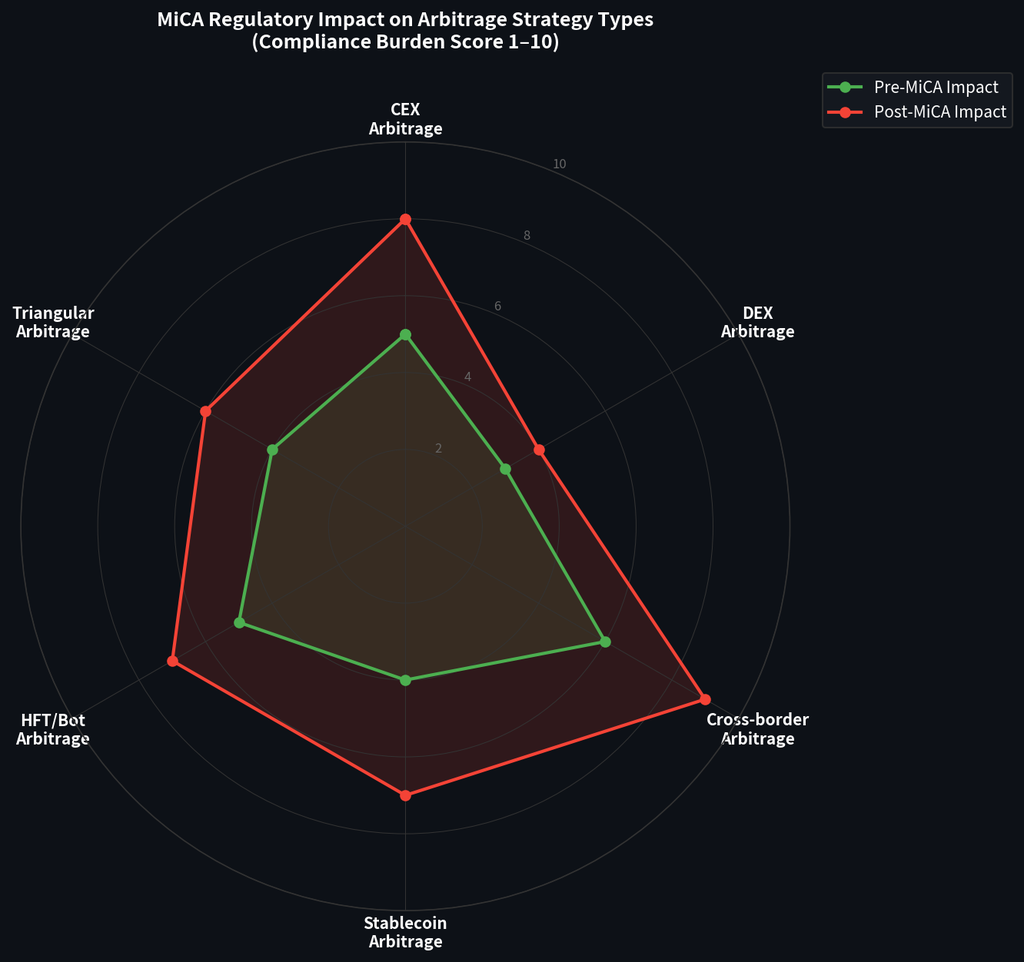
Matrix showing how different arbitrage strategies are affected by regulation
Figure 2: Impact of MiCA on common arbitrage strategies. Spatial arbitrage within the EU becomes seamless, while cross border arbitrage faces friction.
NeuralArB Insight: While simple cross-exchange arbitrage may face friction, spatial arbitrage between compliant EU exchanges will likely become faster and safer. MiCA’s passporting regime means a licensed exchange can operate seamlessly across all 27 countries, potentially deepening liquidity and stabilizing spreads.


4. CASP Requirements: What Exchanges Must Do


If your arbitrage strategy relies on a specific exchange, you must verify their CASP status. Under MiCA, exchanges are no longer just websites with an order book; they are regulated financial institutions.


Capital Requirements


Exchanges must maintain permanent minimum capital to ensure solvency. This protects your funds from “FTX-style” collapses.


    • Class 1 (Advisory/Portfolio Management): €50,000 minimum capital.
    • Class 2 (Order Execution/Exchange Operation): €125,000 minimum capital.
    • Class 3 (Custody/Trading Platform Operation): €150,000 minimum capital.
Bar chart comparing capital requirements for different CASP classes
Figure 3: Minimum capital requirements for different classes of Crypto Asset Service Providers under MiCA.

Governance and Segregation


CASPs must segregate client assets from their own funds. This is non-negotiable. For arbitrageurs, this means that even if an exchange goes bankrupt, your trading capital should theoretically remain safe and recoverable. Additionally, CASPs must have an EU-based registered office and directors who are EU residents, ensuring legal accountability.


5. Stablecoin Rules: USDT, USDC & Arbitrage Impact


Stablecoins are the lifeblood of crypto arbitrage, used to park funds and transfer value quickly. MiCA splits stablecoins into two rigorous categories:


    • Asset-Referenced Tokens (ARTs): Tokens backing their value with a basket of currencies or assets (e.g., MakerDAO’s DAI).
    • E-Money Tokens (EMTs): Tokens pegging their value to a single official currency (e.g., USDC, EURC).

The USDT Problem


Tether (USDT), the world’s most liquid stablecoin, has faced scrutiny under MiCA regarding its reserve transparency and banking partnerships. MiCA requires EMT issuers to be authorized credit institutions or electronic money institutions in the EU. If USDT does not meet these criteria, EU-based exchanges may be forced to delist it for EU users. This creates a massive risk for arbitrageurs holding large USDT balances on EU platforms.


The Rise of EURC and USDC


Circle (issuer of USDC and EURC) has aggressively pursued MiCA compliance. Arbitrage traders should prepare for a shift in base pairs from USDT to USDC or Euro backed stablecoins (EURC) on European platforms. This currency fragmentation (USDT on Asian exchanges, USDC/EURC on EU exchanges) creates FX risk in arbitrage loops that must be hedged.


6. Automated Trading & Bots Under MiCA


Many traders assume regulations only apply to humans or companies. However, MiCA and associated ESMA briefings explicitly address algorithmic trading.


The ESMA Briefing (Feb 2026)


In February 2026, ESMA released a supervisory briefing clarifying that High-Frequency Trading (HFT) firms and operators of algorithmic trading strategies dealing in crypto-assets fall under scrutiny. Key points include:


    • Systems Resilience: Trading algorithms must be tested to ensure they do not contribute to disorderly trading conditions.
    • Audit Trails: Bot operators must maintain detailed logs of all orders sent, modified, and cancelled.
    • Documentation: Sophisticated arbitrage funds must document their algorithmic strategies for regulators upon request.

Do Individual Bots Need a License?


Generally, if you are an individual running a bot for your own capital (proprietary trading), you do not need a CASP license. However, if your bot trades on behalf of others, manages client funds, or provides “signals” that automatically execute trades for subscribers, you are performing “Portfolio Management” or “Reception and Transmission of Orders” and must be licensed as a Class 1 CASP.


7. Market Manipulation & Compliance


MiCA introduces a specific regime against Market Abuse in crypto-assets (Title VI of the regulation). It explicitly prohibits:


    • Insider Dealing: Using non-public information to trade.
    • Market Manipulation: Giving false or misleading signals as to the supply, demand, or price of a crypto-asset.

Impact on Arbitrage Strategies


While legitimate spatial arbitrage is legal, certain aggressive strategies often used by bots are now clearly illegal under MiCA:


    • Wash Trading: Bots trading with themselves to generate volume.
    • Layering/Spoofing: Placing orders with no intention of executing them to move the price.

Exchange surveillance systems are now legally mandated to detect and report these patterns. If your arbitrage bot uses “spoofing” to test market depth, you risk having your account frozen and being reported to national authorities.


8. Penalties for Non-Compliance


The EU has not set toothless tigers to guard the gates. The penalties for violating MiCA are designed to be punitive and dissuasive.

Chart showing potential financial penalties for MiCA violations
Figure 4: Financial penalties for legal entities violating MiCA regulations.

For legal entities (like exchange operators or professional trading firms):


    • Minimum Fines: At least €5,000,000 for serious infringements.
    • Turnover Fines: Up to 3% of annual turnover for ART issuers, and up to 12.5% for other CASPs depending on the violation severity.
    • Periodic Penalties: Up to 3% of average daily turnover for ongoing non-compliance.

For individuals, penalties can include distinct fines €700,000 for individuals responsible for ART breaches and bans from holding management positions in crypto firms.


9. Compliance Checklist


Use this interactive table to check the compliance status of your operations or the exchanges you partner with. This data is critical for due diligence before July 1, 2026.


CategoryRequirementDeadlinePriority
LicensingObtain CASP authorization from national regulatorJuly 2026Critical
LicensingMinimum capital: €125,000 (Exchanges)July 2026Critical
AML/KYCTravel Rule compliance (TFR)ActiveCritical
Market IntegrityAnti-market manipulation systemsActiveCritical
StablecoinsVerify stablecoin CASP authorization (USDT/USDC)ActiveCritical
Bots/AutomationBot activity logging and audit trailJun 2026High
ReportingDAC8 transaction data reportingJan 2026

Critical


Conclusion


July 1, 2026, is not an endpoint but a starting line for a matured, institutional grade European crypto market. While MiCA imposes friction in the form of KYC, stablecoin restrictions, and compliance costs, it effectively removes the existential risk of exchange insolvency that has plagued the industry for a decade.


For the arbitrage trader, the game has evolved. Speed is still king, but compliance is now the queen. The winners in the post MiCA era will be those who adapt their infrastructure to regulated venues, diversify away from non-compliant stablecoins, and utilize AI tools that understand not just price, but policy.


💬 Frequently Asked Questions (FAQ)

What is MiCA and when does it fully apply?

MiCA (Markets in Crypto-Assets) is the EU’s comprehensive regulatory framework for crypto assets. The absolute deadline for full compliance for all Crypto-Asset Service Providers (CASPs) is July 1, 2026. After this date, no unlicensed entity can legally operate in the EU.

It depends on use. Individual software bots do not typically require a license if they are self-custodial tools used by an individual owner. However, if the bot operator provides “portfolio management,” custody services, or executes orders on behalf of third-party clients (Class 1 activities), a CASP license is mandated.

Capital requirements ensure solvency. Class 1 (Advisory/Portfolio Mgmt) requires €50,000; Class 2 (Exchanges) requires €125,000; Class 3 (Custodians) requires €150,000. These funds must be permanently available.

MiCA imposes strict reserve and governance rules on Asset-Referenced Tokens (ARTs). USDC and EURC have moved to comply with these rules. USDT faces scrutiny; if it does not secure authorization as an Electronic Money Token (EMT), EU exchanges may be forced to delist it, forcing arbitrageurs to switch to compliant alternatives.

Penalties are severe: minimum fines of €5,000,000 or 3% to 12.5% of total annual turnover, depending on the infraction. Regulators can also ban individuals from management and revoke operating licenses.

Yes, but the environment is stricter. Bots must not engage in strategies defined as market abuse (wash trading, layering). Exchange surveillance systems will flag suspicious algorithmic patterns more aggressively under MiCA mandates.

Known as the Transfer of Funds Regulation (TFR) alongside MiCA, it requires CASPs to collect and share personal data (name, address) of the originator and beneficiary for crypto transfers. This applies to transactions between exchanges, making anonymous arbitrage loops difficult.

Title VI of MiCA defines market abuse. Exchanges are legally required to implement surveillance systems to detect manipulation. They must report suspicious transaction reports (STRs) to national authorities, similar to traditional stock markets.

Major exchanges like Coinbase, Kraken, and Bitpanda have aggressively pursued compliance. Binance and other global giants are adjusting their EU entities to meet CASP requirements. Always check an exchange’s footer for their specific regulatory license number.

NeuralArB integrates directly with authorized CASPs and utilizes TFR-compliant data protocols. Our AI algorithms are stress-tested against MiCA’s market abuse definitions to ensure your automated strategies remain safe, legal, and profitable.


📱 Stay Connected:

  • Twitter/X for real-time market alerts
  • Telegram community for live trading discussions

🔗 Related Analysis:


Data Sources:

Disclaimer: This analysis is for educational purposes. Arbitrage trading involves substantial risk, including custody risk, regulatory risk, and execution risk. Past performance is not indicative of future results. Never risk capital you cannot afford to lose. Consult qualified financial and legal advisors before trading.

Mr.Q

Mr. Q is the Co-Founder & CEO of NeuralArB, where he spearheads the company’s strategic vision and growth initiatives. With a profound passion for blockchain technology, cryptocurrency trading, and artificial intelligence, Mr. Q has positioned NeuralArB as a leader in the AI-driven arbitrage trading space. Follow Mr. Q on Twitter: @LuisAlvaresQ

MiCA 2026 for Crypto Arbitrage: What EU Rules Change for Traders, Bots, and Exchanges

MiCA 2026 for Crypto Arbitrage

Executive Summary


Key Takeaway: The Markets in Crypto-Assets (MiCA) regulation reaches its final full implementation deadline on July 1, 2026. This framework fundamentally transforms the European crypto arbitrage landscape by mandating strict licensing for exchanges (CASPs), imposing reserve requirements on stablecoins, and introducing surveillance for automated trading bots.


Critical Facts:

    • Deadline: All crypto service providers must be fully authorized by July 1, 2026.
    • Capital: Exchanges require minimum capital of €125,000 to €150,000 depending on services.
    • Penalties: Non-compliance fines start at €5,000,000 or up to 12.5% of annual turnover.
    • Arbitrage Impact: Traders must vet exchange licenses, utilize compliant stablecoins (like USDC/EURC), and ensure bot algorithms do not violate new market abuse definitions.


Introduction


The era of the “Wild West” in cryptocurrency is officially closing in Europe. As of 2026, the European Union’s Markets in Crypto Assets (MiCA) regulation is no longer a theoretical framework, it is the law of the land. For crypto arbitrage traders, who thrive on inefficiencies and speed across multiple exchanges, MiCA presents both a formidable challenge and a stabilizing opportunity.


Arbitrage strategies have historically relied on a fragmented global market where exchange standards varied wildly. MiCA harmonizes these standards across the 27 EU member states, enforcing rigorous requirements for transparency, capital reserves, and operational integrity. While this reduces counterparty risk a major win for institutional capital, it also imposes new compliance burdens on the exchanges you trade on, the stablecoins you hold, and potentially the automated bots you deploy.


This guide is designed specifically for the arbitrage community. We will dissect exactly what changes on July 1, 2026, how to ensure your trading setup remains legal, and why the new regulatory environment might actually increase profitability for sophisticated, compliant traders using advanced AI tools.

Don’t Let Regulation Slow You Down


NeuralArB is built from the ground up to be MiCA ready. Experience compliant, high speed arbitrage today.


1. What is MiCA? The EU’s Crypto Regulatory Framework


The Markets in Crypto-Assets (MiCA) regulation is the world’s first comprehensive legal framework for crypto assets. Unlike the patchwork of laws in the US or Asia, MiCA provides a single rulebook for the entire European Union market of 450 million consumers. Its primary goals are consumer protection, financial stability, and innovation fostering.


MiCA regulates three main categories of actors:


    1. Crypto-Asset Issuers: Entities that create new tokens, including stablecoins (Asset Referenced Tokens and E Money Tokens).
    2. Crypto-Asset Service Providers (CASPs): This covers exchanges, custodians, wallet providers, and portfolio managers.
    3. Trading Venues: Platforms that facilitate the exchange of crypto-assets.

For the arbitrage trader, the most critical designation is the CASP. Every exchange you connect to via API, every wallet you use to store profits, and every custodian holding your funds must be an authorized CASP by mid 2026.


2. MiCA 2026 Timeline: Key Dates Every Trader Must Know


While MiCA was adopted years prior, the transition periods were generous. That generosity ends in 2026. Understanding the specific deadlines is crucial to avoiding sudden service disruptions or frozen assets.

Timeline showing key MiCA dates leading up to July 1, 2026 deadline
Figure 1: The phased rollout of MiCA, culminating in the absolute deadline for CASP authorization in July 2026.
    • June 30, 2024: Rules for Asset-Referenced Tokens (ARTs) and E-Money Tokens (EMTs) became applicable. This was the first wave that impacted stablecoins.
    • December 30, 2024: The core MiCA framework for CASPs officially took effect, beginning the “grandfathering” period.
    • January 1, 2026: DAC8 (Directive on Administrative Cooperation) reporting requirements go live. Exchanges must report transaction data of EU users to tax authorities.
    • February 2026: ESMA (European Securities and Markets Authority) published its crucial Supervisory Briefing on Algorithmic Trading, defining the boundaries for bots.
    • July 1, 2026 (The Absolute Deadline): The transitional “grandfathering” period ends. Any crypto service provider operating in the EU without a full MiCA license becomes illegal. Unlicensed exchanges must cease EU operations immediately.


3. How MiCA Changes Crypto Arbitrage Trading


Arbitrage is the art of profiting from price discrepancies. MiCA alters the landscape in which these discrepancies occur and how they can be exploited.


Liquidity Fragmentation vs. Consolidation


Previously, arbitrage opportunities often arose between highly regulated exchanges (like Kraken or Coinbase) and unregulated offshore entities with lax KYC. MiCA effectively builds a “Fortress Europe.” Offshore exchanges cannot solicit EU customers without a license. This may lead to a bifurcation of liquidity: a “clean,” regulated EU liquidity pool and a “grey” global pool. Price discrepancies between these two pools could be significant, but executing arbitrage between them will become legally perilous and technically difficult due to TFR (Transfer of Funds Regulation) travel rules.


The Cost of Compliance


Exchanges face higher operational costs due to MiCA (compliance staff, reporting systems, capital reserves). These costs may be passed on to traders via higher withdrawal fees or trading fees, tightening arbitrage spreads. Traders must update their fee models to ensure strategies remain profitable.

Matrix showing how different arbitrage strategies are affected by regulation
Figure 2: Impact of MiCA on common arbitrage strategies. Spatial arbitrage within the EU becomes seamless, while cross border arbitrage faces friction.
NeuralArB Insight: While simple cross-exchange arbitrage may face friction, spatial arbitrage between compliant EU exchanges will likely become faster and safer. MiCA’s passporting regime means a licensed exchange can operate seamlessly across all 27 countries, potentially deepening liquidity and stabilizing spreads.


4. CASP Requirements: What Exchanges Must Do


If your arbitrage strategy relies on a specific exchange, you must verify their CASP status. Under MiCA, exchanges are no longer just websites with an order book; they are regulated financial institutions.


Capital Requirements


Exchanges must maintain permanent minimum capital to ensure solvency. This protects your funds from “FTX-style” collapses.


    • Class 1 (Advisory/Portfolio Management): €50,000 minimum capital.
    • Class 2 (Order Execution/Exchange Operation): €125,000 minimum capital.
    • Class 3 (Custody/Trading Platform Operation): €150,000 minimum capital.
Bar chart comparing capital requirements for different CASP classes
Figure 3: Minimum capital requirements for different classes of Crypto Asset Service Providers under MiCA.

Governance and Segregation


CASPs must segregate client assets from their own funds. This is non-negotiable. For arbitrageurs, this means that even if an exchange goes bankrupt, your trading capital should theoretically remain safe and recoverable. Additionally, CASPs must have an EU-based registered office and directors who are EU residents, ensuring legal accountability.


5. Stablecoin Rules: USDT, USDC & Arbitrage Impact


Stablecoins are the lifeblood of crypto arbitrage, used to park funds and transfer value quickly. MiCA splits stablecoins into two rigorous categories:


    • Asset-Referenced Tokens (ARTs): Tokens backing their value with a basket of currencies or assets (e.g., MakerDAO’s DAI).
    • E-Money Tokens (EMTs): Tokens pegging their value to a single official currency (e.g., USDC, EURC).

The USDT Problem


Tether (USDT), the world’s most liquid stablecoin, has faced scrutiny under MiCA regarding its reserve transparency and banking partnerships. MiCA requires EMT issuers to be authorized credit institutions or electronic money institutions in the EU. If USDT does not meet these criteria, EU-based exchanges may be forced to delist it for EU users. This creates a massive risk for arbitrageurs holding large USDT balances on EU platforms.


The Rise of EURC and USDC


Circle (issuer of USDC and EURC) has aggressively pursued MiCA compliance. Arbitrage traders should prepare for a shift in base pairs from USDT to USDC or Euro backed stablecoins (EURC) on European platforms. This currency fragmentation (USDT on Asian exchanges, USDC/EURC on EU exchanges) creates FX risk in arbitrage loops that must be hedged.


6. Automated Trading & Bots Under MiCA


Many traders assume regulations only apply to humans or companies. However, MiCA and associated ESMA briefings explicitly address algorithmic trading.


The ESMA Briefing (Feb 2026)


In February 2026, ESMA released a supervisory briefing clarifying that High-Frequency Trading (HFT) firms and operators of algorithmic trading strategies dealing in crypto-assets fall under scrutiny. Key points include:


    • Systems Resilience: Trading algorithms must be tested to ensure they do not contribute to disorderly trading conditions.
    • Audit Trails: Bot operators must maintain detailed logs of all orders sent, modified, and cancelled.
    • Documentation: Sophisticated arbitrage funds must document their algorithmic strategies for regulators upon request.

Do Individual Bots Need a License?


Generally, if you are an individual running a bot for your own capital (proprietary trading), you do not need a CASP license. However, if your bot trades on behalf of others, manages client funds, or provides “signals” that automatically execute trades for subscribers, you are performing “Portfolio Management” or “Reception and Transmission of Orders” and must be licensed as a Class 1 CASP.


7. Market Manipulation & Compliance


MiCA introduces a specific regime against Market Abuse in crypto-assets (Title VI of the regulation). It explicitly prohibits:


    • Insider Dealing: Using non-public information to trade.
    • Market Manipulation: Giving false or misleading signals as to the supply, demand, or price of a crypto-asset.

Impact on Arbitrage Strategies


While legitimate spatial arbitrage is legal, certain aggressive strategies often used by bots are now clearly illegal under MiCA:


    • Wash Trading: Bots trading with themselves to generate volume.
    • Layering/Spoofing: Placing orders with no intention of executing them to move the price.

Exchange surveillance systems are now legally mandated to detect and report these patterns. If your arbitrage bot uses “spoofing” to test market depth, you risk having your account frozen and being reported to national authorities.


8. Penalties for Non-Compliance


The EU has not set toothless tigers to guard the gates. The penalties for violating MiCA are designed to be punitive and dissuasive.

Chart showing potential financial penalties for MiCA violations
Figure 4: Financial penalties for legal entities violating MiCA regulations.

For legal entities (like exchange operators or professional trading firms):


    • Minimum Fines: At least €5,000,000 for serious infringements.
    • Turnover Fines: Up to 3% of annual turnover for ART issuers, and up to 12.5% for other CASPs depending on the violation severity.
    • Periodic Penalties: Up to 3% of average daily turnover for ongoing non-compliance.

For individuals, penalties can include distinct fines €700,000 for individuals responsible for ART breaches and bans from holding management positions in crypto firms.


9. Compliance Checklist


Use this interactive table to check the compliance status of your operations or the exchanges you partner with. This data is critical for due diligence before July 1, 2026.


CategoryRequirementDeadlinePriority
LicensingObtain CASP authorization from national regulatorJuly 2026Critical
LicensingMinimum capital: €125,000 (Exchanges)July 2026Critical
AML/KYCTravel Rule compliance (TFR)ActiveCritical
Market IntegrityAnti-market manipulation systemsActiveCritical
StablecoinsVerify stablecoin CASP authorization (USDT/USDC)ActiveCritical
Bots/AutomationBot activity logging and audit trailJun 2026High
ReportingDAC8 transaction data reportingJan 2026

Critical


Conclusion


July 1, 2026, is not an endpoint but a starting line for a matured, institutional grade European crypto market. While MiCA imposes friction in the form of KYC, stablecoin restrictions, and compliance costs, it effectively removes the existential risk of exchange insolvency that has plagued the industry for a decade.


For the arbitrage trader, the game has evolved. Speed is still king, but compliance is now the queen. The winners in the post MiCA era will be those who adapt their infrastructure to regulated venues, diversify away from non-compliant stablecoins, and utilize AI tools that understand not just price, but policy.


💬 Frequently Asked Questions (FAQ)

What is MiCA and when does it fully apply?

MiCA (Markets in Crypto-Assets) is the EU’s comprehensive regulatory framework for crypto assets. The absolute deadline for full compliance for all Crypto-Asset Service Providers (CASPs) is July 1, 2026. After this date, no unlicensed entity can legally operate in the EU.

It depends on use. Individual software bots do not typically require a license if they are self-custodial tools used by an individual owner. However, if the bot operator provides “portfolio management,” custody services, or executes orders on behalf of third-party clients (Class 1 activities), a CASP license is mandated.

Capital requirements ensure solvency. Class 1 (Advisory/Portfolio Mgmt) requires €50,000; Class 2 (Exchanges) requires €125,000; Class 3 (Custodians) requires €150,000. These funds must be permanently available.

MiCA imposes strict reserve and governance rules on Asset-Referenced Tokens (ARTs). USDC and EURC have moved to comply with these rules. USDT faces scrutiny; if it does not secure authorization as an Electronic Money Token (EMT), EU exchanges may be forced to delist it, forcing arbitrageurs to switch to compliant alternatives.

Penalties are severe: minimum fines of €5,000,000 or 3% to 12.5% of total annual turnover, depending on the infraction. Regulators can also ban individuals from management and revoke operating licenses.

Yes, but the environment is stricter. Bots must not engage in strategies defined as market abuse (wash trading, layering). Exchange surveillance systems will flag suspicious algorithmic patterns more aggressively under MiCA mandates.

Known as the Transfer of Funds Regulation (TFR) alongside MiCA, it requires CASPs to collect and share personal data (name, address) of the originator and beneficiary for crypto transfers. This applies to transactions between exchanges, making anonymous arbitrage loops difficult.

Title VI of MiCA defines market abuse. Exchanges are legally required to implement surveillance systems to detect manipulation. They must report suspicious transaction reports (STRs) to national authorities, similar to traditional stock markets.

Major exchanges like Coinbase, Kraken, and Bitpanda have aggressively pursued compliance. Binance and other global giants are adjusting their EU entities to meet CASP requirements. Always check an exchange’s footer for their specific regulatory license number.

NeuralArB integrates directly with authorized CASPs and utilizes TFR-compliant data protocols. Our AI algorithms are stress-tested against MiCA’s market abuse definitions to ensure your automated strategies remain safe, legal, and profitable.


📱 Stay Connected:

  • Twitter/X for real-time market alerts
  • Telegram community for live trading discussions

🔗 Related Analysis:


Data Sources:

Disclaimer: This analysis is for educational purposes. Arbitrage trading involves substantial risk, including custody risk, regulatory risk, and execution risk. Past performance is not indicative of future results. Never risk capital you cannot afford to lose. Consult qualified financial and legal advisors before trading.

Mr.Q

Mr. Q is the Co-Founder & CEO of NeuralArB, where he spearheads the company’s strategic vision and growth initiatives. With a profound passion for blockchain technology, cryptocurrency trading, and artificial intelligence, Mr. Q has positioned NeuralArB as a leader in the AI-driven arbitrage trading space. Follow Mr. Q on Twitter: @LuisAlvaresQ

MiCA 2026 for Crypto Arbitrage: What EU Rules Change for Traders, Bots, and Exchanges

MiCA 2026 for Crypto Arbitrage

Executive Summary


Key Takeaway: The Markets in Crypto-Assets (MiCA) regulation reaches its final full implementation deadline on July 1, 2026. This framework fundamentally transforms the European crypto arbitrage landscape by mandating strict licensing for exchanges (CASPs), imposing reserve requirements on stablecoins, and introducing surveillance for automated trading bots.


Critical Facts:

    • Deadline: All crypto service providers must be fully authorized by July 1, 2026.
    • Capital: Exchanges require minimum capital of €125,000 to €150,000 depending on services.
    • Penalties: Non-compliance fines start at €5,000,000 or up to 12.5% of annual turnover.
    • Arbitrage Impact: Traders must vet exchange licenses, utilize compliant stablecoins (like USDC/EURC), and ensure bot algorithms do not violate new market abuse definitions.


Introduction


The era of the “Wild West” in cryptocurrency is officially closing in Europe. As of 2026, the European Union’s Markets in Crypto Assets (MiCA) regulation is no longer a theoretical framework, it is the law of the land. For crypto arbitrage traders, who thrive on inefficiencies and speed across multiple exchanges, MiCA presents both a formidable challenge and a stabilizing opportunity.


Arbitrage strategies have historically relied on a fragmented global market where exchange standards varied wildly. MiCA harmonizes these standards across the 27 EU member states, enforcing rigorous requirements for transparency, capital reserves, and operational integrity. While this reduces counterparty risk a major win for institutional capital, it also imposes new compliance burdens on the exchanges you trade on, the stablecoins you hold, and potentially the automated bots you deploy.


This guide is designed specifically for the arbitrage community. We will dissect exactly what changes on July 1, 2026, how to ensure your trading setup remains legal, and why the new regulatory environment might actually increase profitability for sophisticated, compliant traders using advanced AI tools.

Don’t Let Regulation Slow You Down


NeuralArB is built from the ground up to be MiCA ready. Experience compliant, high speed arbitrage today.


1. What is MiCA? The EU’s Crypto Regulatory Framework


The Markets in Crypto-Assets (MiCA) regulation is the world’s first comprehensive legal framework for crypto assets. Unlike the patchwork of laws in the US or Asia, MiCA provides a single rulebook for the entire European Union market of 450 million consumers. Its primary goals are consumer protection, financial stability, and innovation fostering.


MiCA regulates three main categories of actors:


    1. Crypto-Asset Issuers: Entities that create new tokens, including stablecoins (Asset Referenced Tokens and E Money Tokens).
    2. Crypto-Asset Service Providers (CASPs): This covers exchanges, custodians, wallet providers, and portfolio managers.
    3. Trading Venues: Platforms that facilitate the exchange of crypto-assets.

For the arbitrage trader, the most critical designation is the CASP. Every exchange you connect to via API, every wallet you use to store profits, and every custodian holding your funds must be an authorized CASP by mid 2026.


2. MiCA 2026 Timeline: Key Dates Every Trader Must Know


While MiCA was adopted years prior, the transition periods were generous. That generosity ends in 2026. Understanding the specific deadlines is crucial to avoiding sudden service disruptions or frozen assets.

Timeline showing key MiCA dates leading up to July 1, 2026 deadline
Figure 1: The phased rollout of MiCA, culminating in the absolute deadline for CASP authorization in July 2026.
    • June 30, 2024: Rules for Asset-Referenced Tokens (ARTs) and E-Money Tokens (EMTs) became applicable. This was the first wave that impacted stablecoins.
    • December 30, 2024: The core MiCA framework for CASPs officially took effect, beginning the “grandfathering” period.
    • January 1, 2026: DAC8 (Directive on Administrative Cooperation) reporting requirements go live. Exchanges must report transaction data of EU users to tax authorities.
    • February 2026: ESMA (European Securities and Markets Authority) published its crucial Supervisory Briefing on Algorithmic Trading, defining the boundaries for bots.
    • July 1, 2026 (The Absolute Deadline): The transitional “grandfathering” period ends. Any crypto service provider operating in the EU without a full MiCA license becomes illegal. Unlicensed exchanges must cease EU operations immediately.


3. How MiCA Changes Crypto Arbitrage Trading


Arbitrage is the art of profiting from price discrepancies. MiCA alters the landscape in which these discrepancies occur and how they can be exploited.


Liquidity Fragmentation vs. Consolidation


Previously, arbitrage opportunities often arose between highly regulated exchanges (like Kraken or Coinbase) and unregulated offshore entities with lax KYC. MiCA effectively builds a “Fortress Europe.” Offshore exchanges cannot solicit EU customers without a license. This may lead to a bifurcation of liquidity: a “clean,” regulated EU liquidity pool and a “grey” global pool. Price discrepancies between these two pools could be significant, but executing arbitrage between them will become legally perilous and technically difficult due to TFR (Transfer of Funds Regulation) travel rules.


The Cost of Compliance


Exchanges face higher operational costs due to MiCA (compliance staff, reporting systems, capital reserves). These costs may be passed on to traders via higher withdrawal fees or trading fees, tightening arbitrage spreads. Traders must update their fee models to ensure strategies remain profitable.

Matrix showing how different arbitrage strategies are affected by regulation
Figure 2: Impact of MiCA on common arbitrage strategies. Spatial arbitrage within the EU becomes seamless, while cross border arbitrage faces friction.
NeuralArB Insight: While simple cross-exchange arbitrage may face friction, spatial arbitrage between compliant EU exchanges will likely become faster and safer. MiCA’s passporting regime means a licensed exchange can operate seamlessly across all 27 countries, potentially deepening liquidity and stabilizing spreads.


4. CASP Requirements: What Exchanges Must Do


If your arbitrage strategy relies on a specific exchange, you must verify their CASP status. Under MiCA, exchanges are no longer just websites with an order book; they are regulated financial institutions.


Capital Requirements


Exchanges must maintain permanent minimum capital to ensure solvency. This protects your funds from “FTX-style” collapses.


    • Class 1 (Advisory/Portfolio Management): €50,000 minimum capital.
    • Class 2 (Order Execution/Exchange Operation): €125,000 minimum capital.
    • Class 3 (Custody/Trading Platform Operation): €150,000 minimum capital.
Bar chart comparing capital requirements for different CASP classes
Figure 3: Minimum capital requirements for different classes of Crypto Asset Service Providers under MiCA.

Governance and Segregation


CASPs must segregate client assets from their own funds. This is non-negotiable. For arbitrageurs, this means that even if an exchange goes bankrupt, your trading capital should theoretically remain safe and recoverable. Additionally, CASPs must have an EU-based registered office and directors who are EU residents, ensuring legal accountability.


5. Stablecoin Rules: USDT, USDC & Arbitrage Impact


Stablecoins are the lifeblood of crypto arbitrage, used to park funds and transfer value quickly. MiCA splits stablecoins into two rigorous categories:


    • Asset-Referenced Tokens (ARTs): Tokens backing their value with a basket of currencies or assets (e.g., MakerDAO’s DAI).
    • E-Money Tokens (EMTs): Tokens pegging their value to a single official currency (e.g., USDC, EURC).

The USDT Problem


Tether (USDT), the world’s most liquid stablecoin, has faced scrutiny under MiCA regarding its reserve transparency and banking partnerships. MiCA requires EMT issuers to be authorized credit institutions or electronic money institutions in the EU. If USDT does not meet these criteria, EU-based exchanges may be forced to delist it for EU users. This creates a massive risk for arbitrageurs holding large USDT balances on EU platforms.


The Rise of EURC and USDC


Circle (issuer of USDC and EURC) has aggressively pursued MiCA compliance. Arbitrage traders should prepare for a shift in base pairs from USDT to USDC or Euro backed stablecoins (EURC) on European platforms. This currency fragmentation (USDT on Asian exchanges, USDC/EURC on EU exchanges) creates FX risk in arbitrage loops that must be hedged.


6. Automated Trading & Bots Under MiCA


Many traders assume regulations only apply to humans or companies. However, MiCA and associated ESMA briefings explicitly address algorithmic trading.


The ESMA Briefing (Feb 2026)


In February 2026, ESMA released a supervisory briefing clarifying that High-Frequency Trading (HFT) firms and operators of algorithmic trading strategies dealing in crypto-assets fall under scrutiny. Key points include:


    • Systems Resilience: Trading algorithms must be tested to ensure they do not contribute to disorderly trading conditions.
    • Audit Trails: Bot operators must maintain detailed logs of all orders sent, modified, and cancelled.
    • Documentation: Sophisticated arbitrage funds must document their algorithmic strategies for regulators upon request.

Do Individual Bots Need a License?


Generally, if you are an individual running a bot for your own capital (proprietary trading), you do not need a CASP license. However, if your bot trades on behalf of others, manages client funds, or provides “signals” that automatically execute trades for subscribers, you are performing “Portfolio Management” or “Reception and Transmission of Orders” and must be licensed as a Class 1 CASP.


7. Market Manipulation & Compliance


MiCA introduces a specific regime against Market Abuse in crypto-assets (Title VI of the regulation). It explicitly prohibits:


    • Insider Dealing: Using non-public information to trade.
    • Market Manipulation: Giving false or misleading signals as to the supply, demand, or price of a crypto-asset.

Impact on Arbitrage Strategies


While legitimate spatial arbitrage is legal, certain aggressive strategies often used by bots are now clearly illegal under MiCA:


    • Wash Trading: Bots trading with themselves to generate volume.
    • Layering/Spoofing: Placing orders with no intention of executing them to move the price.

Exchange surveillance systems are now legally mandated to detect and report these patterns. If your arbitrage bot uses “spoofing” to test market depth, you risk having your account frozen and being reported to national authorities.


8. Penalties for Non-Compliance


The EU has not set toothless tigers to guard the gates. The penalties for violating MiCA are designed to be punitive and dissuasive.

Chart showing potential financial penalties for MiCA violations
Figure 4: Financial penalties for legal entities violating MiCA regulations.

For legal entities (like exchange operators or professional trading firms):


    • Minimum Fines: At least €5,000,000 for serious infringements.
    • Turnover Fines: Up to 3% of annual turnover for ART issuers, and up to 12.5% for other CASPs depending on the violation severity.
    • Periodic Penalties: Up to 3% of average daily turnover for ongoing non-compliance.

For individuals, penalties can include distinct fines €700,000 for individuals responsible for ART breaches and bans from holding management positions in crypto firms.


9. Compliance Checklist


Use this interactive table to check the compliance status of your operations or the exchanges you partner with. This data is critical for due diligence before July 1, 2026.


CategoryRequirementDeadlinePriority
LicensingObtain CASP authorization from national regulatorJuly 2026Critical
LicensingMinimum capital: €125,000 (Exchanges)July 2026Critical
AML/KYCTravel Rule compliance (TFR)ActiveCritical
Market IntegrityAnti-market manipulation systemsActiveCritical
StablecoinsVerify stablecoin CASP authorization (USDT/USDC)ActiveCritical
Bots/AutomationBot activity logging and audit trailJun 2026High
ReportingDAC8 transaction data reportingJan 2026

Critical


Conclusion


July 1, 2026, is not an endpoint but a starting line for a matured, institutional grade European crypto market. While MiCA imposes friction in the form of KYC, stablecoin restrictions, and compliance costs, it effectively removes the existential risk of exchange insolvency that has plagued the industry for a decade.


For the arbitrage trader, the game has evolved. Speed is still king, but compliance is now the queen. The winners in the post MiCA era will be those who adapt their infrastructure to regulated venues, diversify away from non-compliant stablecoins, and utilize AI tools that understand not just price, but policy.


💬 Frequently Asked Questions (FAQ)

What is MiCA and when does it fully apply?

MiCA (Markets in Crypto-Assets) is the EU’s comprehensive regulatory framework for crypto assets. The absolute deadline for full compliance for all Crypto-Asset Service Providers (CASPs) is July 1, 2026. After this date, no unlicensed entity can legally operate in the EU.

It depends on use. Individual software bots do not typically require a license if they are self-custodial tools used by an individual owner. However, if the bot operator provides “portfolio management,” custody services, or executes orders on behalf of third-party clients (Class 1 activities), a CASP license is mandated.

Capital requirements ensure solvency. Class 1 (Advisory/Portfolio Mgmt) requires €50,000; Class 2 (Exchanges) requires €125,000; Class 3 (Custodians) requires €150,000. These funds must be permanently available.

MiCA imposes strict reserve and governance rules on Asset-Referenced Tokens (ARTs). USDC and EURC have moved to comply with these rules. USDT faces scrutiny; if it does not secure authorization as an Electronic Money Token (EMT), EU exchanges may be forced to delist it, forcing arbitrageurs to switch to compliant alternatives.

Penalties are severe: minimum fines of €5,000,000 or 3% to 12.5% of total annual turnover, depending on the infraction. Regulators can also ban individuals from management and revoke operating licenses.

Yes, but the environment is stricter. Bots must not engage in strategies defined as market abuse (wash trading, layering). Exchange surveillance systems will flag suspicious algorithmic patterns more aggressively under MiCA mandates.

Known as the Transfer of Funds Regulation (TFR) alongside MiCA, it requires CASPs to collect and share personal data (name, address) of the originator and beneficiary for crypto transfers. This applies to transactions between exchanges, making anonymous arbitrage loops difficult.

Title VI of MiCA defines market abuse. Exchanges are legally required to implement surveillance systems to detect manipulation. They must report suspicious transaction reports (STRs) to national authorities, similar to traditional stock markets.

Major exchanges like Coinbase, Kraken, and Bitpanda have aggressively pursued compliance. Binance and other global giants are adjusting their EU entities to meet CASP requirements. Always check an exchange’s footer for their specific regulatory license number.

NeuralArB integrates directly with authorized CASPs and utilizes TFR-compliant data protocols. Our AI algorithms are stress-tested against MiCA’s market abuse definitions to ensure your automated strategies remain safe, legal, and profitable.


📱 Stay Connected:

  • Twitter/X for real-time market alerts
  • Telegram community for live trading discussions

🔗 Related Analysis:


Data Sources:

Disclaimer: This analysis is for educational purposes. Arbitrage trading involves substantial risk, including custody risk, regulatory risk, and execution risk. Past performance is not indicative of future results. Never risk capital you cannot afford to lose. Consult qualified financial and legal advisors before trading.

Mr.Q

Mr. Q is the Co-Founder & CEO of NeuralArB, where he spearheads the company’s strategic vision and growth initiatives. With a profound passion for blockchain technology, cryptocurrency trading, and artificial intelligence, Mr. Q has positioned NeuralArB as a leader in the AI-driven arbitrage trading space. Follow Mr. Q on Twitter: @LuisAlvaresQ

Still have questions, contact us:

© 2026 NAB CONSULTANCY LTD. All right reserved.

These materials are for general information purposes only and are not investment advice or a recommendation or solicitation to buy, sell or hold any cryptoasset or to engage in any specific trading strategy. Some crypto products and markets are unregulated, and you may not be protected by government compensation and/or regulatory protection schemes. The unpredictable nature of the cryptoasset markets can lead to loss of funds. Tax may be payable on any return and/or on any increase in the value of your cryptoassets and you should seek independent advice on your taxation position.

All trademarks, logos, and brand names are the property of their respective owners. All company, product, and service names used in this website are for identification purposes only. Use of these names, trademarks, and brands does not imply endorsement.

NAB does not provide investment or brokerage services. All cryptocurrency spot, margin, and futures products are offered by third-party platforms. Products and services availability varies by country.

Past performance, whether actual or indicated by historical or simulated tests of strategies, is no guarantee of future performance or success. There is a possibility that you may sustain a loss equal to or greater than your entire investment regardless of which asset class you trade (i.e. cryptocurrency); therefore, you should not invest or risk money that you cannot afford to lose. Online trading is not suitable for all investors. Before trading any asset class, customers should review NFA and CFTC advisories, and other relevant disclosures. System access, trade placement, and execution may be delayed or fail due to market volatility and volume, quote delays, system and software errors, Internet traffic, outages and other unforeseen factors.

Still have questions, contact us:

© 2026 NAB CONSULTANCY LTD. All right reserved.

These materials are for general information purposes only and are not investment advice or a recommendation or solicitation to buy, sell or hold any cryptoasset or to engage in any specific trading strategy. Some crypto products and markets are unregulated, and you may not be protected by government compensation and/or regulatory protection schemes. The unpredictable nature of the cryptoasset markets can lead to loss of funds. Tax may be payable on any return and/or on any increase in the value of your cryptoassets and you should seek independent advice on your taxation position.

All trademarks, logos, and brand names are the property of their respective owners. All company, product, and service names used in this website are for identification purposes only. Use of these names, trademarks, and brands does not imply endorsement.

NAB does not provide investment or brokerage services. All cryptocurrency spot, margin, and futures products are offered by third-party platforms. Products and services availability varies by country.

Past performance, whether actual or indicated by historical or simulated tests of strategies, is no guarantee of future performance or success. There is a possibility that you may sustain a loss equal to or greater than your entire investment regardless of which asset class you trade (i.e. cryptocurrency); therefore, you should not invest or risk money that you cannot afford to lose. Online trading is not suitable for all investors. Before trading any asset class, customers should review NFA and CFTC advisories, and other relevant disclosures. System access, trade placement, and execution may be delayed or fail due to market volatility and volume, quote delays, system and software errors, Internet traffic, outages and other unforeseen factors.

Still have questions, contact us:

© 2026 NAB CONSULTANCY LTD. All right reserved.

These materials are for general information purposes only and are not investment advice or a recommendation or solicitation to buy, sell or hold any cryptoasset or to engage in any specific trading strategy. Some crypto products and markets are unregulated, and you may not be protected by government compensation and/or regulatory protection schemes. The unpredictable nature of the cryptoasset markets can lead to loss of funds. Tax may be payable on any return and/or on any increase in the value of your cryptoassets and you should seek independent advice on your taxation position.

All trademarks, logos, and brand names are the property of their respective owners. All company, product, and service names used in this website are for identification purposes only. Use of these names, trademarks, and brands does not imply endorsement.

NAB does not provide investment or brokerage services. All cryptocurrency spot, margin, and futures products are offered by third-party platforms. Products and services availability varies by country.

Past performance, whether actual or indicated by historical or simulated tests of strategies, is no guarantee of future performance or success. There is a possibility that you may sustain a loss equal to or greater than your entire investment regardless of which asset class you trade (i.e. cryptocurrency); therefore, you should not invest or risk money that you cannot afford to lose. Online trading is not suitable for all investors. Before trading any asset class, customers should review NFA and CFTC advisories, and other relevant disclosures. System access, trade placement, and execution may be delayed or fail due to market volatility and volume, quote delays, system and software errors, Internet traffic, outages and other unforeseen factors.

btc address
bc1ql27m5pygdxpmnvjzkamaj88mwphwl8q6n9n06l

Only use this insured address for BTC on the Bitcoin network. Do not send Ordinals. Lost funds cannot be recovered.