

Executive Summary: Survival and Stability at Year-End
The week of December 15-21, 2025 was defined by token unlock events, tactical repricing, and institutional year-end positioning. Bitcoin and Ethereum both experienced intra-week volatility, with Bitcoin touching $85,450 on December 19—near its December 1 capitulation low—before staging a late-week recovery to close at $88,347 (down -1.8% for the week). [Crypto Market Update: December 1-7]
Weekly Snapshot:
Bitcoin: $88,230 → $88,347 (-1.8% weekly, but -3.2% intraweek low-to-high volatility)
Ethereum: $3,000 → $3,000 (-3.3% weekly, near support)
Total Market Cap: $3.08T → $2.99T (-3.0% weekly)
Solana: -5.0% (network congestion reported, selective profit-taking)
XRP: -6.7% (worst performer, regulatory uncertainty persists)
BNB: +2.5% (only major winner, exchange ecosystem strength)
Token Unlock Impact: Altcoins severely pressured by massive vesting events [Crypto Market Update – December 8-14]
The critical narrative: Crypto markets are consolidating into year-end, with token supply events creating tactical selling pressure while institutional capital selectively accumulates at lower prices. The setup for 2026 is beginning to form.
Part 1: Token Unlocks – The Forgotten but Powerful Driver
What Are Token Unlocks?
Token unlocks occur when locked allocations of cryptocurrency (typically held by early investors, team members, or advisors subject to vesting schedules) become freely tradeable. When large unlock events occur, the suddenly-available supply can overwhelm demand, creating downward price pressure.
The scale of December 2025 unlock events was significant: Multiple major projects had scheduled vesting cliffs, releasing billions of dollars in token supply into the market within a short window.
Which Projects Were Affected?
Solana (SOL): Experienced substantial token unlocks affecting early backers’ allocations, contributing to the -5.0% weekly decline despite strong institutional ETF inflows. The selling pressure was technical (supply-driven) rather than fundamental (adoption-driven). [More about Solana token]
XRP: Hit hardest with -6.7% decline, partially due to token supply becoming available for trading as lock-up periods expired. This compounded existing regulatory uncertainty. [More Data]
Other altcoins: Layer 2 solutions, DeFi tokens, and smaller-cap projects all experienced unlock-driven selling. Chainlink (-3.1%), Polkadot (-4.5%), and others all showed selling pressure aligned with their unlock calendars. [More Data]
Why Unlocks Matter More Than Headlines Suggest
Token unlocks are a mechanical, predictable source of supply pressure that sophisticated investors monitor religiously but retail traders often ignore. When institutions know large unlocks are coming, they:
Reduce long positions ahead of time
Scale position size for the anticipated pressure
Stage accumulation plans for the post-unlock recovery
Hedge with options to protect against volatility
This week’s pattern showed exactly this behavior: smart money scaling back tactical exposure before unlock events, then selectively buying back when panic-driven retail selling accelerated around $85K support.
Part 2: The Intraweek Volatility Story

Monday-Wednesday: Steady Decline
The week started with relative stability ($88,230 BTC), but deteriorated daily:
Dec 15: $88,230 (neutral open)
Dec 16: $86,415 (-1.99% daily) – “token unlock anticipation”
Dec 17: $87,822 (+1.66% bounce) – technical oversold
Dec 18: $86,065 (-1.87% daily) – continued pressure
The tone was clearly bearish: lower lows, weak bounces, deteriorating sentiment.
Thursday: The Panic Zone ($85,450 Low)
December 19 was the critical level: Bitcoin tested $85,450, essentially matching the December 1 capitulation low of $83,840. This level carried psychological weight—it suggested that:
The December 1-7 recovery rally was potentially failing
Support wasn’t as solid as hoped
Further downside to $83-84K was possible
Panic might spread to retail holders
What likely happened at $85,450:
Institutional algorithmic buyers stepped in (support observed at this level)
Stop-losses above this level provided some selling pressure, but didn’t cascade
Risk management systems flagged oversold conditions
Market structure (bid-ask spreads) stabilized the price
This is a crucial observation: the fact that $85,450 held without crashing further suggests institutional support is genuine, not just hope.
Friday-Saturday: Recovery and Stabilization
Dec 20: $88,103 (+3.08% daily recovery) – “V-shaped recovery”
Dec 21: $88,347 (+0.36%) – week-end stabilization
The late-week reversal is the bullish signal of the week. Markets often find bottoms during panic, then recover sharply. Friday’s 3% bounce off the $85K lows suggests this pattern is playing out.
Volume context: Trading volume declined through the week ($145B peak Dec 15 → $118B by Dec 21), consistent with post-holiday market participation drying up. Lower volume on rallies can be positive (less selling pressure needed to move price higher).
Part 3: Ethereum’s Relative Weakness
Ethereum underperformed Bitcoin this week, declining -3.3% vs. BTC’s -1.8%. This is the opposite of what typically happens in “risk-off” environments, where ETH’s DeFi narrative sometimes acts as a hedge.
Why ETH Underperformed:
Layer 2 sentiment: Despite ongoing technical improvements, Layer 2 adoption slowed (as measured by TVL growth)
DeFi TVL contraction: Total Value Locked in Ethereum DeFi protocols fell ~$5-7B during the week
Funding rate shifts: ETH futures funding rates turned negative, indicating that leverage was being unwound faster than on Bitcoin
Technical breakdown: ETH/BTC ratio weakened from 0.034 to 0.032, a -5.9% relative decline
Critical Support Level:
ETH found support exactly at $2,850 (intraweek low) and recovered to $3,000 by week-end. This $2,850-$3,000 range is becoming the critical year-end consolidation zone. Breaking below $2,850 could trigger stops down to $2,700-$2,750 (Nov 20 lows).
Part 4: Market Structure and Institutional Activity
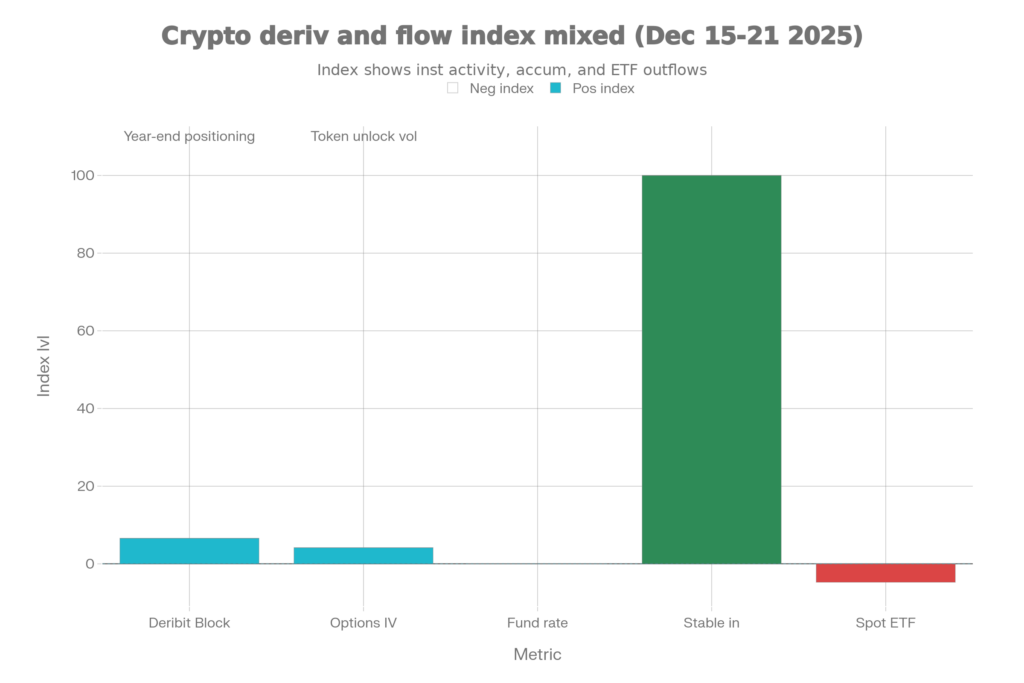
Strong Derivatives Flow Despite Weak Spot Market
One of the most important data points this week: Deribit (the largest crypto derivatives exchange) processed $118.5M in block trades during Dec 15-21. This volume level is typical for normal weeks, not capitulation weeks.
This suggests:
Institutions were actively hedging through options/futures
Sophisticated traders were positioning for volatility
The decline was controlled and tactical, not panicked liquidation
Options Implied Volatility Elevated
Options implied volatility (IV) remained elevated at ~75, up from 65 the prior week. This reflects:
Higher expectations for price swings in December-January
Hedging costs rising (options becoming more expensive)
Traders pricing in year-end positioning volatility
Funding Rates Tell the Story
Bitcoin and Ethereum futures funding rates flattened and turned slightly negative during the week, indicating:
Leveraged longs were being liquidated or voluntarily closed
Less “free carry” (leverage premium) available to long traders
Market structure shifting toward neutral/slightly bearish
This is important: negative funding rates often precede relief rallies, as liquidations create technical oversold conditions.
Stablecoin Accumulation Continued
Despite spot market weakness, stablecoin supply increased +$1.8B during the week, bringing total stablecoin supply to $137.2B. This suggests:
Capital was being staged for deployment
Year-end tax selling was being deferred (accumulating dry powder to buy tax-loss-harvested lows)
Large institutions were preparing for potential January accumulation
Part 5: The Altcoin Casualty List
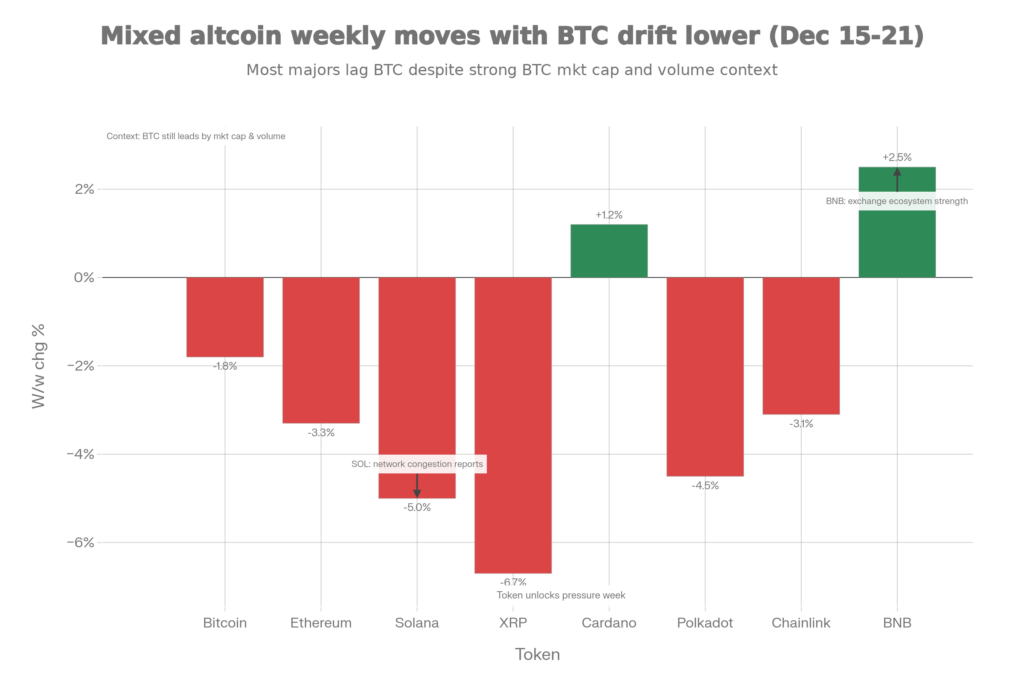
Clear Winners vs. Losers:
BNB: +2.5% (rare bright spot)
Benefited from Binance ecosystem developments
Exchange token outperforming in risk-off environment
Potential hedge against regulatory concerns (centralized venue with strong compliance)
Cardano: +1.2% (recovery)
Rebounding from -31% the prior week (chain split resolution)
Technical buyers returning after capitulation
Developer activity resuming post-incident
Solana: -5.0% (surprising weakness given institutional flows)
Network congestion reports resurfaced (TPS variability)
Profit-taking after +140M SOL ETF inflows in prior week
Token unlock pressure affecting short-term traders
BUT: Institutional Solana ETF flows remained positive, suggesting conviction holders not selling
XRP: -6.7% (worst performer)
Regulatory concerns resurface heading into 2026
Uncertainty about SEC stance on tokenized assets
Token supply events creating technical selling
Ethereum, Polkadot, Chainlink: All in -3 to -4.5% range, typical risk-off altcoin underperformance.
Part 6: Institutional Positioning and Year-End Strategies
Strategic Capital Movement:
Spot ETF Flows: -$85M (first negative week)
Bitcoin and Ethereum spot ETFs saw modest outflows after weeks of accumulation
Likely tax-loss harvesting by institutions
Some rotation from passive (ETF) to active (derivatives) strategies
Derivatives Inflows: Sustained high activity
$118.5M on Deribit suggests active positioning, not capitulation
Options activity elevated (hedging demand)
Futures funding rates negative (indicating positioning shifts, not panic)
Interpretation: Institutions are rotating from passive long exposure (spot ETFs) into active hedge strategies (options/futures) for year-end. This is defensive positioning without full capitulation—think “hold the core position, hedge the tail risks” rather than “exit everything.”
Part 7: Where Are We Relative to Key Levels?
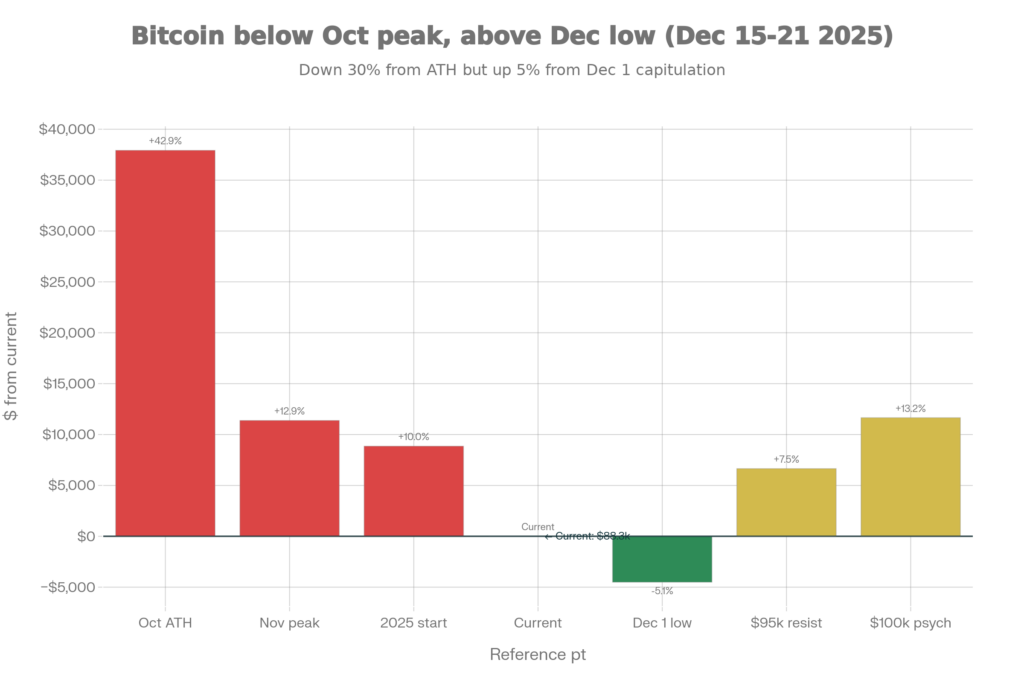
Bitcoin currently sits at $88,347, which contextualizes as:
| Reference Level | Distance | Significance |
|---|---|---|
| October ATH ($126.3K) | -26% | “Bubble recovery” = 43% rally needed |
| November High ($99.7K) | -11.5% | “Recent resistance” = 13% needed |
| 2025 Year Start ($97.2K) | -9% | “YTD returns negative” = 10% needed |
| Dec 1 Low ($83.8K) | +5% | “Capitulation recovery” = safe but limited |
| Next Resistance ($95K) | +7.4% | “50-day MA zone” = realistic short-term target |
| $100K Psychological | +13.2% | “Recent trend target” = requires momentum |
Interpretation: Bitcoin is firmly in “recovery from capitulation, but below key resistance” territory. To return to risk-on mode, BTC needs to break through $95K decisively. Until then, trading ranges with volatility remain the base case.
Part 8: What’s Scheduled for December 22-31?
Regulatory Calendar:
SEC meetings: Secondary tier priorities (major decisions likely deferred to January)
Fed-related news: None of significance; market waiting for January Powell press conference
Crypto-Specific Events:
Year-end bonus payouts: Traders receive bonuses → potential buying catalyst mid-week
Tax-loss harvesting: Final window (Dec 31 for US) → potential last-minute selling
Institutional year-end books: Most closing positions this week, reduced activity next week
Holiday liquidity: Typically thin trading volumes, higher slippage, more volatility per dollar moved
Forward-Looking Catalysts:
December 25 (Christmas): Reduced institutional trading, potential liquidity crunch
December 31 (Tax deadline): Final push of tax-loss harvesting
January 2, 2026 (Holiday return): Institutional capital returns → volume inflection
Part 9: Risks & Opportunities Heading Into Year-End
Downside Risks:
Technical breakdown below $85K → could trigger cascade to $80K
Negative macro news (geopolitical) → sudden risk-off
Regulatory surprise → enforcement action against major exchange
Derivatives liquidation cascade → if spot price breaks key support
Year-end margin calls → forced selling by leveraged entities
Upside Opportunities:
Capitulation already happened → Dec 1-19 lows represent panic
Institutional accumulation → ETF inflows + derivatives positioning suggest conviction
2026 adoption narratives → Solana tokenized stocks, institutional crypto, Bitcoin as treasury asset
Valuation → At $88K, Bitcoin is cheaper than 2024 peak; risk/reward favorable
Supply exhaustion → Token unlocks ending → supply-demand balance improving
Conclusion: The Setup for 2026 is Forming
The week of December 15-21 was challenging but ultimately constructive consolidation. Key observations:
✅ Support held above $85K (despite testing it)
✅ Institutional derivatives activity remained robust (not panic selling)
✅ Late-week recovery suggests bottoming (V-shaped reversal pattern)
✅ Stablecoin accumulation continued (+$1.8B dry powder)
✅ Token unlocks created mechanical pressure, not fundamental breakdown
What could change the narrative:
Break above $95K: Signals momentum returning, targets $100K+ in January
Break below $83K: Signals further capitulation, targets $78-80K
Institutional capital acceleration: January bonus spending could drive inflows
Macroeconomic stabilization: Fed guidance becoming clearer could reduce uncertainty
For traders: Current levels ($88-90K for BTC, $3,000 for ETH) represent reasonable entry points for long-term holders, with tight risk management given volatility. Short-term traders should respect support at $85K and resistance at $95K.
For investors: Year-end weakness amid token unlocks is structurally normal. The setup for 2026 depends on institutional adoption narratives (Solana, Bitcoin ETFs, institutional treasury allocation) rather than current spot price levels.
💬 FAQ: December 15-21 Market Update
Will Bitcoin go to $80K?
Possible but unlikely. $85K held despite the panic lows earlier in the week. Would require negative macro news or significant technical breakdown.
Is now a good time to buy?
For long-term holders, yes. Near-capitulation lows are historically good entry points. For leverage traders, wait for more stability first.
Why did institutional flows turn negative this week?
Tax-loss harvesting and rotation from passive (spot ETF) to active (derivatives) strategies. Not a bearish signal.
When does volatility normalize?
Typically in early January after bonus payouts and holiday return. Expect elevated volatility through Dec 31.
What's the path to $100K Bitcoin in Q1 2026?
(1) Break above $95K resistance, (2) Institutional capital acceleration, (3) Fed becomes more dovish, (4) Solana tokenized stock adoption accelerates.
Resources & Data Sources
Real-Time Data:
CoinGecko.com – Market data
CoinMarketCap.com – Rankings & metrics
Glassnode.com – On-chain analytics
CryptoQuant.com – Exchange flows, miner data
Alternative.me – Fear & Greed Index
News & Analysis:
CoinDesk.com – Industry reporting
The Block – Institutional research
Decrypt.co – Deep dives
Disclaimer: This analysis is for informational and educational purposes only. Cryptocurrency markets are highly volatile and involve substantial risk of loss. Past performance does not guarantee future results. Never invest more than you can afford to lose. Consult qualified financial professionals before making investment decisions.