How to Spot a Crypto Arbitrage Scam: 7 Red Flags to Watch For

Crypto Arbitrage Scam: 7 Red Flags to Watch For


Introduction


The cryptocurrency market attracts millions of investors annually, but alongside legitimate opportunities lies a growing epidemic of fraudulent schemes designed to drain your funds. Among the most deceptive are crypto arbitrage scams—fraudulent platforms that exploit the complexity of the market to convince unsuspecting investors they can generate quick, risk-free profits.


At NeuralArb, we believe that education is the best defense. Because we utilize legitimate data analysis for our own trading execution, we know exactly how difficult real arbitrage is—and why the “get rich quick” promises you see elsewhere are mathematically impossible.


Whether you are exploring NeuralArb or vetting another platform, this guide will arm you with the 7 critical red flags to spot a scam before you deposit a single cent.


What is Cryptocurrency Arbitrage? (The Reality Check)


Before examining the red flags, it’s important to understand the difference between the “magic” scammers promise and the “math” that legitimate traders use.


Legitimate Arbitrage Explained

Arbitrage is a trading strategy based on exploiting price discrepancies of the same asset across different markets. For example, if Bitcoin trades at $45,000 on Exchange A and $45,500 on Exchange B, an arbitrageur buys on A and sells on B, capturing the difference. (Crypto Arbitrage 101)


However, in the real world, these opportunities are:

    • Rare: They often last only milliseconds.

    • Small Margin: Real profits are typically 0.5% – 2% per trade (not 50%).

    • Competitive: They require high-speed algorithmic execution, not “magic.”

Real Arbitrage vs. Scam Arbitrage

Use this checklist to immediately verify if a platform is telling the truth:


FeatureLegitimate Arbitrage (e.g., NeuralArb)Scam Arbitrage
Returns0.5-2% per opportunity (unpredictable)20-50%+ “Guaranteed” monthly
StrategyMathematical probability & speed“Secret” or “Magic” AI
TransparencyAudit logs & verifiable historyBlack box (no proof of trade)
WithdrawalsImmediate (minus network gas fees)Delayed + “Tax/Unlock Fees”
TeamVerifiable humansAnonymous or Fake Stock Photos
Free vs Paid Arbitrage Bots


The 7 Red Flags


Red Flag #1: Promises of Guaranteed High Returns


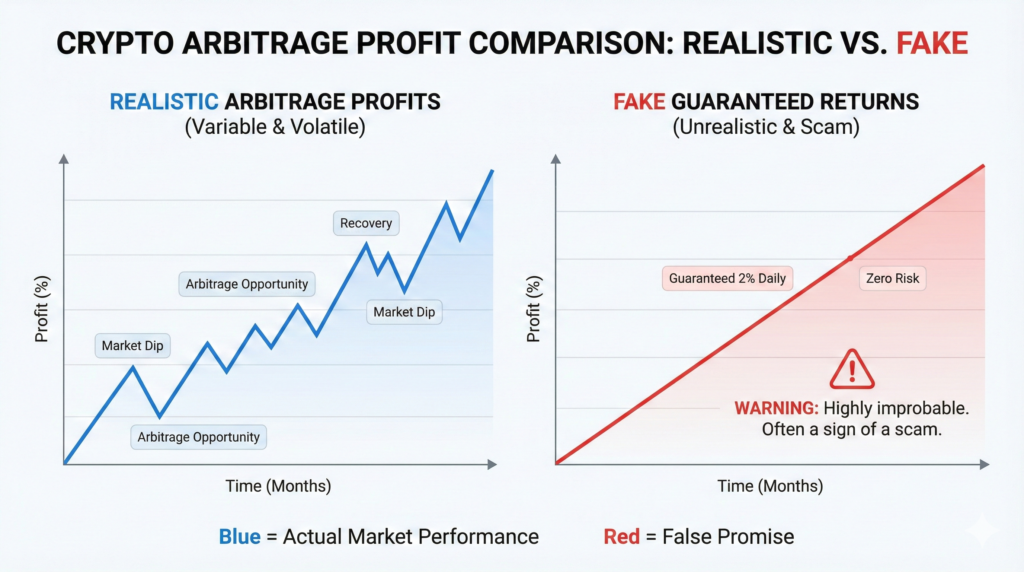
This is the single most important red flag. Every legitimate investment—including real arbitrage operations—carries risk. The fundamental principle of investing is that returns correlate with risk. Higher promised returns indicate higher risk.


What Scammers Claim

Fraudulent arbitrage platforms commonly advertise:

    • “20-50% guaranteed monthly returns”

    • “60% returns in just 3 days”

    • “Risk-free trading with guaranteed profits”

    • “2% daily returns”

    • “Zero chance of losing your capital”

    • “Profits regardless of market conditions”

Why This Should Alarm You

Legitimate investment returns fluctuate based on market performance. If Bitcoin drops 10%, arbitrage opportunities may disappear entirely. (Crypto Market Update) Real traders can’t guarantee returns because markets are unpredictable. Any platform claiming guaranteed profits is either:

    1. Running a Ponzi scheme (paying early investors with new investor capital)

    2. Using a bait-and-switch tactic (showing fake profits initially)

    3. Manipulating fabricated trading data

    4. Planning to abscond with funds once they reach a target

✅ The NeuralArb Green Flag: We provide historical performance data, but we never guarantee future results. Real markets are volatile. If a platform promises you a fixed income regardless of market conditions, close the tab immediately.


Red Flag #2: Unrealistic Claims About Trade Execution Speed


Scam arbitrage bots often claim to execute profitable trades in under one minute, sometimes claiming transactions complete in seconds.


Why This Is Fraudulent

Real arbitrage, by definition, exploits temporary price discrepancies that disappear within milliseconds. Legitimate arbitrageurs use:

    • High-frequency trading infrastructure (proprietary technology costing millions)

    • Co-located servers positioned physically near exchange data centers

    • Sophisticated algorithms that detect opportunities faster than competitors

A retail investor or small platform cannot compete with these institutional advantages. Moreover, blockchain transactions themselves have confirmation times:

    • Bitcoin transactions: 10 minutes average

    • Ethereum transactions: 12-15 seconds average

A crypto arbitrage bot claiming to complete profitable trades in under a minute is operating fake simulations, not real transactions.

✅ The NeuralArb Difference: Real Tech vs. Buzzwords

There is a massive difference between “Marketing AI” and “Algorithmic Execution.”

    • Scam AI: Claims to “predict the future” and never loses.

    • Real Technology (What We Use): NeuralArb uses neural networks to analyze order book depth and latency. We don’t predict the future; we use math to calculate the probability of a price gap closing. We win some, we lose some, but our aim is a net positive over time based on data—not magic.


Red Flag #3: Unregistered Trading Platforms Operating Without Regulatory Oversight


The Registration Reality

Legitimate crypto trading platforms must register with financial regulatory bodies in the jurisdictions where they operate:

    • United States: CFTC (Commodity Futures Trading Commission) or SEC (Securities and Exchange Commission)

    • Canada: Provincial Securities Administrators and CSA (Canadian Securities Administrators)

    • United Kingdom: FCA (Financial Conduct Authority)

    • Europe: ESMA and national regulators

How to Check Registration

Before investing, verify that a platform appears on:

    1. Your country’s official list of registered crypto trading platforms

    2. Reputable exchange directories like CoinMarketCap‘s verified exchange list

    3. The regulatory body’s official website (not a look-alike site)

Critical Statistic: The majority of crypto investors who lost money to fraud invested on unregistered platforms. These platforms operate without:

    • Client asset protection requirements

    • Regular audits or compliance oversight

    • Know Your Customer (KYC) procedures

    • Anti-Money Laundering (AML) controls

    • Secure fund custody standards

    • Insurance or recovery mechanisms

✅ The Green Flag: Always check the footer of the website. A legitimate company lists its registered business name, physical address, and jurisdiction.


Red Flag #4: Complex, Opaque Investment Structures and Vague Trading Strategies


Why Opacity Signals Fraud

Legitimate investment firms are transparent about their strategies. They explain:

    • How they identify opportunities

    • What technologies they use

    • What fees they charge

    • How risk management works

    • What performance benchmarks they track

Fraudulent platforms deliberately obscure their operations using:

    • Convoluted explanations of trading strategies

    • Excessive technical jargon without substance

    • Frequent references to “proprietary algorithms” and “secret methods”

    • Refusal to provide documentation or whitepapers

    • Complex token economies that make it hard to understand fee structures

✅ The NeuralArb Green Flag: We believe in the “Glass Box” approach. Our users can view clear explanations of our strategy, and we also use open source for our Neural Bot. We don’t hide behind “proprietary secrets” when it comes to the basic mechanics of how funds are handled.


The Withdrawal Trap

Red Flag #5: Pressure to Invest More Money or Withdrawal Fees and Delays


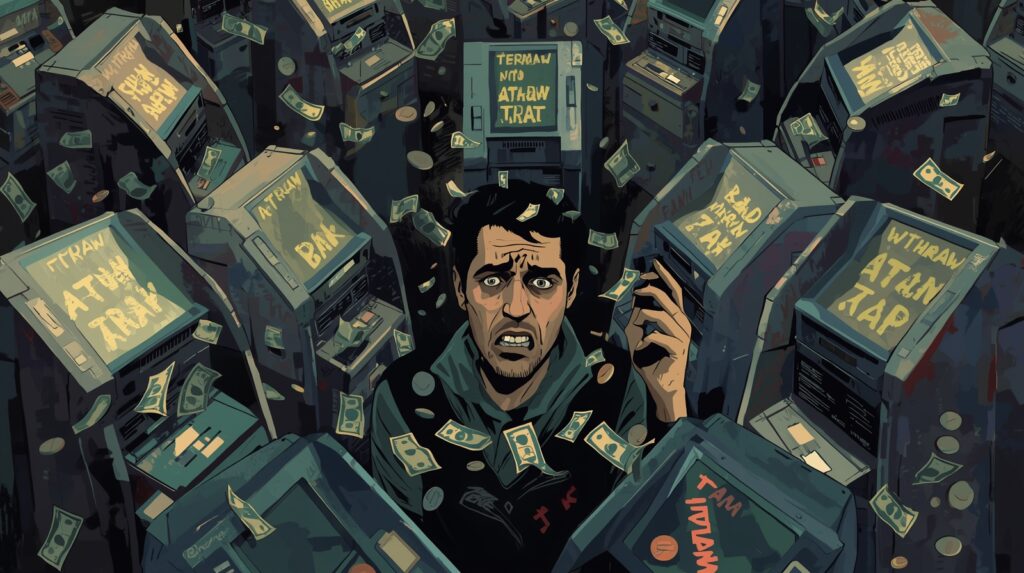
The Withdrawal Trap

This red flag often emerges after you’ve invested. The sequence typically unfolds as:

    1. Initial investment succeeds – You deposit $500 and see it appear in your account

    2. Fake profits accumulate – Your dashboard shows 20% returns after two weeks

    3. You attempt withdrawal – You request your $600 back

    4. Surprise fees emerge – You’re told you must pay a “processing fee,” “tax fee,” or “withdrawal fee” (often 10-30% of your balance)

    5. Funds disappear – You pay the fee and never receive any money back

    6. Additional demands – Support agents now claim you need to deposit more capital before accessing your original investment

Why This Indicates a Scam

Legitimate platforms don’t charge withdrawal fees that require depositing more capital. This is a classic recovery room scam tactic where victims are contacted repeatedly and pressured to invest additional money with promises of “unlocking” their original funds.

Real-World Example: In May 2025, an Australian resident lost $64,000 to exactly this tactic. He invested $500 with a company claiming investment returns, saw initial positive results, then was asked to pay increasing “fees” to withdraw profits. After several months of additional investments, he realized his funds were gone.

Warning Signs of Withdrawal Obstacles

    • Unable to reach customer support when requesting withdrawals

    • Disappearing chat functions or customer service accounts

    • Vague explanations for why withdrawals are delayed

    • Demands to complete unnecessary “verification” processes

    • Claims that you must reach a minimum balance before withdrawing

    • Requirements to purchase more of the platform’s token before accessing funds



Anonymous Teams

Red Flag #6: Anonymous or Unverifiable Team and Lack of Accountability


The Faceless Company Problem

Legitimate financial platforms have identifiable teams with verifiable credentials. You can typically find:

    • Named executives with LinkedIn profiles

    • Team members’ backgrounds and certifications

    • Company registration information

    • Physical office locations

    • Regulatory filing records

What Scam Platforms Display

Fraudulent arbitrage schemes often feature:

    • Stock photos of “team members” (sometimes stolen from other websites or AI-generated)

    • Vague team descriptions with no verifiable credentials

    • Anonymous founders hiding behind pseudonyms

    • No company registration information publicly available

    • No physical address or only a mailbox address

    • Social media accounts created recently with few followers

The Liability Problem

Anonymous teams create zero accountability. When funds disappear, there’s no one to sue, no person to hold responsible, and no legal recourse for victims.


Red Flag #7: Unsolicited Contact and High-Pressure Sales Tactics


How Scammers Find You

Fraudulent arbitrage schemes reach victims through:

    • Unsolicited social media messages (Facebook, Instagram, Telegram, WhatsApp)

    • Spam emails claiming “exclusive investment opportunities”

    • Cold phone calls from alleged “wealth managers”

    • Paid advertisements on social media platforms

    • Celebrity endorsements (often fake or unauthorized)

    • Referral schemes where friends (who are also being scammed) recommend the platform

Red Flags in the Sales Approach

High-pressure tactics include:

    • “Limited-time opportunity—offer expires in 24 hours”

    • “Other investors are getting in quickly—don’t miss out”

    • “Only $100 to start, but prices are going up”

    • “Your friend already invested—see how much they’re earning”

    • Aggressive follow-up messages after initial contact

    • Emotional manipulation (“Secure your financial future now”)

    • Requests to download applications or browser extensions

Why Unsolicited Contact Matters

Legitimate investment platforms don’t need to chase customers. They attract investors through:

    • Professional marketing and content

    • Industry recognition and awards

    • Organic referrals from satisfied customers

    • Media coverage and analyst reports

    • Regulatory approval and transparency

If a crypto investment opportunity finds you, rather than you finding it, treat this as a major warning sign.


Conclusion: Trust, but Verify


Crypto arbitrage scams exploit legitimate concepts through fraudulent execution. By understanding these seven red flags—guaranteed returns, impossible speed claims, unregistered platforms, complex structures, withdrawal obstacles, anonymous teams, and high-pressure sales tactics—you significantly reduce your risk of financial loss.


Remember: If an investment opportunity sounds too good to be true, it is. Legitimate arbitrage operations have slim margins and unpredictable returns. Platforms promising consistent, high, guaranteed returns are not operating arbitrage strategies; they’re operating fraud schemes.


If you are looking for an automated solution, look for the Green Flags:

    1. Realistic Returns: No “get rich quick” promises.

    2. Verifiable Data: Proof of trade logic.

    3. Human Support: Real teams you can contact.

Ready to see what legitimate data analysis looks like? At NeuralArB, we are building the future of transparent algorithmic trading!


Disclaimer

This article is for educational and informational purposes only and is not investment advice or a recommendation to buy, sell, or hold any cryptoasset. Past performance does not guarantee future results. Cryptocurrency and crypto asset trading carry substantial risk of loss. Never invest money you cannot afford to lose. Conduct your own due diligence and consult with a qualified financial advisor before making investment decisions. Regulatory frameworks vary by jurisdiction, and crypto asset trading may be restricted or prohibited in your location.
Zhen Patel

Chief Legal Officer at NeuralArB. Web3-native legal strategist. Zhen blends traditional compliance expertise with cutting-edge AI/blockchain frameworks. Ex-regulatory counsel, now steering NeuralArB through the evolving global landscape of digital assets, DeFi law, and AI governance. Passionate about decentralized systems with real-world legal resilience.

How to Spot a Crypto Arbitrage Scam: 7 Red Flags to Watch For

Crypto Arbitrage Scam: 7 Red Flags to Watch For


Introduction


The cryptocurrency market attracts millions of investors annually, but alongside legitimate opportunities lies a growing epidemic of fraudulent schemes designed to drain your funds. Among the most deceptive are crypto arbitrage scams—fraudulent platforms that exploit the complexity of the market to convince unsuspecting investors they can generate quick, risk-free profits.


At NeuralArb, we believe that education is the best defense. Because we utilize legitimate data analysis for our own trading execution, we know exactly how difficult real arbitrage is—and why the “get rich quick” promises you see elsewhere are mathematically impossible.


Whether you are exploring NeuralArb or vetting another platform, this guide will arm you with the 7 critical red flags to spot a scam before you deposit a single cent.


What is Cryptocurrency Arbitrage? (The Reality Check)


Before examining the red flags, it’s important to understand the difference between the “magic” scammers promise and the “math” that legitimate traders use.


Legitimate Arbitrage Explained

Arbitrage is a trading strategy based on exploiting price discrepancies of the same asset across different markets. For example, if Bitcoin trades at $45,000 on Exchange A and $45,500 on Exchange B, an arbitrageur buys on A and sells on B, capturing the difference. (Crypto Arbitrage 101)


However, in the real world, these opportunities are:

    • Rare: They often last only milliseconds.

    • Small Margin: Real profits are typically 0.5% – 2% per trade (not 50%).

    • Competitive: They require high-speed algorithmic execution, not “magic.”

Real Arbitrage vs. Scam Arbitrage

Use this checklist to immediately verify if a platform is telling the truth:


FeatureLegitimate Arbitrage (e.g., NeuralArb)Scam Arbitrage
Returns0.5-2% per opportunity (unpredictable)20-50%+ “Guaranteed” monthly
StrategyMathematical probability & speed“Secret” or “Magic” AI
TransparencyAudit logs & verifiable historyBlack box (no proof of trade)
WithdrawalsImmediate (minus network gas fees)Delayed + “Tax/Unlock Fees”
TeamVerifiable humansAnonymous or Fake Stock Photos
Free vs Paid Arbitrage Bots


The 7 Red Flags


Red Flag #1: Promises of Guaranteed High Returns


This is the single most important red flag. Every legitimate investment—including real arbitrage operations—carries risk. The fundamental principle of investing is that returns correlate with risk. Higher promised returns indicate higher risk.


What Scammers Claim

Fraudulent arbitrage platforms commonly advertise:

    • “20-50% guaranteed monthly returns”

    • “60% returns in just 3 days”

    • “Risk-free trading with guaranteed profits”

    • “2% daily returns”

    • “Zero chance of losing your capital”

    • “Profits regardless of market conditions”

Why This Should Alarm You

Legitimate investment returns fluctuate based on market performance. If Bitcoin drops 10%, arbitrage opportunities may disappear entirely. (Crypto Market Update) Real traders can’t guarantee returns because markets are unpredictable. Any platform claiming guaranteed profits is either:

    1. Running a Ponzi scheme (paying early investors with new investor capital)

    2. Using a bait-and-switch tactic (showing fake profits initially)

    3. Manipulating fabricated trading data

    4. Planning to abscond with funds once they reach a target

✅ The NeuralArb Green Flag: We provide historical performance data, but we never guarantee future results. Real markets are volatile. If a platform promises you a fixed income regardless of market conditions, close the tab immediately.


Red Flag #2: Unrealistic Claims About Trade Execution Speed


Scam arbitrage bots often claim to execute profitable trades in under one minute, sometimes claiming transactions complete in seconds.


Why This Is Fraudulent

Real arbitrage, by definition, exploits temporary price discrepancies that disappear within milliseconds. Legitimate arbitrageurs use:

    • High-frequency trading infrastructure (proprietary technology costing millions)

    • Co-located servers positioned physically near exchange data centers

    • Sophisticated algorithms that detect opportunities faster than competitors

A retail investor or small platform cannot compete with these institutional advantages. Moreover, blockchain transactions themselves have confirmation times:

    • Bitcoin transactions: 10 minutes average

    • Ethereum transactions: 12-15 seconds average

A crypto arbitrage bot claiming to complete profitable trades in under a minute is operating fake simulations, not real transactions.

✅ The NeuralArb Difference: Real Tech vs. Buzzwords

There is a massive difference between “Marketing AI” and “Algorithmic Execution.”

    • Scam AI: Claims to “predict the future” and never loses.

    • Real Technology (What We Use): NeuralArb uses neural networks to analyze order book depth and latency. We don’t predict the future; we use math to calculate the probability of a price gap closing. We win some, we lose some, but our aim is a net positive over time based on data—not magic.


Red Flag #3: Unregistered Trading Platforms Operating Without Regulatory Oversight


The Registration Reality

Legitimate crypto trading platforms must register with financial regulatory bodies in the jurisdictions where they operate:

    • United States: CFTC (Commodity Futures Trading Commission) or SEC (Securities and Exchange Commission)

    • Canada: Provincial Securities Administrators and CSA (Canadian Securities Administrators)

    • United Kingdom: FCA (Financial Conduct Authority)

    • Europe: ESMA and national regulators

How to Check Registration

Before investing, verify that a platform appears on:

    1. Your country’s official list of registered crypto trading platforms

    2. Reputable exchange directories like CoinMarketCap‘s verified exchange list

    3. The regulatory body’s official website (not a look-alike site)

Critical Statistic: The majority of crypto investors who lost money to fraud invested on unregistered platforms. These platforms operate without:

    • Client asset protection requirements

    • Regular audits or compliance oversight

    • Know Your Customer (KYC) procedures

    • Anti-Money Laundering (AML) controls

    • Secure fund custody standards

    • Insurance or recovery mechanisms

✅ The Green Flag: Always check the footer of the website. A legitimate company lists its registered business name, physical address, and jurisdiction.


Red Flag #4: Complex, Opaque Investment Structures and Vague Trading Strategies


Why Opacity Signals Fraud

Legitimate investment firms are transparent about their strategies. They explain:

    • How they identify opportunities

    • What technologies they use

    • What fees they charge

    • How risk management works

    • What performance benchmarks they track

Fraudulent platforms deliberately obscure their operations using:

    • Convoluted explanations of trading strategies

    • Excessive technical jargon without substance

    • Frequent references to “proprietary algorithms” and “secret methods”

    • Refusal to provide documentation or whitepapers

    • Complex token economies that make it hard to understand fee structures

✅ The NeuralArb Green Flag: We believe in the “Glass Box” approach. Our users can view clear explanations of our strategy, and we also use open source for our Neural Bot. We don’t hide behind “proprietary secrets” when it comes to the basic mechanics of how funds are handled.


The Withdrawal Trap

Red Flag #5: Pressure to Invest More Money or Withdrawal Fees and Delays


The Withdrawal Trap

This red flag often emerges after you’ve invested. The sequence typically unfolds as:

    1. Initial investment succeeds – You deposit $500 and see it appear in your account

    2. Fake profits accumulate – Your dashboard shows 20% returns after two weeks

    3. You attempt withdrawal – You request your $600 back

    4. Surprise fees emerge – You’re told you must pay a “processing fee,” “tax fee,” or “withdrawal fee” (often 10-30% of your balance)

    5. Funds disappear – You pay the fee and never receive any money back

    6. Additional demands – Support agents now claim you need to deposit more capital before accessing your original investment

Why This Indicates a Scam

Legitimate platforms don’t charge withdrawal fees that require depositing more capital. This is a classic recovery room scam tactic where victims are contacted repeatedly and pressured to invest additional money with promises of “unlocking” their original funds.

Real-World Example: In May 2025, an Australian resident lost $64,000 to exactly this tactic. He invested $500 with a company claiming investment returns, saw initial positive results, then was asked to pay increasing “fees” to withdraw profits. After several months of additional investments, he realized his funds were gone.

Warning Signs of Withdrawal Obstacles

    • Unable to reach customer support when requesting withdrawals

    • Disappearing chat functions or customer service accounts

    • Vague explanations for why withdrawals are delayed

    • Demands to complete unnecessary “verification” processes

    • Claims that you must reach a minimum balance before withdrawing

    • Requirements to purchase more of the platform’s token before accessing funds


Anonymous Teams

Red Flag #6: Anonymous or Unverifiable Team and Lack of Accountability


The Faceless Company Problem

Legitimate financial platforms have identifiable teams with verifiable credentials. You can typically find:

    • Named executives with LinkedIn profiles

    • Team members’ backgrounds and certifications

    • Company registration information

    • Physical office locations

    • Regulatory filing records

What Scam Platforms Display

Fraudulent arbitrage schemes often feature:

    • Stock photos of “team members” (sometimes stolen from other websites or AI-generated)

    • Vague team descriptions with no verifiable credentials

    • Anonymous founders hiding behind pseudonyms

    • No company registration information publicly available

    • No physical address or only a mailbox address

    • Social media accounts created recently with few followers

The Liability Problem

Anonymous teams create zero accountability. When funds disappear, there’s no one to sue, no person to hold responsible, and no legal recourse for victims.


Red Flag #7: Unsolicited Contact and High-Pressure Sales Tactics


How Scammers Find You

Fraudulent arbitrage schemes reach victims through:

    • Unsolicited social media messages (Facebook, Instagram, Telegram, WhatsApp)

    • Spam emails claiming “exclusive investment opportunities”

    • Cold phone calls from alleged “wealth managers”

    • Paid advertisements on social media platforms

    • Celebrity endorsements (often fake or unauthorized)

    • Referral schemes where friends (who are also being scammed) recommend the platform

Red Flags in the Sales Approach

High-pressure tactics include:

    • “Limited-time opportunity—offer expires in 24 hours”

    • “Other investors are getting in quickly—don’t miss out”

    • “Only $100 to start, but prices are going up”

    • “Your friend already invested—see how much they’re earning”

    • Aggressive follow-up messages after initial contact

    • Emotional manipulation (“Secure your financial future now”)

    • Requests to download applications or browser extensions

Why Unsolicited Contact Matters

Legitimate investment platforms don’t need to chase customers. They attract investors through:

    • Professional marketing and content

    • Industry recognition and awards

    • Organic referrals from satisfied customers

    • Media coverage and analyst reports

    • Regulatory approval and transparency

If a crypto investment opportunity finds you, rather than you finding it, treat this as a major warning sign.


Conclusion: Trust, but Verify


Crypto arbitrage scams exploit legitimate concepts through fraudulent execution. By understanding these seven red flags—guaranteed returns, impossible speed claims, unregistered platforms, complex structures, withdrawal obstacles, anonymous teams, and high-pressure sales tactics—you significantly reduce your risk of financial loss.


Remember: If an investment opportunity sounds too good to be true, it is. Legitimate arbitrage operations have slim margins and unpredictable returns. Platforms promising consistent, high, guaranteed returns are not operating arbitrage strategies; they’re operating fraud schemes.


If you are looking for an automated solution, look for the Green Flags:

    1. Realistic Returns: No “get rich quick” promises.

    2. Verifiable Data: Proof of trade logic.

    3. Human Support: Real teams you can contact.

Ready to see what legitimate data analysis looks like? At NeuralArB, we are building the future of transparent algorithmic trading!


Disclaimer

This article is for educational and informational purposes only and is not investment advice or a recommendation to buy, sell, or hold any cryptoasset. Past performance does not guarantee future results. Cryptocurrency and crypto asset trading carry substantial risk of loss. Never invest money you cannot afford to lose. Conduct your own due diligence and consult with a qualified financial advisor before making investment decisions. Regulatory frameworks vary by jurisdiction, and crypto asset trading may be restricted or prohibited in your location.

Zhen Patel

Chief Legal Officer at NeuralArB. Web3-native legal strategist. Zhen blends traditional compliance expertise with cutting-edge AI/blockchain frameworks. Ex-regulatory counsel, now steering NeuralArB through the evolving global landscape of digital assets, DeFi law, and AI governance. Passionate about decentralized systems with real-world legal resilience.

How to Spot a Crypto Arbitrage Scam: 7 Red Flags to Watch For

Crypto Arbitrage Scam: 7 Red Flags to Watch For


Introduction


The cryptocurrency market attracts millions of investors annually, but alongside legitimate opportunities lies a growing epidemic of fraudulent schemes designed to drain your funds. Among the most deceptive are crypto arbitrage scams—fraudulent platforms that exploit the complexity of the market to convince unsuspecting investors they can generate quick, risk-free profits.


At NeuralArb, we believe that education is the best defense. Because we utilize legitimate data analysis for our own trading execution, we know exactly how difficult real arbitrage is—and why the “get rich quick” promises you see elsewhere are mathematically impossible.


Whether you are exploring NeuralArb or vetting another platform, this guide will arm you with the 7 critical red flags to spot a scam before you deposit a single cent.


What is Cryptocurrency Arbitrage? (The Reality Check)


Before examining the red flags, it’s important to understand the difference between the “magic” scammers promise and the “math” that legitimate traders use.


Legitimate Arbitrage Explained

Arbitrage is a trading strategy based on exploiting price discrepancies of the same asset across different markets. For example, if Bitcoin trades at $45,000 on Exchange A and $45,500 on Exchange B, an arbitrageur buys on A and sells on B, capturing the difference. (Crypto Arbitrage 101)


However, in the real world, these opportunities are:

    • Rare: They often last only milliseconds.

    • Small Margin: Real profits are typically 0.5% – 2% per trade (not 50%).

    • Competitive: They require high-speed algorithmic execution, not “magic.”

Real Arbitrage vs. Scam Arbitrage

Use this checklist to immediately verify if a platform is telling the truth:


FeatureLegitimate Arbitrage (e.g., NeuralArb)Scam Arbitrage
Returns0.5-2% per opportunity (unpredictable)20-50%+ “Guaranteed” monthly
StrategyMathematical probability & speed“Secret” or “Magic” AI
TransparencyAudit logs & verifiable historyBlack box (no proof of trade)
WithdrawalsImmediate (minus network gas fees)Delayed + “Tax/Unlock Fees”
TeamVerifiable humansAnonymous or Fake Stock Photos
Free vs Paid Arbitrage Bots


The 7 Red Flags


Red Flag #1: Promises of Guaranteed High Returns


This is the single most important red flag. Every legitimate investment—including real arbitrage operations—carries risk. The fundamental principle of investing is that returns correlate with risk. Higher promised returns indicate higher risk.


What Scammers Claim

Fraudulent arbitrage platforms commonly advertise:

    • “20-50% guaranteed monthly returns”

    • “60% returns in just 3 days”

    • “Risk-free trading with guaranteed profits”

    • “2% daily returns”

    • “Zero chance of losing your capital”

    • “Profits regardless of market conditions”

Why This Should Alarm You

Legitimate investment returns fluctuate based on market performance. If Bitcoin drops 10%, arbitrage opportunities may disappear entirely. (Crypto Market Update) Real traders can’t guarantee returns because markets are unpredictable. Any platform claiming guaranteed profits is either:

    1. Running a Ponzi scheme (paying early investors with new investor capital)

    2. Using a bait-and-switch tactic (showing fake profits initially)

    3. Manipulating fabricated trading data

    4. Planning to abscond with funds once they reach a target

✅ The NeuralArb Green Flag: We provide historical performance data, but we never guarantee future results. Real markets are volatile. If a platform promises you a fixed income regardless of market conditions, close the tab immediately.


Red Flag #2: Unrealistic Claims About Trade Execution Speed


Scam arbitrage bots often claim to execute profitable trades in under one minute, sometimes claiming transactions complete in seconds.


Why This Is Fraudulent

Real arbitrage, by definition, exploits temporary price discrepancies that disappear within milliseconds. Legitimate arbitrageurs use:

    • High-frequency trading infrastructure (proprietary technology costing millions)

    • Co-located servers positioned physically near exchange data centers

    • Sophisticated algorithms that detect opportunities faster than competitors

A retail investor or small platform cannot compete with these institutional advantages. Moreover, blockchain transactions themselves have confirmation times:

    • Bitcoin transactions: 10 minutes average

    • Ethereum transactions: 12-15 seconds average

A crypto arbitrage bot claiming to complete profitable trades in under a minute is operating fake simulations, not real transactions.

✅ The NeuralArb Difference: Real Tech vs. Buzzwords

There is a massive difference between “Marketing AI” and “Algorithmic Execution.”

    • Scam AI: Claims to “predict the future” and never loses.

    • Real Technology (What We Use): NeuralArb uses neural networks to analyze order book depth and latency. We don’t predict the future; we use math to calculate the probability of a price gap closing. We win some, we lose some, but our aim is a net positive over time based on data—not magic.


Red Flag #3: Unregistered Trading Platforms Operating Without Regulatory Oversight


The Registration Reality

Legitimate crypto trading platforms must register with financial regulatory bodies in the jurisdictions where they operate:

    • United States: CFTC (Commodity Futures Trading Commission) or SEC (Securities and Exchange Commission)

    • Canada: Provincial Securities Administrators and CSA (Canadian Securities Administrators)

    • United Kingdom: FCA (Financial Conduct Authority)

    • Europe: ESMA and national regulators

How to Check Registration

Before investing, verify that a platform appears on:

    1. Your country’s official list of registered crypto trading platforms

    2. Reputable exchange directories like CoinMarketCap‘s verified exchange list

    3. The regulatory body’s official website (not a look-alike site)

Critical Statistic: The majority of crypto investors who lost money to fraud invested on unregistered platforms. These platforms operate without:

    • Client asset protection requirements

    • Regular audits or compliance oversight

    • Know Your Customer (KYC) procedures

    • Anti-Money Laundering (AML) controls

    • Secure fund custody standards

    • Insurance or recovery mechanisms

✅ The Green Flag: Always check the footer of the website. A legitimate company lists its registered business name, physical address, and jurisdiction.


Red Flag #4: Complex, Opaque Investment Structures and Vague Trading Strategies


Why Opacity Signals Fraud

Legitimate investment firms are transparent about their strategies. They explain:

    • How they identify opportunities

    • What technologies they use

    • What fees they charge

    • How risk management works

    • What performance benchmarks they track

Fraudulent platforms deliberately obscure their operations using:

    • Convoluted explanations of trading strategies

    • Excessive technical jargon without substance

    • Frequent references to “proprietary algorithms” and “secret methods”

    • Refusal to provide documentation or whitepapers

    • Complex token economies that make it hard to understand fee structures

✅ The NeuralArb Green Flag: We believe in the “Glass Box” approach. Our users can view clear explanations of our strategy, and we also use open source for our Neural Bot. We don’t hide behind “proprietary secrets” when it comes to the basic mechanics of how funds are handled.


The Withdrawal Trap

Red Flag #5: Pressure to Invest More Money or Withdrawal Fees and Delays


The Withdrawal Trap

This red flag often emerges after you’ve invested. The sequence typically unfolds as:

    1. Initial investment succeeds – You deposit $500 and see it appear in your account

    2. Fake profits accumulate – Your dashboard shows 20% returns after two weeks

    3. You attempt withdrawal – You request your $600 back

    4. Surprise fees emerge – You’re told you must pay a “processing fee,” “tax fee,” or “withdrawal fee” (often 10-30% of your balance)

    5. Funds disappear – You pay the fee and never receive any money back

    6. Additional demands – Support agents now claim you need to deposit more capital before accessing your original investment

Why This Indicates a Scam

Legitimate platforms don’t charge withdrawal fees that require depositing more capital. This is a classic recovery room scam tactic where victims are contacted repeatedly and pressured to invest additional money with promises of “unlocking” their original funds.

Real-World Example: In May 2025, an Australian resident lost $64,000 to exactly this tactic. He invested $500 with a company claiming investment returns, saw initial positive results, then was asked to pay increasing “fees” to withdraw profits. After several months of additional investments, he realized his funds were gone.

Warning Signs of Withdrawal Obstacles

    • Unable to reach customer support when requesting withdrawals

    • Disappearing chat functions or customer service accounts

    • Vague explanations for why withdrawals are delayed

    • Demands to complete unnecessary “verification” processes

    • Claims that you must reach a minimum balance before withdrawing

    • Requirements to purchase more of the platform’s token before accessing funds


Anonymous Teams

Red Flag #6: Anonymous or Unverifiable Team and Lack of Accountability


The Faceless Company Problem

Legitimate financial platforms have identifiable teams with verifiable credentials. You can typically find:

    • Named executives with LinkedIn profiles

    • Team members’ backgrounds and certifications

    • Company registration information

    • Physical office locations

    • Regulatory filing records

What Scam Platforms Display

Fraudulent arbitrage schemes often feature:

    • Stock photos of “team members” (sometimes stolen from other websites or AI-generated)

    • Vague team descriptions with no verifiable credentials

    • Anonymous founders hiding behind pseudonyms

    • No company registration information publicly available

    • No physical address or only a mailbox address

    • Social media accounts created recently with few followers

The Liability Problem

Anonymous teams create zero accountability. When funds disappear, there’s no one to sue, no person to hold responsible, and no legal recourse for victims.


Red Flag #7: Unsolicited Contact and High-Pressure Sales Tactics


How Scammers Find You

Fraudulent arbitrage schemes reach victims through:

    • Unsolicited social media messages (Facebook, Instagram, Telegram, WhatsApp)

    • Spam emails claiming “exclusive investment opportunities”

    • Cold phone calls from alleged “wealth managers”

    • Paid advertisements on social media platforms

    • Celebrity endorsements (often fake or unauthorized)

    • Referral schemes where friends (who are also being scammed) recommend the platform

Red Flags in the Sales Approach

High-pressure tactics include:

    • “Limited-time opportunity—offer expires in 24 hours”

    • “Other investors are getting in quickly—don’t miss out”

    • “Only $100 to start, but prices are going up”

    • “Your friend already invested—see how much they’re earning”

    • Aggressive follow-up messages after initial contact

    • Emotional manipulation (“Secure your financial future now”)

    • Requests to download applications or browser extensions

Why Unsolicited Contact Matters

Legitimate investment platforms don’t need to chase customers. They attract investors through:

    • Professional marketing and content

    • Industry recognition and awards

    • Organic referrals from satisfied customers

    • Media coverage and analyst reports

    • Regulatory approval and transparency

If a crypto investment opportunity finds you, rather than you finding it, treat this as a major warning sign.


Conclusion: Trust, but Verify


Crypto arbitrage scams exploit legitimate concepts through fraudulent execution. By understanding these seven red flags—guaranteed returns, impossible speed claims, unregistered platforms, complex structures, withdrawal obstacles, anonymous teams, and high-pressure sales tactics—you significantly reduce your risk of financial loss.


Remember: If an investment opportunity sounds too good to be true, it is. Legitimate arbitrage operations have slim margins and unpredictable returns. Platforms promising consistent, high, guaranteed returns are not operating arbitrage strategies; they’re operating fraud schemes.


If you are looking for an automated solution, look for the Green Flags:

    1. Realistic Returns: No “get rich quick” promises.

    2. Verifiable Data: Proof of trade logic.

    3. Human Support: Real teams you can contact.

Ready to see what legitimate data analysis looks like? At NeuralArB, we are building the future of transparent algorithmic trading!


Disclaimer

This article is for educational and informational purposes only and is not investment advice or a recommendation to buy, sell, or hold any cryptoasset. Past performance does not guarantee future results. Cryptocurrency and crypto asset trading carry substantial risk of loss. Never invest money you cannot afford to lose. Conduct your own due diligence and consult with a qualified financial advisor before making investment decisions. Regulatory frameworks vary by jurisdiction, and crypto asset trading may be restricted or prohibited in your location.

Zhen Patel

Chief Legal Officer at NeuralArB. Web3-native legal strategist. Zhen blends traditional compliance expertise with cutting-edge AI/blockchain frameworks. Ex-regulatory counsel, now steering NeuralArB through the evolving global landscape of digital assets, DeFi law, and AI governance. Passionate about decentralized systems with real-world legal resilience.

Still have questions, contact us:

© 2026 NAB CONSULTANCY LTD. All right reserved.

These materials are for general information purposes only and are not investment advice or a recommendation or solicitation to buy, sell or hold any cryptoasset or to engage in any specific trading strategy. Some crypto products and markets are unregulated, and you may not be protected by government compensation and/or regulatory protection schemes. The unpredictable nature of the cryptoasset markets can lead to loss of funds. Tax may be payable on any return and/or on any increase in the value of your cryptoassets and you should seek independent advice on your taxation position.

All trademarks, logos, and brand names are the property of their respective owners. All company, product, and service names used in this website are for identification purposes only. Use of these names, trademarks, and brands does not imply endorsement.

NAB does not provide investment or brokerage services. All cryptocurrency spot, margin, and futures products are offered by third-party platforms. Products and services availability varies by country.

Past performance, whether actual or indicated by historical or simulated tests of strategies, is no guarantee of future performance or success. There is a possibility that you may sustain a loss equal to or greater than your entire investment regardless of which asset class you trade (i.e. cryptocurrency); therefore, you should not invest or risk money that you cannot afford to lose. Online trading is not suitable for all investors. Before trading any asset class, customers should review NFA and CFTC advisories, and other relevant disclosures. System access, trade placement, and execution may be delayed or fail due to market volatility and volume, quote delays, system and software errors, Internet traffic, outages and other unforeseen factors.

Still have questions, contact us:

© 2026 NAB CONSULTANCY LTD. All right reserved.

These materials are for general information purposes only and are not investment advice or a recommendation or solicitation to buy, sell or hold any cryptoasset or to engage in any specific trading strategy. Some crypto products and markets are unregulated, and you may not be protected by government compensation and/or regulatory protection schemes. The unpredictable nature of the cryptoasset markets can lead to loss of funds. Tax may be payable on any return and/or on any increase in the value of your cryptoassets and you should seek independent advice on your taxation position.

All trademarks, logos, and brand names are the property of their respective owners. All company, product, and service names used in this website are for identification purposes only. Use of these names, trademarks, and brands does not imply endorsement.

NAB does not provide investment or brokerage services. All cryptocurrency spot, margin, and futures products are offered by third-party platforms. Products and services availability varies by country.

Past performance, whether actual or indicated by historical or simulated tests of strategies, is no guarantee of future performance or success. There is a possibility that you may sustain a loss equal to or greater than your entire investment regardless of which asset class you trade (i.e. cryptocurrency); therefore, you should not invest or risk money that you cannot afford to lose. Online trading is not suitable for all investors. Before trading any asset class, customers should review NFA and CFTC advisories, and other relevant disclosures. System access, trade placement, and execution may be delayed or fail due to market volatility and volume, quote delays, system and software errors, Internet traffic, outages and other unforeseen factors.

Still have questions, contact us:

© 2026 NAB CONSULTANCY LTD. All right reserved.

These materials are for general information purposes only and are not investment advice or a recommendation or solicitation to buy, sell or hold any cryptoasset or to engage in any specific trading strategy. Some crypto products and markets are unregulated, and you may not be protected by government compensation and/or regulatory protection schemes. The unpredictable nature of the cryptoasset markets can lead to loss of funds. Tax may be payable on any return and/or on any increase in the value of your cryptoassets and you should seek independent advice on your taxation position.

All trademarks, logos, and brand names are the property of their respective owners. All company, product, and service names used in this website are for identification purposes only. Use of these names, trademarks, and brands does not imply endorsement.

NAB does not provide investment or brokerage services. All cryptocurrency spot, margin, and futures products are offered by third-party platforms. Products and services availability varies by country.

Past performance, whether actual or indicated by historical or simulated tests of strategies, is no guarantee of future performance or success. There is a possibility that you may sustain a loss equal to or greater than your entire investment regardless of which asset class you trade (i.e. cryptocurrency); therefore, you should not invest or risk money that you cannot afford to lose. Online trading is not suitable for all investors. Before trading any asset class, customers should review NFA and CFTC advisories, and other relevant disclosures. System access, trade placement, and execution may be delayed or fail due to market volatility and volume, quote delays, system and software errors, Internet traffic, outages and other unforeseen factors.

btc address
bc1ql27m5pygdxpmnvjzkamaj88mwphwl8q6n9n06l

Only use this insured address for BTC on the Bitcoin network. Do not send Ordinals. Lost funds cannot be recovered.