

📌 TL;DR — Key Takeaways for the Week
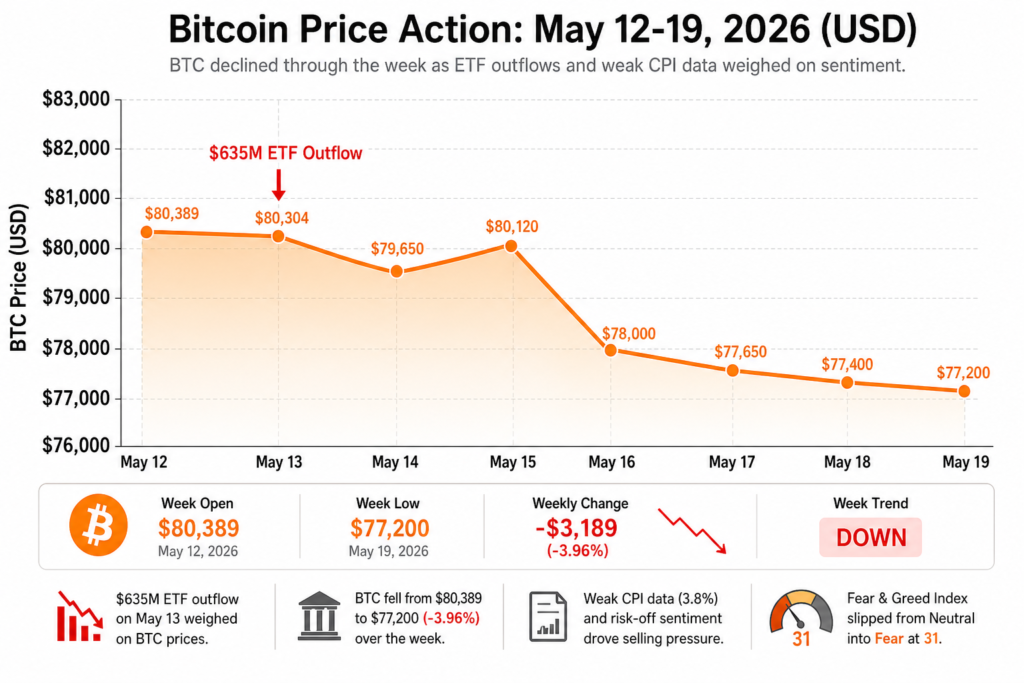
- Bitcoin (BTC): Fell from $80,389 → $77,200 (-3.97%), breaking below the $78K psychological support on May 16.
- Ethereum (ETH): Down -5.3% to $2,215, underperforming BTC as L2 activity cooled.
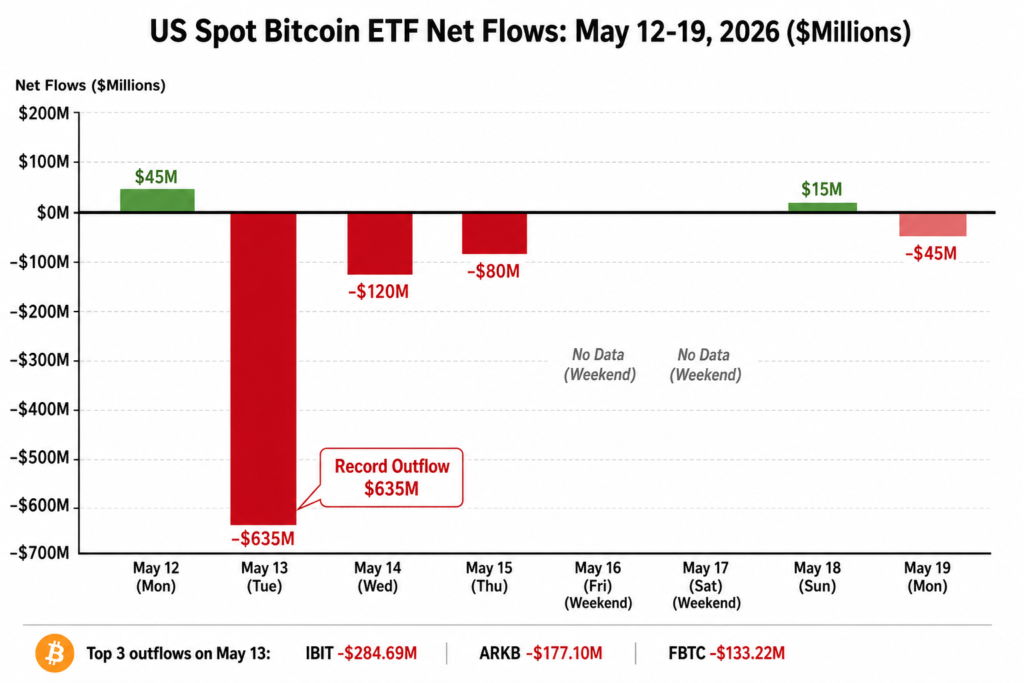
- ETF Outflows: A record $635.23M single-day exit on May 13 — largest since January 2026.
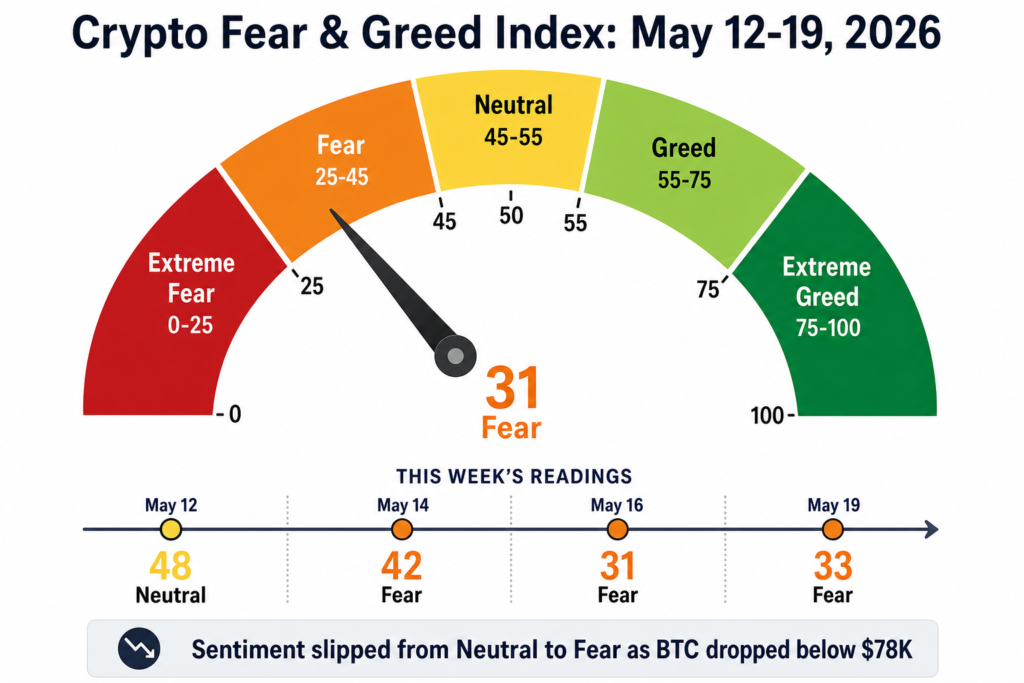
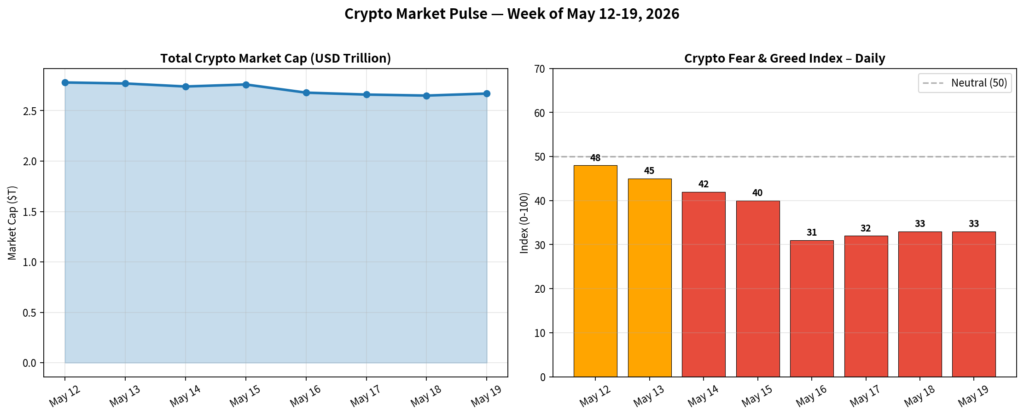
- Sentiment: Fear & Greed Index dropped from 48 (Neutral) → 31 (Fear).
- Macro Drivers: April CPI hit 3.8% (highest since Sept 2023); Iran ceasefire on “life support.”
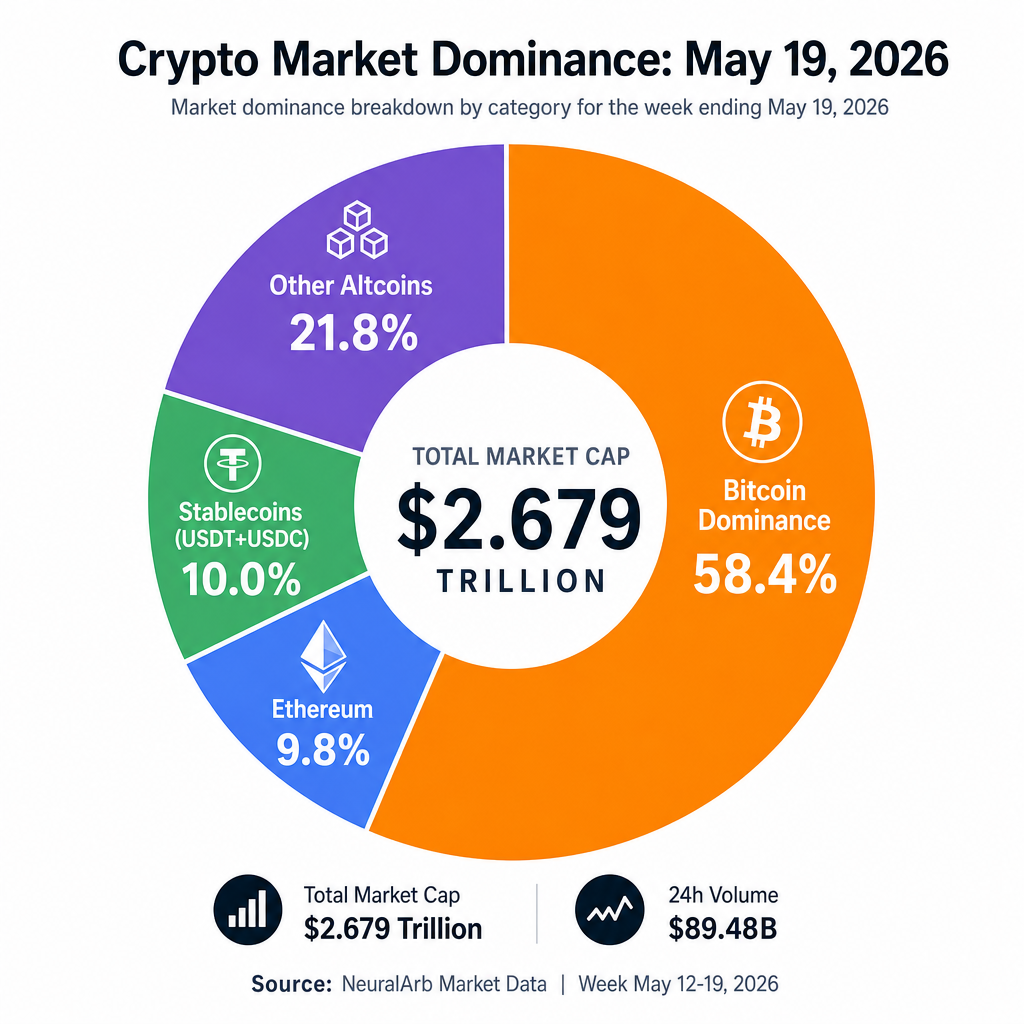
- BTC Dominance: Rose to 58.4% as altcoins underperformed.
- Total Market Cap: Contracted from $2.78T → $2.67T.
1. Weekly Market Overview
The week of May 12 to May 19, 2026 was a sobering reminder that crypto markets remain tightly correlated with macro liquidity conditions. After a strong April that delivered over $2 billion in spot Bitcoin ETF inflows, the first half of May turned decisively risk-off. Bitcoin started the week at $80,389 on May 12 — already down 0.5% from Monday’s open — and never reclaimed those levels.
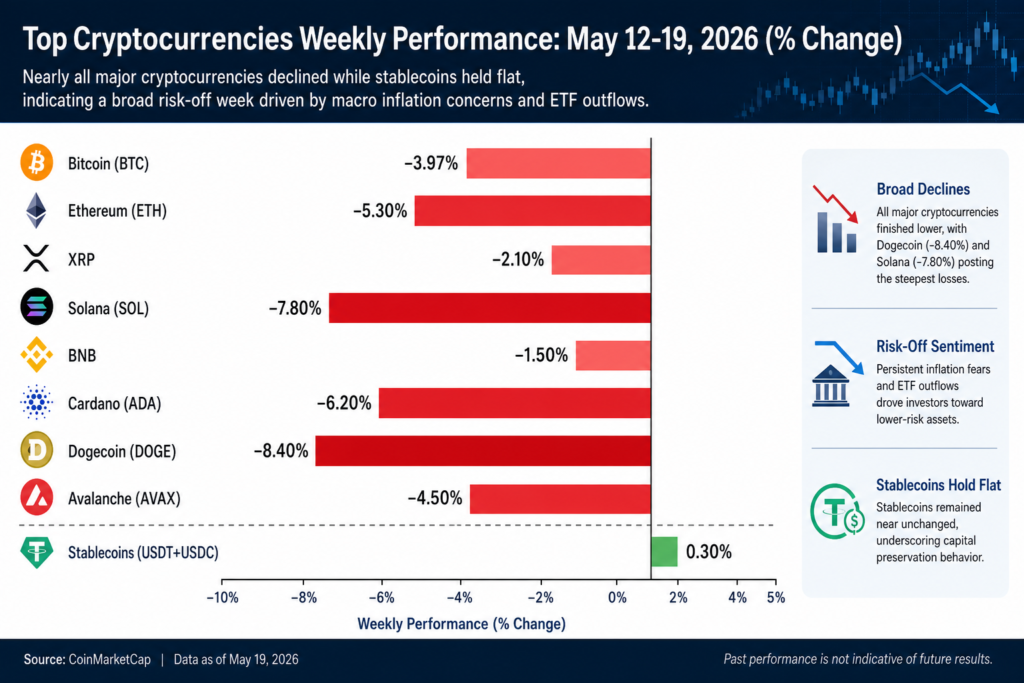
By Friday, May 19, BTC had slid to $77,200, an intraweek decline of nearly 4%. Ethereum fared worse at -5.3%, while higher-beta names like Solana (-7.72%) and Dogecoin (-8.52%) led the downside. The catalyst cocktail was unmistakable: a hot April CPI print, deteriorating geopolitics around the Iran ceasefire, and a sharp pullback in institutional ETF demand.
2. Bitcoin (BTC) — The Anatomy of a 4% Weekly Drop
Price Action Day by Day
Bitcoin’s correction was orderly rather than panicked. The largest single-day move came on May 16, when BTC broke below $78K for the first time in three weeks. The Yahoo Finance data showed Bitcoin down over 1% to $80,389 on May 12 after the CPI release, and by week’s end the cumulative damage was -3.97%.
Crucially, this drop occurred against a backdrop where BTC was still +2.4% over the prior week and +11.9% on a one-month basis, suggesting the week was a tactical pullback within a broader recovery — not a structural top.
Why Bitcoin Sold Off
- Hot April CPI (3.8%): The highest year-over-year reading since September 2023, driven by surging energy costs from the Iran conflict.
- PPI Spike to 6%: Producer inflation reinforced the “higher for longer” rate narrative.
- Corporate Bitcoin Buying Down 80%: Treasury buyers like MicroStrategy paused aggressive accumulation, removing a key bid.
- Sell-on-News Effect: Earlier April ETF approvals and regulatory clarity had been priced in.
3. The $635M ETF Shock — What Really Happened on May 13
The defining event of the week was unquestionably the May 13 ETF outflow. According to data tracked by SoSoValue and Bitcoin Foundation, US spot Bitcoin ETFs hemorrhaged $635.23 million in a single trading session — the worst day since late January.
The Three Funds That Drove the Outflow
| ETF | Issuer | May 13 Net Flow | % of Total Outflow |
|---|---|---|---|
| IBIT | BlackRock | -$284.69M | 44.8% |
| ARKB | ARK Invest | -$177.10M | 27.9% |
| FBTC | Fidelity | -$133.22M | 21.0% |
| Others | — | -$40.22M | 6.3% |
| Total | — | -$635.23M | 100% |
Importantly, analysts at major institutions have framed this outflow as a “healthy consolidation” rather than the start of a structural reversal. Spot Bitcoin ETFs still recorded six consecutive weeks of net inflows through May 11 — the longest streak since 2025 — and total AUM stood at $107.35 billion.
“Earlier in May, BTC ETFs showed solid inflows, and the segment attracted more than $2B in April. Current dynamics reflect a reaction to macro data, not a loss of long-term interest in bitcoin.” — Bitcoin Foundation analysis
4. Ethereum (ETH) — Quiet Underperformance
Ether opened the week at $2,339.40 on May 12 and slid to $2,215 by May 19, a weekly drop of -5.3%. Spot Ethereum ETFs added insult to injury with an additional $36.3M outflow on May 13.
The underperformance vs. Bitcoin (ETH/BTC ratio compressed roughly 1.4% over the week) reflects three structural pressures:
- L2 fee compression: Layer-2 activity continued draining transaction fees from mainnet.
- Staking yield drag: Real yields on ETH staking remained below 3% net of inflation.
- Narrative fatigue: No major catalyst between the Pectra upgrade afterglow and upcoming roadmap items.
5. Altcoin Carnage — Who Got Hit Hardest
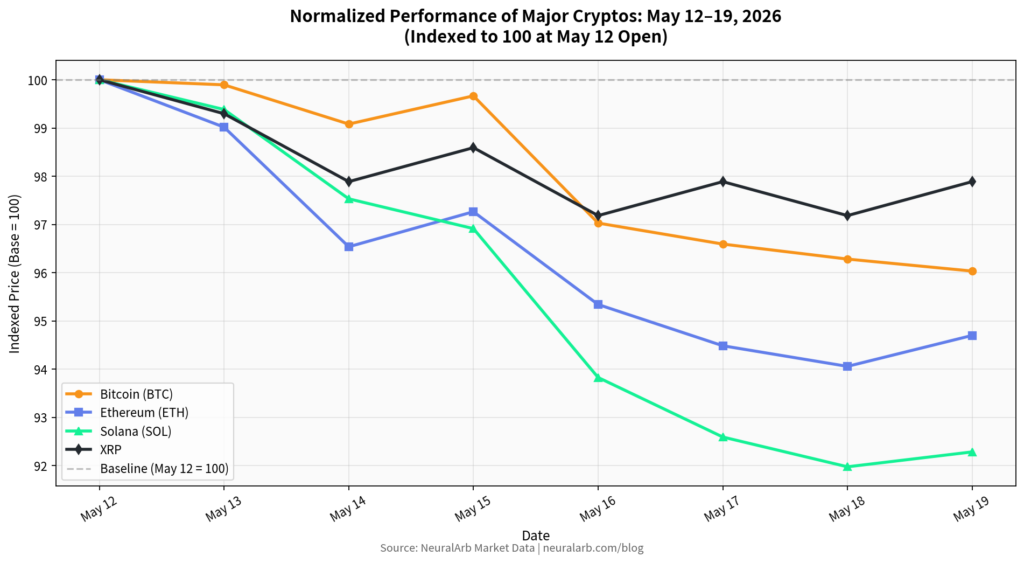
The altcoin complex absorbed most of the damage. Higher-beta names like Dogecoin (-8.52%) and Solana (-7.72%)led declines, while XRP held up surprisingly well at -2.10%, supported by continued institutional flows and progress on its regulatory front.
Normalized Performance Comparison
6. Stablecoins & Market Plumbing
The stablecoin sector continued its steady growth trajectory. According to DefiLlama data, Tether (USDT) held a market cap near $189.68B while USD Coin (USDC) was at $77.02B. The combined “Big Two” stablecoin cap of roughly $266Bprovided ample on-chain dry powder despite the price drawdown.
Total stablecoin volume during the week exceeded $580B, indicating that traders rotated into cash rather than off-ramping entirely — a constructive sign for a quick rebound if catalysts turn favorable.
7. Sentiment — The Fear & Greed Tipping Point
The Crypto Fear & Greed Index reading of 31 on May 16 marked the first sub-35 print since February 2026. Historically, sub-30 prints have preceded short-term rebounds in roughly 65% of cases over the past two years — though the indicator is not predictive in isolation.
8. Market Dominance Shift
Bitcoin dominance climbed from 57.9% to 58.4% over the week — the classic “flight to quality” within crypto during risk-off periods. Ethereum’s share dipped to 9.8%, and stablecoin dominance held near 10%, leaving the “other altcoins” bucket at roughly 21.8% of the $2.67T total market cap.
9. Regulatory Watch — Quiet Tailwinds Behind the Noise
Despite the price weakness, the regulatory backdrop continued to improve:
- SEC issued an interpretation clarifying how federal securities laws apply to crypto assets — generally viewed as constructive for compliant projects.
- The CLARITY Act advanced through Senate markup with bipartisan momentum.
- New SEC ETF disclosure guidelines signal that altcoin spot ETFs (SOL, XRP, ADA candidates) could see accelerated approval timelines.
- SEC-CFTC cooperation framework continued to mature under “Project Crypto.”
10. Macro & Geopolitical Catalysts
| Date | Event | Market Impact |
|---|---|---|
| May 12 | April CPI released: 3.8% YoY | BTC -1%, broad risk-off |
| May 13 | PPI 6%; Trump comments on Iran ceasefire | $635M ETF outflow |
| May 14-15 | Energy prices rise on Iran tension | Continued selling pressure |
| May 16 | BTC breaks $78K; F&G hits 31 | Capitulation signs |
| May 18-19 | Stabilization; CLARITY Act progress | Modest recovery attempt |
11. Downloadable Data Pack
📥 Free Data Downloads
We’ve packaged every data point referenced in this article into clean, ready-to-use spreadsheets. Feel free to use them for your own research, modeling, or backtesting:
12. Outlook — What to Watch Next Week
- $77K Support Hold: If BTC holds above $77K on a daily close basis, the consolidation thesis remains intact. A break below $75K would target the $72K April lows.
- ETF Flows Reversal: A return to net inflows by mid-week would signal institutional re-engagement.
- FOMC Minutes (May 21): Any hawkish language could extend the pullback; dovish hints would unleash a relief rally.
- Iran Ceasefire Status: A confirmed breakdown could spike oil and pressure all risk assets.
- Altcoin ETF Filings: Solana or XRP spot ETF news could trigger a sharp alt-rotation.
💬 Frequently Asked Questions (FAQ)
What was the Bitcoin price during the week of May 12–19, 2026?
- Bitcoin opened at $80,389 on May 12 and closed near $77,200 on May 19, a weekly decline of approximately 3.97%. The intraweek low was $77,400 on May 18.
Why did Bitcoin ETFs see record outflows in May 2026?
- US spot Bitcoin ETFs recorded a $635.23 million net outflow on May 13, 2026 — driven by a hot April CPI of 3.8%, a PPI jump to 6%, and an 80% slowdown in corporate Bitcoin buying. IBIT (BlackRock) led outflows at -$284.69M.
What is the current Crypto Fear and Greed Index?
- The index slipped from 48 (Neutral) on May 12 into Fear territory, reaching 31 by May 16, 2026, and stayed in the Fear zone through May 19.
Which cryptocurrency performed worst during the week?
- Dogecoin (-8.52%) was the worst major performer, followed by Solana (-7.72%) and Cardano (-6.18%). Stablecoins were the only category to remain flat.
Should I buy the dip after the May 2026 crypto correction?
- That depends on your time horizon and risk tolerance. Analysts describe the outflow as “healthy consolidation,” but persistent macro stress means volatility will likely remain elevated. This article is for education only — not financial advice.
What was the total crypto market cap this week?
- Total crypto market cap peaked at $2.78T on May 12 and contracted to $2.679T by May 16 before recovering slightly to $2.67T on May 19.
Did any regulatory news affect crypto during May 12–19, 2026?
- Yes. The SEC issued an interpretation on crypto asset securities classification, the CLARITY Act advanced in the Senate, and new SEC ETF disclosure guidelines hinted at faster altcoin ETF approvals.
How can I track NeuralArb's weekly crypto updates?
- Visit our NeuralArb Blog every Monday for the previous week’s deep-dive analysis, on-chain data, and arbitrage signals.
14. Final Word
The week of May 12–19, 2026 will be remembered as the moment institutional capital paused to digest macro reality. The fundamentals of crypto — regulatory clarity, ETF infrastructure, stablecoin liquidity, and on-chain demand — remain intact and arguably stronger than ever. What changed is the price of risk, not the long-term thesis.
At NeuralArb, we view weeks like this as signal-rich rather than fear-driven. Volatility creates dislocations; dislocations create arbitrage. Whether you’re a long-only HODLer or an active arbitrage trader, the data in this report should help you frame next week’s setups.
🤖 Want AI-powered crypto arbitrage that works 24/7?
Neural Arb’s algorithmic engine identifies and executes cross-exchange and cross-protocol arbitrage opportunities — even while you sleep.
Stay Connected:
Related Analysis:
How High-Frequency Trading (HFT) (Impacts Crypto Arbitrage)
- Reinforcement Learning in Dynamic Markets (AI trading strategies)
- Crypto Arbitrage 101 (beginner’s guide to arbitrage)
Data Sources:
- CoinGecko – Real-time price data and market cap
- Yahoo Finance – Historical price data
- CoinDesk – Liquidation data
- Reuters – Market analysis
- Binance – Upcoming catalysts
Disclaimer: This analysis is for educational purposes. Arbitrage trading involves substantial risk, including custody risk, regulatory risk, and execution risk. Past performance is not indicative of future results. Never risk capital you cannot afford to lose. Consult qualified financial and legal advisors before trading.