
Crypto Arbitrage 101: How to Trade with no Experience in 2025

Crypto Arbitrage 101: How to Trade with no Experience in 2025


Introduction: The Easiest Way to Profit from Crypto Without Predicting Prices


Imagine making money from cryptocurrency without predicting whether Bitcoin will go up or down. No chart analysis. No technical indicators. No stress about market crashes. Just pure mathematical profit from price differences that exist right now, across different exchanges.

That’s crypto arbitrage—and in 2025, it’s more accessible to beginners than ever before.


This complete guide will teach you everything you need to know to start arbitrage trading, even if you’ve never traded crypto before. By the end, you’ll understand:

✅ What arbitrage is and why it works
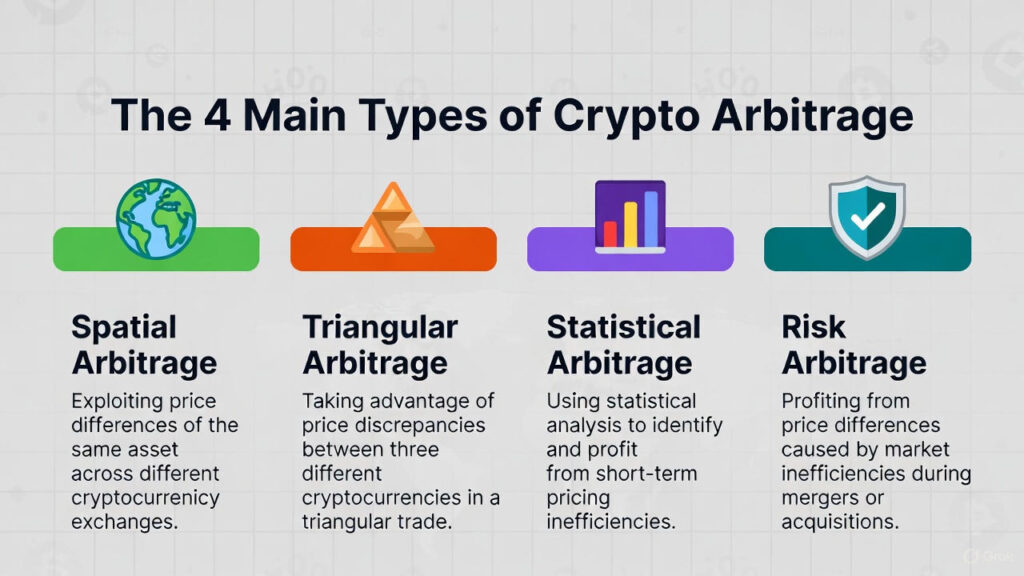
✅ The 4 main types of arbitrage strategies
✅ Step-by-step how to execute your first arbitrage trade
✅ Best tools and platforms for beginners
✅ How to avoid common mistakes that eat profits
✅ Whether bots are worth it (spoiler: yes, but not immediately)


Current Reality Check (November 2025):

    • Total crypto market cap: $3.04 trillion
    • Daily trading volume: $170+ billion
    • Number of exchanges: 500+ (creating constant price discrepancies)
    • Average arbitrage opportunity: 0.5-2% profit per trade
    • Time to execute: 15-30 minutes manually, <1 second with bots

Let’s dive in.


Part 1: What is Crypto Arbitrage? (Explained Simply)
What is Crypto Arbitrage?


The Core Concept


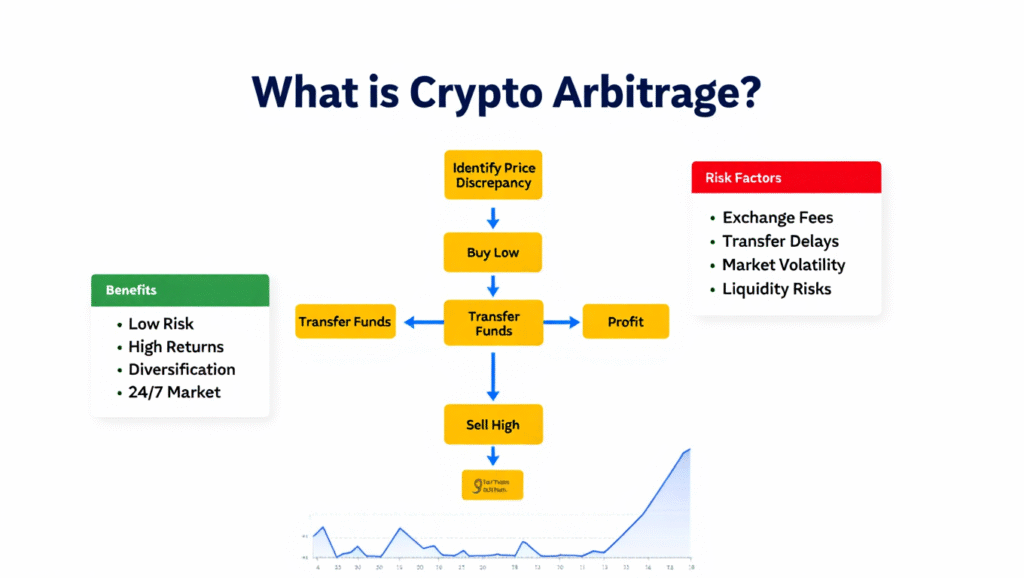
Crypto arbitrage is buying a cryptocurrency on one exchange where the price is lower, and simultaneously (or near-simultaneously) selling it on another exchange where the price is higher. The price difference is your profit.


Simple Example:

    • Bitcoin on Binance: $50,000
    • Bitcoin on Coinbase: $50,500
    • Your action: Buy 1 BTC on Binance for $50,000, sell 1 BTC on Coinbase for $50,500
    • Profit: $500 (1% gain) minus trading fees

Why Do Price Differences Exist?


You might wonder: “If everyone can see these price differences, why don’t they disappear instantly?”

Reasons for price discrepancies:

    1. Geographical differences: Exchanges in different countries have different supply/demand dynamics
    2. Liquidity variations: Some exchanges have more trading activity than others
    3. Transfer delays: Moving crypto between exchanges takes time (5-30 minutes)
    4. Trading restrictions: Not everyone has access to all exchanges
    5. Information lag: Prices update at slightly different times across platforms
    6. Market inefficiency: Crypto markets are still relatively young and inefficient
    7. Withdrawal limits: Large traders can’t always move capital fast enough

The “Too Good to Be True” Reality


Important truth: Arbitrage opportunities DO exist in 2025, but:

    • Profit margins are shrinking: From 5-10% in 2017 to 0.5-2% in 2025
    • Competition is intense: Bots execute in milliseconds; manual traders get 30-50% of opportunities
    • Fees matter hugely: A 1% opportunity can become 0.3% after 0.1% trading fees on each side plus $5 transfer fee
    • Capital requirements: Small accounts ($500-1,000) make $20-50/day; serious profit needs $10,000+

But it’s NOT dead. Here’s why 2025 is actually a GREAT time to start:

    • More exchanges = more opportunities: 500+ exchanges create constant inefficiencies
    • Automation is accessible: Beginner-friendly bots available for $50-200/month
    • Volatility creates spreads: The November 2025 crash created 1.5-2% spreads (rare!)
    • DeFi expansion: Decentralized exchanges add new arbitrage vectors
    • Educational resources: Guides like this didn’t exist in 2017


Part 2: The 4 Main Types of Crypto Arbitrage
 

The 4 Main Types of Crypto Arbitrage


1. Cross-Exchange Arbitrage (Easiest for Beginners)


What it is: Buy crypto on Exchange A, sell on Exchange B.

How it works:

    • Monitor prices across multiple exchanges simultaneously
    • When Price(Exchange B) > Price(Exchange A) + Fees, execute trade
    • Transfer crypto from A to B, or use pre-funded accounts on both

Example:

Binance: BTC = $86,500
Coinbase: BTC = $87,000
Spread: $500 (0.58%)

Buy 1 BTC on Binance: -$86,500
Sell 1 BTC on Coinbase: +$87,000
Gross profit: $500

Trading fees (0.1% each side): -$173
Transfer fees: -$15
Net profit: $312 (0.36%)

Pros:

    • Simplest to understand
    • Easy to execute manually
    • Works with any cryptocurrency

Cons:

    • Transfer time risk (price may change during transfer)
    • Requires funds on multiple exchanges
    • Withdrawal fees can be significant

Best for: Complete beginners learning the basics

Time to execute: 15-30 minutes manually

Typical profit: 0.3-1.2% per successful trade


2. Triangular Arbitrage (Single Exchange)


What it is: Trade through 3 different cryptocurrency pairs on ONE exchange to exploit price inefficiencies.

How it works: Start with BTC → Convert to ETH → Convert to USDT → Convert back to BTC

Example:

Starting: 1 BTC

1. BTC → ETH: 1 BTC = 28.5 ETH (BTC/ETH = 28.5)
2. ETH → USDT: 28.5 ETH = $85,800 (ETH/USDT = $3,010)
3. USDT → BTC: $85,800 = 1.015 BTC (BTC/USDT = $84,532)

Result: 1.015 BTC (1.5% gain before fees)
After fees (0.1% x 3 trades = 0.3%): 1.012 BTC (1.2% profit)

Why it works: The three exchange rates (BTC/ETH, ETH/USDT, BTC/USDT) occasionally become misaligned.

Pros:

    • No transfer between exchanges (instant execution)
    • No transfer fees
    • Can execute in seconds

Cons:

    • Harder to spot opportunities manually
    • Requires understanding of exchange rate math
    • Opportunities disappear quickly (10-30 seconds)
    • Less frequent than cross-exchange

Best for: Intermediate traders comfortable with multi-leg trades

Time to execute: 1-2 minutes manually, <1 second with bot

Typical profit: 0.5-1.5% per opportunity


3. CEX-DEX Arbitrage (Centralized vs Decentralized)


What it is: Exploit price differences between centralized exchanges (Binance, Coinbase) and decentralized exchanges (Uniswap, SushiSwap).

How it works:

    • DEXs often have lower liquidity → bigger price impact
    • Gas fees on Ethereum create inefficiencies
    • CEXs and DEXs price discovery happens at different speeds

Example:

Binance (CEX): ETH = $3,050
Uniswap (DEX): ETH = $3,090
Spread: $40 (1.3%)

Buy 10 ETH on Binance: $30,500
Sell 10 ETH on Uniswap: $30,900
Gross profit: $400

Trading fees: -$61
Gas fees (Ethereum): -$45
Net profit: $294 (0.96%)

Pros:

    • Often larger spreads (1-2%)
    • Less competition (many traders avoid DEXs)
    • Can combine with liquidity mining

Cons:

    • Gas fees are killer: Ethereum gas can be $10-50 per transaction
    • Requires crypto wallet knowledge
    • DEX interfaces harder for beginners
    • Slippage on large trades

Best for: Intermediate traders comfortable with wallets and DeFi

Time to execute: 5-10 minutes

Typical profit: 0.5-1.8% when opportunities arise

2025 Note: Layer-2 solutions (Arbitrum, Optimism) have much lower gas fees ($0.50-2), making this strategy more viable.


4. Statistical Arbitrage (Advanced, Algorithm-Based)


What it is: Use mathematical models and algorithms to predict short-term price movements and profit from mean reversion.

How it works:

    • Analyze historical price correlations (e.g., ETH usually trades at 0.03 BTC)
    • When correlation breaks (ETH drops to 0.028 BTC), bet on reversion
    • Not pure arbitrage (involves prediction), but low-risk

Example:

Historical average: ETH/BTC = 0.0350
Current price: ETH/BTC = 0.0335 (-4.3% deviation)

Strategy: Buy ETH, short BTC (or buy ETH/BTC pair)
Expected reversion: Back to 0.0345-0.0350 within hours/days
Profit target: 2-3% on the pair trade

Pros:

    • Higher profit potential (2-5%)
    • Exploits market inefficiencies not visible to simple arbitrage

Cons:

    • NOT for beginners (requires programming, statistics knowledge)
    • Prediction risk (not guaranteed like pure arbitrage)
    • Needs sophisticated tools/software
    • Requires significant capital ($10,000+)

Best for: Advanced traders with quant/programming skills

Time to execute: Automated only (algorithms run 24/7)

Typical profit: 2-5% per successful trade, but NOT every trade is successful


Part 3: How to Start Your First Arbitrage Trade (Step-by-Step)
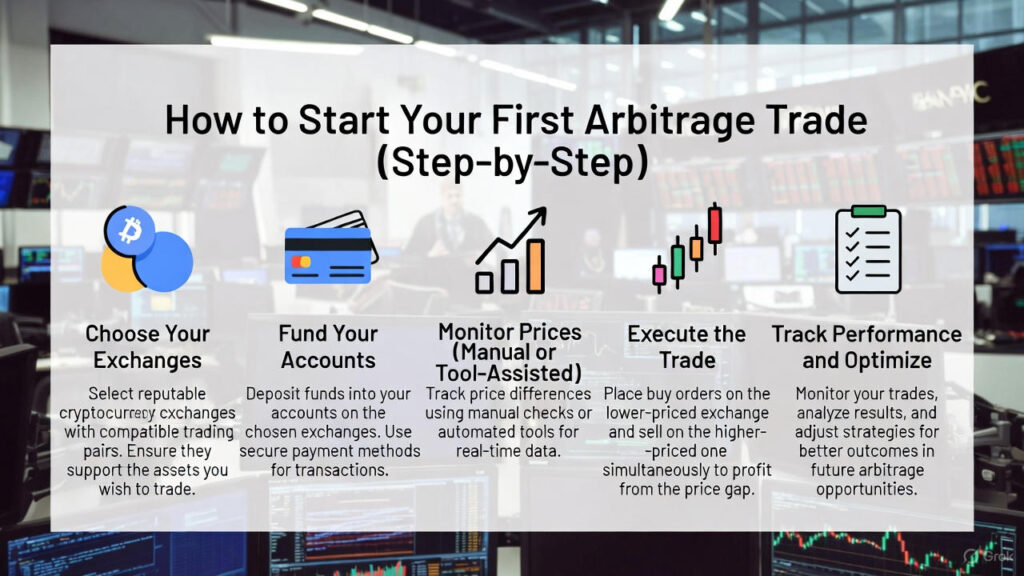


Step 1: Choose Your Exchanges (15 minutes)


Recommended for beginners (choose 2-3):

ExchangeWhy It’s GoodTrading FeesWithdrawal Speed
BinanceHighest liquidity, most trading pairs0.10%Fast (10-20 min)
CoinbaseUser-friendly, regulated, US-friendly0.40% advanced / 1.49% basicMedium (20-40 min)
KrakenLow fees, strong security0.16-0.26%Fast (10-25 min)
OKXGood for non-US users, low fees0.08-0.10%Very fast (5-15 min)
BybitPopular for futures, good UI0.10%Fast (10-20 min)

Setup requirements:

    1. Email verification (instant)
    2. KYC verification (identity documents, 1-24 hours)
    3. 2FA security (Google Authenticator, 5 minutes)
    4. Deposit method (bank account or crypto wallet)

Pro tip: Start with Binance + Coinbase (most beginner-friendly, largest price differences)


Step 2: Fund Your Accounts ($500-1,000 minimum)


Capital allocation strategy:

For $1,000 starting capital:

    • Exchange A (Binance): $500
    • Exchange B (Coinbase): $500

Why split 50/50:

    • Enables immediate buying AND selling without waiting for transfers
    • Reduces transfer frequency (saves fees)
    • Allows you to “loop” arbitrage (buy on A, sell on B, then reverse)

What to buy:

    • Stablecoins (USDT or USDC): 80% of capital
      • Reason: No price volatility while you scout for opportunities
      • Easy to convert to any crypto quickly
    • Bitcoin: 10% of capital
      • Reason: Most liquid, easiest to arbitrage
    • Ethereum: 10% of capital
      • Reason: Second most liquid, good opportunities

Deposit method:

    • Bank transfer: Cheapest (often free), slowest (1-5 days)
    • Debit card: Fast (instant), expensive (3-5% fee)
    • Crypto transfer: Instant if you already own crypto, watch network fees

Step 3: Monitor Prices (Manual or Tool-Assisted)


Manual method (free, educational):

    1. Open 2-3 exchange tabs in your browser
    2. Search for the same cryptocurrency on each
    3. Compare prices side-by-side
    4. Calculate: Spread % = (Higher Price - Lower Price) / Lower Price × 100
    5. Check if: Spread % > (Trading Fees % × 2 + Transfer Fees)

Example manual calculation:

Binance BTC: $86,500
Coinbase BTC: $87,100

Spread: $600 / $86,500 = 0.69%

Fees:
- Binance trading: 0.10%
- Coinbase trading: 0.40%
- BTC transfer: $15 (≈ 0.017% of $86,500)
- Total: 0.517%

Profit potential: 0.69% - 0.517% = 0.173% (profitable!)
On $1,000: $1.73 profit (not worth manual effort)
On $10,000: $17.30 profit (possibly worth it)

Tool-assisted method (easier, faster):

Free price comparison tools:

    • CoinGecko: Shows prices across 20+ exchanges simultaneously
    • CoinMarketCap: Real-time price comparison
    • TradingView: Advanced charting, multi-exchange price tracking

Paid arbitrage scanners ($0-50/month):

    • Arbitrage Scanner: Real-time opportunities, $29/month
    • CoinArbitrageBot: Signals for opportunities, $39/month
    • ArbiSmart: Automated scanning, free tier available

What to look for:

    • Minimum spread: 0.5% after fees for manual trading
    • Volume check: Both exchanges should have >$1M daily volume for that pair
    • Withdrawal status: Ensure both exchanges allow withdrawals (check status pages)

Step 4: Execute the Trade (The Critical 15 Minutes)


Execution sequence:

Option A: Transfer Method (Slower, cheaper)

    1. Buy crypto on cheaper exchange (Exchange A)
    2. Initiate withdrawal to more expensive exchange (Exchange B)
    3. Wait for confirmations (10-30 minutes, varies by blockchain)
    4. Sell on Exchange B
    5. Repeat in reverse when opportunity flips

Risks: Price may change during transfer (called “execution risk”)


Option B: Pre-Funded Method (Faster, recommended)

    1. Already have funds on BOTH exchanges
    2. Simultaneously: Buy on Exchange A, Sell on Exchange B
    3. Profit locked immediately (no transfer risk)
    4. Later, rebalance accounts when convenient (during low-fee periods)

Example execution:

You have: $500 USDT on Binance, 0.2 BTC on Coinbase

Opportunity spotted:
Binance BTC: $86,000 (cheaper)
Coinbase BTC: $86,700 (expensive)

Action:
1. Buy 0.0058 BTC on Binance for $500
2. Sell 0.0058 BTC on Coinbase for $503.06
3. Profit: $3.06 (0.61% before fees)
4. After fees: ~$2.50 net

Result:
- Binance: Now has 0.0058 BTC (instead of $500 USDT)
- Coinbase: Now has $503 USDT (instead of 0.0058 BTC)
- Positions are "flipped" but total value increased

Common mistake to avoid: Don’t buy on Coinbase and expect to transfer to Binance in 5 minutes. Bitcoin confirmations take 10-60 minutes; price will likely change.


Step 5: Track Performance and Optimize


Metrics to track:

    • Success rate: Profitable trades / Total attempts
    • Average profit: Net profit per trade after ALL fees
    • Time invested: Hours spent vs. profit earned
    • Opportunity frequency: Profitable opportunities per day

First week realistic expectations:

    • Opportunities spotted: 3-5 per day
    • Successful executions: 1-2 per day (30-50% success rate for beginners)
    • Average profit per trade: $3-8 on $1,000 capital
    • Weekly profit: $20-50 ($1,040-2,600 annualized return on $1,000)

Optimization tactics:

    • Reduce fees: Use “maker” orders (limit orders) instead of “taker” (market orders) when possible
    • Time transfers: Withdraw during low-traffic hours (lower blockchain fees)
    • Batch transfers: Accumulate profits and transfer larger amounts less frequently
    • Use fee-discount tokens: Binance BNB gives 25% fee discount, OKX OKB gives 20%


Part 4: Pros vs Cons of Arbitrage Trading
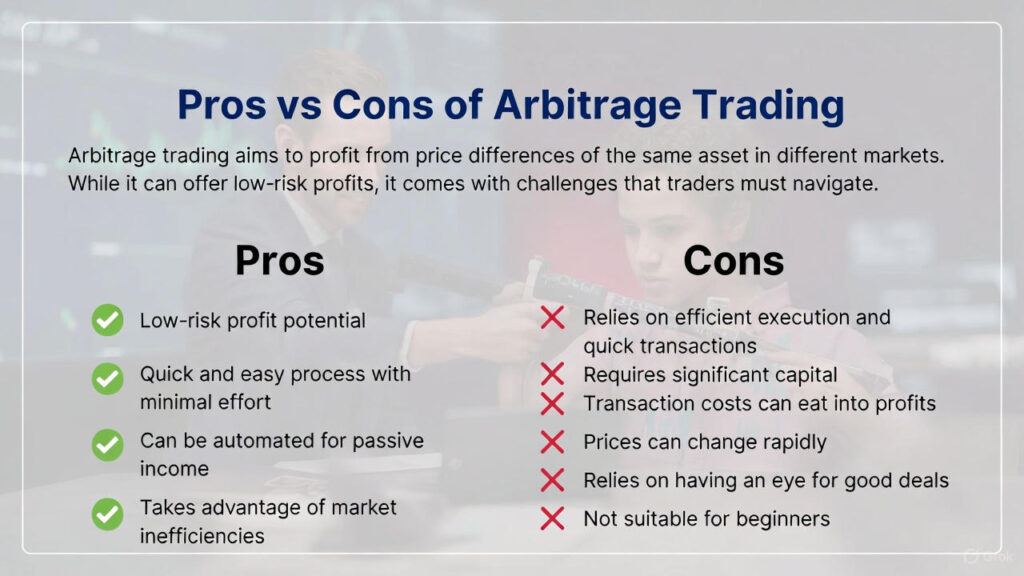
 

Pros vs Cons of Arbitrage Trading


The Good News: Why Arbitrage is Beginner-Friendly


1. Low Market Risk ✅

    • You don’t care if Bitcoin is going up or down
    • Profit from price differences, not price direction
    • Works equally well in bull and bear markets

2. Predictable Profits ✅

    • If spread = 1% and fees = 0.5%, you KNOW profit = 0.5%
    • No guessing, no chart reading, pure math
    • Consistent small wins compound over time

3. No Technical Analysis Needed ✅

    • Don’t need to read candlestick charts
    • Don’t need to understand RSI, MACD, or any indicators
    • Simple arithmetic is enough

4. Works 24/7 ✅

    • Crypto markets never close
    • Opportunities occur at all hours
    • Perfect for automation (bots trade while you sleep)

5. Can Be Automated ✅

    • Bots handle tedious price monitoring
    • Execute trades in milliseconds
    • Scales easily (bot can monitor 50 exchanges, you can’t)

The Challenges: What Makes Arbitrage Hard


1. Trading Fees Eat Profits ❌

    • Exchange fees: 0.1-0.5% per trade (both buy AND sell)
    • Network fees: $2-50 depending on blockchain
    • Spread needed: Must be >0.5-1% just to break even

Real example:

Spotted opportunity: 0.8% spread
Trading fees: 0.1% + 0.4% = 0.5%
Transfer fee: $15 on $1,000 = 1.5%
RESULT: -1.2% loss!

Solution: Only trade when spread > fees + 0.3% buffer


2. Transfer Times = Price Risk ❌

    • Bitcoin: 10-60 minutes for confirmations
    • Ethereum: 2-15 minutes
    • Altcoins: 5-30 minutes

Risk: Price changes during transfer, eliminating profit

Solution: Use pre-funded accounts on both exchanges (eliminates transfer risk)


3. Competition from Bots ❌

    • Bots execute in <1 second
    • You execute in 15-30 minutes manually
    • By the time you act, opportunity often gone

Statistics:

    • Manual traders: Capture 30-50% of opportunities
    • Bot traders: Capture 70-85% of opportunities

Solution: Start manual to learn, switch to bots for profit


4. Requires Multiple Accounts ❌

    • Need 2-5 exchange accounts
    • KYC verification on each (time-consuming)
    • Managing funds across platforms (organizational challenge)

5. Limited Profit Per Trade ❌

    • Typical profit: 0.3-1.5% per successful trade
    • On $1,000: $3-15 profit per trade
    • Need volume or frequency to make meaningful income

Solution: Increase capital over time, use bots to increase frequency


The Net Reality


Profit margins after fees: 0.3-1.5% per opportunity
Manual trading opportunities: 2-5 per day
Bot trading opportunities: 20-100 per day
Starting capital needed: $500-1,000 (learning), $10,000+ (serious profit)
Time to proficiency: 2-4 weeks of practice
Realistic monthly returns: 3-10% for skilled manual traders, 8-25% for sophisticated bots

Verdict: Arbitrage works, but requires discipline, capital, and eventually automation to be truly profitable.


Part 5: Manual Trading vs. Arbitrage Bots
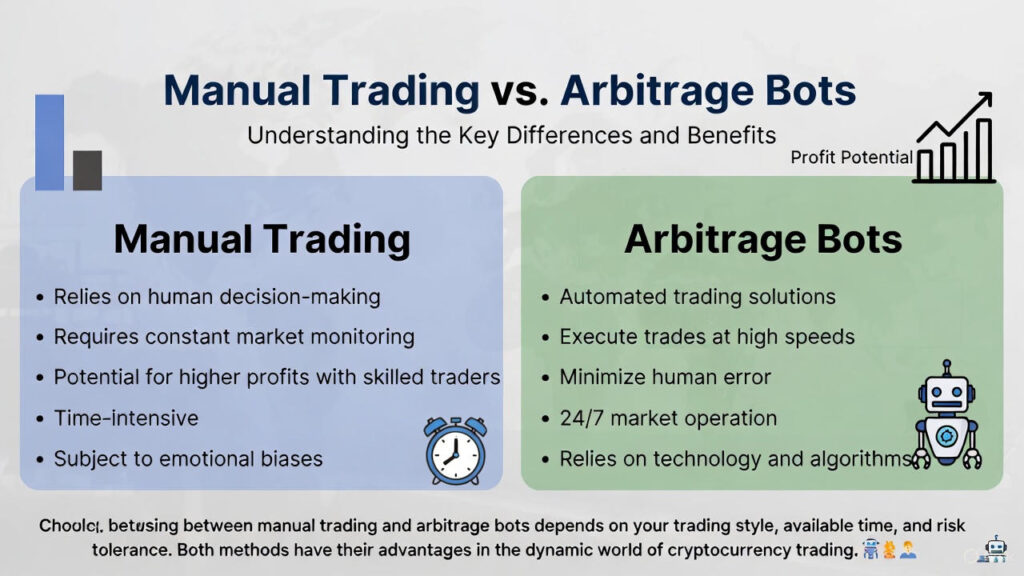


Manual Trading: Learn First, Profit Later


Characteristics:

MetricManual Trading
SpeedSlow (15-30 min per trade)
Cost$0 (free, only pay exchange fees)
Win Rate30-50% (miss opportunities due to speed)
Best ForLearning the fundamentals
Time InvestmentHigh (constant monitoring)
Opportunities/Day2-5
Daily Profit Potential$10-30 on $1,000 capital

When manual makes sense:

    • First 2-4 weeks: Learn how arbitrage works without losing money to a bad bot
    • Small capital: Under $2,000 (bot fees aren’t justified)
    • Educational goals: Understand pricing dynamics before automating
    • Testing strategies: Validate ideas before coding/buying a bot

Manual trading workflow:

    1. Wake up, check CoinGecko for spread opportunities (10 min)
    2. Execute 1-2 profitable trades (30-60 min total)
    3. Monitor again at lunch (10 min)
    4. Execute evening trades if available (30 min)
    5. Total time: 1-2 hours/day, profit: $10-30/day

Arbitrage Bots: Scale Your Profits


Characteristics:

MetricBot Trading
SpeedInstant (<1 second execution)
Cost$50-500/month (platform fees)
Win Rate70-85% (captures most opportunities)
Best ForProfit maximization
Time InvestmentLow (setup only, 2-4 hours initial)
Opportunities/Day20-100
Daily Profit Potential$50-200 on $1,000 capital


Top arbitrage bots for beginners (2025):

1. Pionex (Best for Beginners)

    • Price: Free (0.05% trading fee)
    • Features: 16 built-in bots including arbitrage
    • Ease of use: 5/5 (simplest interface)
    • Exchanges: Works only on Pionex exchange
    • Minimum capital: $500

Pros: No monthly fee, beginner-friendly UI
Cons: Limited to one exchange (misses cross-exchange opportunities)


2. Cryptohopper (Most Versatile)

    • Price: $19-99/month (3 tiers)
    • Features: Cross-exchange arbitrage, triangular arbitrage, marketplace strategies
    • Ease of use: 4/5 (moderate learning curve)
    • Exchanges: Connects to 10+ exchanges
    • Minimum capital: $1,000

Pros: Powerful features, strategy marketplace, active community
Cons: Monthly cost, requires configuration time


3. 3Commas (Best for Advanced)

    • Price: $29-99/month
    • Features: SmartTrade terminal, portfolio management, arbitrage
    • Ease of use: 3/5 (advanced features)
    • Exchanges: 20+ exchange integrations
    • Minimum capital: $2,000

Pros: Professional-grade tools, excellent for scaling
Cons: Steeper learning curve, higher cost


4. Bitsgap (Good Balance)

    • Price: $29-149/month (14-day free trial)
    • Features: Arbitrage scanner, demo trading, portfolio tracking
    • Ease of use: 4/5
    • Exchanges: 15+ exchanges
    • Minimum capital: $1,000

Pros: Free trial to test, good balance of features vs. complexity
Cons: Monthly cost, arbitrage isn’t the primary focus


5. NeuralArB (Fully Automated)

    • Price: Free (trading cycle 0.5% fee)
    • Features: EU-licensed, fully automated arbitrage
    • Ease of use: 5/5 (set-and-forget)
    • Exchanges: 250+ exchanges
    • Minimum capital: $500

Pros: Hands-off automation, regulatory compliance
Cons: Geographic restrictions, higher capital requirement


Weeks 1-2: Manual Only

    • Open Binance + Coinbase accounts
    • Practice spotting opportunities with CoinGecko
    • Execute 5-10 manual trades
    • Goal: Understand mechanics, avoid costly mistakes

Weeks 3-4: Manual with Scanner

    • Subscribe to Arbitrage Scanner ($29/month) or use free tier
    • Let scanner find opportunities, you execute manually
    • Track success rate and profit margins
    • Goal: Identify which opportunities are worth automating

Month 2+: Introduce Bot (If Profitable)

    • If manual trading is profitable: Subscribe to Cryptohopper or Bitsgap
    • Start bot with 30-50% of capital (keep rest for manual)
    • Monitor bot performance daily for first week
    • Goal: Validate bot is more profitable than manual

Month 3+: Scale with Bot

    • Increase capital allocated to bot
    • Reduce manual trading to occasional high-margin opportunities
    • Optimize bot settings based on performance data
    • Goal: Achieve 5-15% monthly returns on total capital

The math:

Manual (Month 1): $1,000 capital, 3% monthly return = $30 profit
Bot (Month 2): $1,000 capital, 10% monthly return = $100 profit
Bot fee: -$50/month
Net improvement: $50 - $30 = $20 extra profit
ROI on bot: 40% (worth it!)

After 6 months:
Manual path: $1,000 → $1,197 (3%/month compounded)
Bot path: $1,000 → $1,610 (10%/month compounded, minus $300 fees)
Difference: $413 extra profit (41% more)


Part 6: Common Mistakes Beginners Make (And How to Avoid Them)


Mistake #1: Ignoring Withdrawal Fees


The error: Seeing a 1% spread and thinking you’ll profit 1%, forgetting that withdrawing Bitcoin costs $10-25.

Example:

Capital: $500
Spread: 1% = $5 profit potential
Withdrawal fee: $15
Result: -$10 loss!

Solution:

    • Only use withdrawal-heavy strategies with $2,000+ capital
    • Use pre-funded accounts to avoid frequent withdrawals
    • Batch withdrawals (transfer $5,000 once instead of $500 ten times)

Mistake #2: Trading on Low-Liquidity Exchanges


The error: Chasing a huge 5% spread on a small exchange, then finding you can’t withdraw.

Red flags:

    • Exchange has <$10M daily volume
    • Withdrawal “temporarily disabled” for your crypto
    • Reviews mention withdrawal delays

Solution:

    • Stick to Top 20 exchanges by volume (Binance, Coinbase, Kraken, OKX, Bybit, etc.)
    • Check withdrawal status BEFORE trading
    • Never deposit more than you can afford to lose on any single exchange

Mistake #3: Not Accounting for Slippage


The error: Seeing ETH at $3,000 on DEX, placing market order, actually getting filled at $3,025.

What is slippage: The difference between expected price and actual execution price.

Causes:

    • Low liquidity pools (small DEXs)
    • Large order size relative to available liquidity
    • High volatility periods

Solution:

    • Set slippage tolerance: 0.5-1% on DEXs
    • Use limit orders: Specify exact price (may not fill, but no surprises)
    • Check liquidity depth: Ensure order book can absorb your trade size
    • Trade smaller amounts: Split $5,000 order into 5x $1,000 orders

Mistake #4: Falling for “Guaranteed Profit” Scams


The scam: Website/Telegram group promises “40% monthly returns from arbitrage, no risk!”

Reality check:

    • Legitimate arbitrage: 3-15% monthly returns (skilled traders with bots)
    • Anything >20%/month: Almost certainly a Ponzi scheme
    • “No risk” claims: Always a lie (arbitrage has risks)

Red flags:

    • Promises of guaranteed returns
    • Requires upfront payment to “unlock” the bot
    • No trial period or transparent track record
    • Uses testimonials from fake accounts

Solution:

    • If it sounds too good to be true, it is
    • Only use established platforms with verifiable track records
    • Never pay for “secret” arbitrage strategies
    • Test with small capital first

Mistake #5: Over-Leveraging


The error: Using borrowed money or margin trading for arbitrage.

Why it’s dangerous:

    • Arbitrage margins (0.5-1.5%) don’t justify leverage costs (interest 5-20%/year)
    • Liquidation risk if exchange prices spike temporarily
    • Turns low-risk strategy into high-risk gambling

Solution:

    • Never use leverage for arbitrage
    • Only trade with capital you own
    • Arbitrage is about consistency, not home runs

Mistake #6: Analysis Paralysis


The error: Spending 3 hours calculating the “perfect” trade for $2 profit, missing 5 other $8 opportunities.

Symptoms:

    • Over-analyzing every fee structure
    • Waiting for the “big” opportunity that never comes
    • Not executing because “it might get better”

Solution:

    • Set clear criteria: “If spread >0.7% after fees, execute immediately”
    • Accept small wins: 10x $5 profits = $50 (same as 1x $50 profit)
    • Done is better than perfect: Execute, learn, improve

Mistake #7: Neglecting Security


The error: Using weak passwords, no 2FA, leaving funds on exchange after trading.

Risks:

    • Exchange hacks (even Binance has been hacked)
    • Account takeovers (phishing, SIM swaps)
    • Exit scams on smaller exchanges

Security checklist:

    • ✅ Unique passwords for each exchange (use password manager)
    • ✅ 2FA enabled (Google Authenticator, not SMS)
    • ✅ Withdraw to personal wallet after accumulating profits
    • ✅ Use hardware wallet (Ledger/Trezor) for long-term storage
    • ✅ Enable withdrawal whitelist (only allow specific addresses)


Part 7: Your 30-Day Arbitrage Action Plan


Days 1-7: Education & Setup


Day 1-2: Learn fundamentals

    • Read this guide fully
    • Watch 3-5 YouTube tutorials on crypto arbitrage
    • Understand how exchanges work

Day 3-4: Choose and verify exchanges

    • Sign up for Binance + Coinbase (or your chosen pair)
    • Complete KYC verification
    • Set up 2FA security

Day 5-6: Make first deposit

    • Deposit $500-1,000 (split across exchanges)
    • Buy stablecoins (USDT or USDC)
    • Practice navigating exchange interfaces

Day 7: Paper trading

    • Spot 5 arbitrage opportunities (don’t execute)
    • Calculate profits including all fees
    • Track how long opportunities last

Days 8-14: First Manual Trades


Day 8-10: Execute first 3 trades

    • Start with small size ($100-200 per trade)
    • Focus on execution, not profit
    • Track every fee meticulously

Day 11-14: Daily trading practice

    • Aim for 1-2 trades per day
    • Increase size to $300-500 per trade
    • Calculate actual profit margins vs. expected

Goal: 10 successful trades, understand real-world fees


Days 15-21: Optimization


Day 15-16: Analyze performance

    • Calculate average profit per trade
    • Identify which exchange pairs work best
    • Find optimal trading times (when spreads are largest)

Day 17-19: Reduce costs

    • Apply for fee discounts (BNB on Binance, etc.)
    • Optimize withdrawal timing (off-peak hours for lower network fees)
    • Batch smaller opportunities into one larger trade

Day 20-21: Scale up

    • If profitable, increase trade size to $800-1,000
    • Test one triangular arbitrage opportunity
    • Explore one CEX-DEX opportunity

Days 22-30: Automation Exploration


Day 22-24: Research bots

    • Compare Pionex, Cryptohopper, Bitsgap
    • Read reviews, watch tutorials
    • Sign up for free trials

Day 25-27: Test bot with small capital

    • Allocate $200-300 to bot
    • Run parallel to manual trading
    • Monitor bot trades closely

Day 28-30: Decide and scale

    • If bot is profitable: Increase allocation, reduce manual trading
    • If bot underperforms: Stick with manual, revisit bots in Month 2
    • Set Month 2 goals: Target capital, target returns, time investment

Expected outcomes after 30 days:

    • Executed trades: 20-30
    • Success rate: 40-60%
    • Total profit: $80-250 (on $1,000 starting capital)
    • ROI: 8-25% monthly
    • Lessons learned: Priceless


Part 8: Advanced Tips for Maximizing Profits


Tip #1: Monitor Multiple Asset Classes


Don’t just focus on BTC and ETH. Check:

    • Top 20 coins by volume: SOL, XRP, ADA, MATIC, LINK
    • Stablecoin pairs: USDT/USDC spreads (yes, “stable” coins sometimes differ!)
    • Altcoin pumps: When an altcoin pumps 20%, arbitrage opportunities spike

Why it works: Less competition on altcoins; Bitcoin arbitrage is crowded.


Tip #2: Exploit Regional Differences


    • Korean Premium: Korean exchanges (Upbit, Bithumb) often trade 0.5-2% higher
    • US vs. European exchanges: Regulatory differences create price gaps
    • Emerging markets: High demand in countries with capital controls creates premiums

Caveat: Cross-border arbitrage has tax and legal complexities; consult a professional.


Tip #3: Combine with Yield Strategies


While waiting for arbitrage opportunities:

    • Stablecoin lending: Earn 5-12% APY on USDT/USDC (Aave, Compound)
    • Liquidity provision: Provide liquidity on DEXs (risk: impermanent loss)
    • Flexible savings: Exchanges offer 2-8% on idle stablecoins

Example:

You have $5,000 in USDT waiting for opportunities
Lend on Aave at 8% APY
Daily passive income: $5,000 × 8% / 365 = $1.10/day
Plus active arbitrage: $10-30/day
Total: $11-31/day instead of just $10-30

Tip #4: Track Gas Fees for CEX-DEX Arbitrage


Use tools:

    • Etherscan Gas Tracker: Real-time Ethereum gas prices
    • L2Fees.info: Compare gas costs across Layer-2s (Arbitrum, Optimism, Base)
    • GasNow: Predictive gas fee model

Strategy:

    • Only execute CEX-DEX arbitrage when gas <30 gwei on Ethereum
    • Or use Layer-2 DEXs where gas is $0.10-0.50 (Arbitrum, Optimism)

Tip #5: Build Relationships with OTC Desks


For larger capital ($50,000+):

    • OTC (Over-The-Counter) desks offer better pricing than retail exchanges
    • Can negotiate custom rates for arbitrage volume
    • Access to institutional liquidity

Examples: Genesis, Cumberland, Galaxy Digital


Part 9: Is NeuralArB Right for You?


What NeuralArB Offers


NeuralArB is an AI-powered arbitrage platform designed for serious arbitrage traders who want to move beyond basic bots.


Key features:

    • Multi-agent RL system: 5 specialized AI agents (CEX-DEX, cross-chain, market-making, liquidity, risk)
    • Real-time execution: <100ms latency on arbitrage opportunities
    • 50+ exchange integration: Monitor more markets than any manual trader or basic bot
    • Risk-adjusted strategies: Automatically adjusts position sizing based on volatility
    • Performance: 8-15% monthly returns (realistic, not “guaranteed”)

Who Should Use NeuralArB?


Good fit if you:

    • Have $10,000+ capital for arbitrage
    • Completed 1-2 months of manual/simple bot trading
    • Want to scale beyond single-exchange or simple cross-exchange strategies
    • Value sophisticated risk management
    • Seek hands-off automation (not monitoring trades hourly)

Not a good fit if you:

    • Have <$5,000 capital (platform fees won’t justify on small accounts)
    • Complete beginner (start manual first)
    • Want to “learn” arbitrage mechanics (platform does everything automatically)
    • Prefer active trading involvement (NeuralArB is set-and-forget)

The Learning Path to NeuralArB


Month 1: Manual arbitrage (this guide)
Month 2: Simple bot (Pionex or Cryptohopper)
Month 3+: Evaluate NeuralArB or similar sophisticated platforms


Why this sequence:

    1. Manual teaches fundamentals (fees, timing, risks)
    2. Simple bot introduces automation, validates bot profitability
    3. Sophisticated platform scales proven strategies with advanced AI

Expected progression:

    • Manual: $1,000 → $1,030 (3% month 1)
    • Simple bot: $1,030 → $1,133 (10% month 2)
    • NeuralArB: $1,133 → $1,303 (15% month 3)
    • Total after 3 months: 30.3% return vs. 9% with manual only


Conclusion: Your Path to Arbitrage Success


Crypto arbitrage in 2025 is NOT a get-rich-quick scheme, but it IS a legitimate strategy for generating consistent, low-risk returns when approached with discipline and realistic expectations.


Key takeaways:

✅ Arbitrage works — but profits are 0.3-1.5% per trade, not 10-50%
✅ Start manual — learn mechanics before paying for bots
✅ Fees are everything — a 0.8% spread can become a 0.2% profit (or loss) after fees
✅ Pre-fund accounts — eliminate transfer risk, execute instantly
✅ Automate when ready — bots capture 2-3x more opportunities than manual
✅ Scale gradually — $500 → $1,000 → $5,000 → $20,000 over months, not days
✅ Security first — 2FA, withdrawal whitelists, cold storage for profits


Realistic first-year journey:

MonthCapitalStrategyMonthly ReturnProfit
1$1,000Manual3%$30
2$1,030Manual + Scanner5%$52
3$1,082Simple Bot8%$87
4-6$1,169 → $1,401Optimized Bot10%/mo avg$232 total
7-12$1,401 → $2,490Advanced Platform12%/mo avg$1,089 total

Year 1 total: $1,000 → $2,490 (149% return)

This beats:

    • S&P 500 average (10%/year)
    • Crypto buy-and-hold (highly volatile)
    • Savings accounts (1-5%/year)

But requires:

    • Initial learning investment (20-40 hours)
    • Consistent monitoring (or bot subscription)
    • Emotional discipline (not chasing huge spreads on sketchy exchanges)
    • Capital to scale (more capital = more absolute profit)

Your next steps:

    1. Today: Sign up for Binance + Coinbase, start verification
    2. This week: Deposit $500-1,000, buy stablecoins
    3. Week 2: Execute first 3 manual trades, track every fee
    4. Week 3: Spot 10 opportunities, execute 5, analyze performance
    5. Week 4: Decide: continue manual or test a bot?

Final thought: Arbitrage is a skill that compounds. Month 1 is learning (small profits), Month 6 is proficiency (consistent profits), Year 2 is mastery (scaling to meaningful income). The journey starts with a single trade.


Start simple. Start small. Start today.


🔗 Related Analysis:


Disclaimer: This article is for educational purposes only and does not constitute financial advice. Cryptocurrency arbitrage carries risks including exchange failures, price volatility during transfers, regulatory changes, and technical errors. Always conduct your own research, start with capital you can afford to lose, and consult with financial professionals before making investment decisions. Past performance of arbitrage strategies does not guarantee future results.

Mr.Q

Mr. Q is the Co-Founder & CEO of NeuralArB, where he spearheads the company’s strategic vision and growth initiatives. With a profound passion for blockchain technology, cryptocurrency trading, and artificial intelligence, Mr. Q has positioned NeuralArB as a leader in the AI-driven arbitrage trading space. Follow Mr. Q on Twitter: @LuisAlvaresQ

Crypto Arbitrage 101: How to Trade with no Experience in 2025

Crypto Arbitrage 101: How to Trade with no Experience in 2025


Introduction: The Easiest Way to Profit from Crypto Without Predicting Prices


Imagine making money from cryptocurrency without predicting whether Bitcoin will go up or down. No chart analysis. No technical indicators. No stress about market crashes. Just pure mathematical profit from price differences that exist right now, across different exchanges.

That’s crypto arbitrage—and in 2025, it’s more accessible to beginners than ever before.


This complete guide will teach you everything you need to know to start arbitrage trading, even if you’ve never traded crypto before. By the end, you’ll understand:

✅ What arbitrage is and why it works
✅ The 4 main types of arbitrage strategies
✅ Step-by-step how to execute your first arbitrage trade
✅ Best tools and platforms for beginners
✅ How to avoid common mistakes that eat profits
✅ Whether bots are worth it (spoiler: yes, but not immediately)


Current Reality Check (November 2025):

    • Total crypto market cap: $3.04 trillion
    • Daily trading volume: $170+ billion
    • Number of exchanges: 500+ (creating constant price discrepancies)
    • Average arbitrage opportunity: 0.5-2% profit per trade
    • Time to execute: 15-30 minutes manually, <1 second with bots

Let’s dive in.


Part 1: What is Crypto Arbitrage? (Explained Simply)

What is Crypto Arbitrage?


The Core Concept


Crypto arbitrage is buying a cryptocurrency on one exchange where the price is lower, and simultaneously (or near-simultaneously) selling it on another exchange where the price is higher. The price difference is your profit.


Simple Example:

    • Bitcoin on Binance: $50,000
    • Bitcoin on Coinbase: $50,500
    • Your action: Buy 1 BTC on Binance for $50,000, sell 1 BTC on Coinbase for $50,500
    • Profit: $500 (1% gain) minus trading fees

Why Do Price Differences Exist?


You might wonder: “If everyone can see these price differences, why don’t they disappear instantly?”

Reasons for price discrepancies:

    1. Geographical differences: Exchanges in different countries have different supply/demand dynamics
    2. Liquidity variations: Some exchanges have more trading activity than others
    3. Transfer delays: Moving crypto between exchanges takes time (5-30 minutes)
    4. Trading restrictions: Not everyone has access to all exchanges
    5. Information lag: Prices update at slightly different times across platforms
    6. Market inefficiency: Crypto markets are still relatively young and inefficient
    7. Withdrawal limits: Large traders can’t always move capital fast enough

The “Too Good to Be True” Reality


Important truth: Arbitrage opportunities DO exist in 2025, but:

    • Profit margins are shrinking: From 5-10% in 2017 to 0.5-2% in 2025
    • Competition is intense: Bots execute in milliseconds; manual traders get 30-50% of opportunities
    • Fees matter hugely: A 1% opportunity can become 0.3% after 0.1% trading fees on each side plus $5 transfer fee
    • Capital requirements: Small accounts ($500-1,000) make $20-50/day; serious profit needs $10,000+

But it’s NOT dead. Here’s why 2025 is actually a GREAT time to start:

    • More exchanges = more opportunities: 500+ exchanges create constant inefficiencies
    • Automation is accessible: Beginner-friendly bots available for $50-200/month
    • Volatility creates spreads: The November 2025 crash created 1.5-2% spreads (rare!)
    • DeFi expansion: Decentralized exchanges add new arbitrage vectors
    • Educational resources: Guides like this didn’t exist in 2017


Part 2: The 4 Main Types of Crypto Arbitrage


The 4 Main Types of Crypto Arbitrage


1. Cross-Exchange Arbitrage (Easiest for Beginners)


What it is: Buy crypto on Exchange A, sell on Exchange B.

How it works:

    • Monitor prices across multiple exchanges simultaneously
    • When Price(Exchange B) > Price(Exchange A) + Fees, execute trade
    • Transfer crypto from A to B, or use pre-funded accounts on both

Example:

Binance: BTC = $86,500
Coinbase: BTC = $87,000
Spread: $500 (0.58%)

Buy 1 BTC on Binance: -$86,500
Sell 1 BTC on Coinbase: +$87,000
Gross profit: $500

Trading fees (0.1% each side): -$173
Transfer fees: -$15
Net profit: $312 (0.36%)

Pros:

    • Simplest to understand
    • Easy to execute manually
    • Works with any cryptocurrency

Cons:

    • Transfer time risk (price may change during transfer)
    • Requires funds on multiple exchanges
    • Withdrawal fees can be significant

Best for: Complete beginners learning the basics

Time to execute: 15-30 minutes manually

Typical profit: 0.3-1.2% per successful trade


2. Triangular Arbitrage (Single Exchange)


What it is: Trade through 3 different cryptocurrency pairs on ONE exchange to exploit price inefficiencies.

How it works: Start with BTC → Convert to ETH → Convert to USDT → Convert back to BTC

Example:

Starting: 1 BTC

1. BTC → ETH: 1 BTC = 28.5 ETH (BTC/ETH = 28.5)
2. ETH → USDT: 28.5 ETH = $85,800 (ETH/USDT = $3,010)
3. USDT → BTC: $85,800 = 1.015 BTC (BTC/USDT = $84,532)

Result: 1.015 BTC (1.5% gain before fees)
After fees (0.1% x 3 trades = 0.3%): 1.012 BTC (1.2% profit)

Why it works: The three exchange rates (BTC/ETH, ETH/USDT, BTC/USDT) occasionally become misaligned.

Pros:

    • No transfer between exchanges (instant execution)
    • No transfer fees
    • Can execute in seconds

Cons:

    • Harder to spot opportunities manually
    • Requires understanding of exchange rate math
    • Opportunities disappear quickly (10-30 seconds)
    • Less frequent than cross-exchange

Best for: Intermediate traders comfortable with multi-leg trades

Time to execute: 1-2 minutes manually, <1 second with bot

Typical profit: 0.5-1.5% per opportunity


3. CEX-DEX Arbitrage (Centralized vs Decentralized)


What it is: Exploit price differences between centralized exchanges (Binance, Coinbase) and decentralized exchanges (Uniswap, SushiSwap).

How it works:

    • DEXs often have lower liquidity → bigger price impact
    • Gas fees on Ethereum create inefficiencies
    • CEXs and DEXs price discovery happens at different speeds

Example:

Binance (CEX): ETH = $3,050
Uniswap (DEX): ETH = $3,090
Spread: $40 (1.3%)

Buy 10 ETH on Binance: $30,500
Sell 10 ETH on Uniswap: $30,900
Gross profit: $400

Trading fees: -$61
Gas fees (Ethereum): -$45
Net profit: $294 (0.96%)

Pros:

    • Often larger spreads (1-2%)
    • Less competition (many traders avoid DEXs)
    • Can combine with liquidity mining

Cons:

    • Gas fees are killer: Ethereum gas can be $10-50 per transaction
    • Requires crypto wallet knowledge
    • DEX interfaces harder for beginners
    • Slippage on large trades

Best for: Intermediate traders comfortable with wallets and DeFi

Time to execute: 5-10 minutes

Typical profit: 0.5-1.8% when opportunities arise

2025 Note: Layer-2 solutions (Arbitrum, Optimism) have much lower gas fees ($0.50-2), making this strategy more viable.


4. Statistical Arbitrage (Advanced, Algorithm-Based)


What it is: Use mathematical models and algorithms to predict short-term price movements and profit from mean reversion.

How it works:

    • Analyze historical price correlations (e.g., ETH usually trades at 0.03 BTC)
    • When correlation breaks (ETH drops to 0.028 BTC), bet on reversion
    • Not pure arbitrage (involves prediction), but low-risk

Example:

Historical average: ETH/BTC = 0.0350
Current price: ETH/BTC = 0.0335 (-4.3% deviation)

Strategy: Buy ETH, short BTC (or buy ETH/BTC pair)
Expected reversion: Back to 0.0345-0.0350 within hours/days
Profit target: 2-3% on the pair trade

Pros:

    • Higher profit potential (2-5%)
    • Exploits market inefficiencies not visible to simple arbitrage

Cons:

    • NOT for beginners (requires programming, statistics knowledge)
    • Prediction risk (not guaranteed like pure arbitrage)
    • Needs sophisticated tools/software
    • Requires significant capital ($10,000+)

Best for: Advanced traders with quant/programming skills

Time to execute: Automated only (algorithms run 24/7)

Typical profit: 2-5% per successful trade, but NOT every trade is successful


Part 3: How to Start Your First Arbitrage Trade (Step-by-Step)


Step 1: Choose Your Exchanges (15 minutes)


Recommended for beginners (choose 2-3):

ExchangeWhy It’s GoodTrading FeesWithdrawal Speed
BinanceHighest liquidity, most trading pairs0.10%Fast (10-20 min)
CoinbaseUser-friendly, regulated, US-friendly0.40% advanced / 1.49% basicMedium (20-40 min)
KrakenLow fees, strong security0.16-0.26%Fast (10-25 min)
OKXGood for non-US users, low fees0.08-0.10%Very fast (5-15 min)
BybitPopular for futures, good UI0.10%Fast (10-20 min)

Setup requirements:

    1. Email verification (instant)
    2. KYC verification (identity documents, 1-24 hours)
    3. 2FA security (Google Authenticator, 5 minutes)
    4. Deposit method (bank account or crypto wallet)

Pro tip: Start with Binance + Coinbase (most beginner-friendly, largest price differences)


Step 2: Fund Your Accounts ($500-1,000 minimum)


Capital allocation strategy:

For $1,000 starting capital:

    • Exchange A (Binance): $500
    • Exchange B (Coinbase): $500

Why split 50/50:

    • Enables immediate buying AND selling without waiting for transfers
    • Reduces transfer frequency (saves fees)
    • Allows you to “loop” arbitrage (buy on A, sell on B, then reverse)

What to buy:

    • Stablecoins (USDT or USDC): 80% of capital
      • Reason: No price volatility while you scout for opportunities
      • Easy to convert to any crypto quickly
    • Bitcoin: 10% of capital
      • Reason: Most liquid, easiest to arbitrage
    • Ethereum: 10% of capital
      • Reason: Second most liquid, good opportunities

Deposit method:

    • Bank transfer: Cheapest (often free), slowest (1-5 days)
    • Debit card: Fast (instant), expensive (3-5% fee)
    • Crypto transfer: Instant if you already own crypto, watch network fees

Step 3: Monitor Prices (Manual or Tool-Assisted)


Manual method (free, educational):

    1. Open 2-3 exchange tabs in your browser
    2. Search for the same cryptocurrency on each
    3. Compare prices side-by-side
    4. Calculate: Spread % = (Higher Price - Lower Price) / Lower Price × 100
    5. Check if: Spread % > (Trading Fees % × 2 + Transfer Fees)

Example manual calculation:

Binance BTC: $86,500
Coinbase BTC: $87,100

Spread: $600 / $86,500 = 0.69%

Fees:
- Binance trading: 0.10%
- Coinbase trading: 0.40%
- BTC transfer: $15 (≈ 0.017% of $86,500)
- Total: 0.517%

Profit potential: 0.69% - 0.517% = 0.173% (profitable!)
On $1,000: $1.73 profit (not worth manual effort)
On $10,000: $17.30 profit (possibly worth it)

Tool-assisted method (easier, faster):

Free price comparison tools:

    • CoinGecko: Shows prices across 20+ exchanges simultaneously
    • CoinMarketCap: Real-time price comparison
    • TradingView: Advanced charting, multi-exchange price tracking

Paid arbitrage scanners ($0-50/month):

    • Arbitrage Scanner: Real-time opportunities, $29/month
    • CoinArbitrageBot: Signals for opportunities, $39/month
    • ArbiSmart: Automated scanning, free tier available

What to look for:

    • Minimum spread: 0.5% after fees for manual trading
    • Volume check: Both exchanges should have >$1M daily volume for that pair
    • Withdrawal status: Ensure both exchanges allow withdrawals (check status pages)

Step 4: Execute the Trade (The Critical 15 Minutes)


Execution sequence:

Option A: Transfer Method (Slower, cheaper)

    1. Buy crypto on cheaper exchange (Exchange A)
    2. Initiate withdrawal to more expensive exchange (Exchange B)
    3. Wait for confirmations (10-30 minutes, varies by blockchain)
    4. Sell on Exchange B
    5. Repeat in reverse when opportunity flips

Risks: Price may change during transfer (called “execution risk”)


Option B: Pre-Funded Method (Faster, recommended)

    1. Already have funds on BOTH exchanges
    2. Simultaneously: Buy on Exchange A, Sell on Exchange B
    3. Profit locked immediately (no transfer risk)
    4. Later, rebalance accounts when convenient (during low-fee periods)

Example execution:

You have: $500 USDT on Binance, 0.2 BTC on Coinbase

Opportunity spotted:
Binance BTC: $86,000 (cheaper)
Coinbase BTC: $86,700 (expensive)

Action:
1. Buy 0.0058 BTC on Binance for $500
2. Sell 0.0058 BTC on Coinbase for $503.06
3. Profit: $3.06 (0.61% before fees)
4. After fees: ~$2.50 net

Result:
- Binance: Now has 0.0058 BTC (instead of $500 USDT)
- Coinbase: Now has $503 USDT (instead of 0.0058 BTC)
- Positions are "flipped" but total value increased

Common mistake to avoid: Don’t buy on Coinbase and expect to transfer to Binance in 5 minutes. Bitcoin confirmations take 10-60 minutes; price will likely change.


Step 5: Track Performance and Optimize


Metrics to track:

    • Success rate: Profitable trades / Total attempts
    • Average profit: Net profit per trade after ALL fees
    • Time invested: Hours spent vs. profit earned
    • Opportunity frequency: Profitable opportunities per day

First week realistic expectations:

    • Opportunities spotted: 3-5 per day
    • Successful executions: 1-2 per day (30-50% success rate for beginners)
    • Average profit per trade: $3-8 on $1,000 capital
    • Weekly profit: $20-50 ($1,040-2,600 annualized return on $1,000)

Optimization tactics:

    • Reduce fees: Use “maker” orders (limit orders) instead of “taker” (market orders) when possible
    • Time transfers: Withdraw during low-traffic hours (lower blockchain fees)
    • Batch transfers: Accumulate profits and transfer larger amounts less frequently
    • Use fee-discount tokens: Binance BNB gives 25% fee discount, OKX OKB gives 20%


Part 4: Pros vs Cons of Arbitrage Trading


Pros vs Cons of Arbitrage Trading


The Good News: Why Arbitrage is Beginner-Friendly


1. Low Market Risk ✅

    • You don’t care if Bitcoin is going up or down
    • Profit from price differences, not price direction
    • Works equally well in bull and bear markets

2. Predictable Profits ✅

    • If spread = 1% and fees = 0.5%, you KNOW profit = 0.5%
    • No guessing, no chart reading, pure math
    • Consistent small wins compound over time

3. No Technical Analysis Needed ✅

    • Don’t need to read candlestick charts
    • Don’t need to understand RSI, MACD, or any indicators
    • Simple arithmetic is enough

4. Works 24/7 ✅

    • Crypto markets never close
    • Opportunities occur at all hours
    • Perfect for automation (bots trade while you sleep)

5. Can Be Automated ✅

    • Bots handle tedious price monitoring
    • Execute trades in milliseconds
    • Scales easily (bot can monitor 50 exchanges, you can’t)

The Challenges: What Makes Arbitrage Hard


1. Trading Fees Eat Profits ❌

    • Exchange fees: 0.1-0.5% per trade (both buy AND sell)
    • Network fees: $2-50 depending on blockchain
    • Spread needed: Must be >0.5-1% just to break even

Real example:

Spotted opportunity: 0.8% spread
Trading fees: 0.1% + 0.4% = 0.5%
Transfer fee: $15 on $1,000 = 1.5%
RESULT: -1.2% loss!

Solution: Only trade when spread > fees + 0.3% buffer


2. Transfer Times = Price Risk ❌

    • Bitcoin: 10-60 minutes for confirmations
    • Ethereum: 2-15 minutes
    • Altcoins: 5-30 minutes

Risk: Price changes during transfer, eliminating profit

Solution: Use pre-funded accounts on both exchanges (eliminates transfer risk)


3. Competition from Bots ❌

    • Bots execute in <1 second
    • You execute in 15-30 minutes manually
    • By the time you act, opportunity often gone

Statistics:

    • Manual traders: Capture 30-50% of opportunities
    • Bot traders: Capture 70-85% of opportunities

Solution: Start manual to learn, switch to bots for profit


4. Requires Multiple Accounts ❌

    • Need 2-5 exchange accounts
    • KYC verification on each (time-consuming)
    • Managing funds across platforms (organizational challenge)

5. Limited Profit Per Trade ❌

    • Typical profit: 0.3-1.5% per successful trade
    • On $1,000: $3-15 profit per trade
    • Need volume or frequency to make meaningful income

Solution: Increase capital over time, use bots to increase frequency


The Net Reality


Profit margins after fees: 0.3-1.5% per opportunity
Manual trading opportunities: 2-5 per day
Bot trading opportunities: 20-100 per day
Starting capital needed: $500-1,000 (learning), $10,000+ (serious profit)
Time to proficiency: 2-4 weeks of practice
Realistic monthly returns: 3-10% for skilled manual traders, 8-25% for sophisticated bots

Verdict: Arbitrage works, but requires discipline, capital, and eventually automation to be truly profitable.


Part 5: Manual Trading vs. Arbitrage Bots


Manual Trading: Learn First, Profit Later


Characteristics:

MetricManual Trading
SpeedSlow (15-30 min per trade)
Cost$0 (free, only pay exchange fees)
Win Rate30-50% (miss opportunities due to speed)
Best ForLearning the fundamentals
Time InvestmentHigh (constant monitoring)
Opportunities/Day2-5
Daily Profit Potential$10-30 on $1,000 capital

When manual makes sense:

    • First 2-4 weeks: Learn how arbitrage works without losing money to a bad bot
    • Small capital: Under $2,000 (bot fees aren’t justified)
    • Educational goals: Understand pricing dynamics before automating
    • Testing strategies: Validate ideas before coding/buying a bot

Manual trading workflow:

    1. Wake up, check CoinGecko for spread opportunities (10 min)
    2. Execute 1-2 profitable trades (30-60 min total)
    3. Monitor again at lunch (10 min)
    4. Execute evening trades if available (30 min)
    5. Total time: 1-2 hours/day, profit: $10-30/day

Arbitrage Bots: Scale Your Profits


Characteristics:

MetricBot Trading
SpeedInstant (<1 second execution)
Cost$50-500/month (platform fees)
Win Rate70-85% (captures most opportunities)
Best ForProfit maximization
Time InvestmentLow (setup only, 2-4 hours initial)
Opportunities/Day20-100
Daily Profit Potential$50-200 on $1,000 capital


Top arbitrage bots for beginners (2025):

1. Pionex (Best for Beginners)

    • Price: Free (0.05% trading fee)
    • Features: 16 built-in bots including arbitrage
    • Ease of use: 5/5 (simplest interface)
    • Exchanges: Works only on Pionex exchange
    • Minimum capital: $500

Pros: No monthly fee, beginner-friendly UI
Cons: Limited to one exchange (misses cross-exchange opportunities)


2. Cryptohopper (Most Versatile)

    • Price: $19-99/month (3 tiers)
    • Features: Cross-exchange arbitrage, triangular arbitrage, marketplace strategies
    • Ease of use: 4/5 (moderate learning curve)
    • Exchanges: Connects to 10+ exchanges
    • Minimum capital: $1,000

Pros: Powerful features, strategy marketplace, active community
Cons: Monthly cost, requires configuration time


3. 3Commas (Best for Advanced)

    • Price: $29-99/month
    • Features: SmartTrade terminal, portfolio management, arbitrage
    • Ease of use: 3/5 (advanced features)
    • Exchanges: 20+ exchange integrations
    • Minimum capital: $2,000

Pros: Professional-grade tools, excellent for scaling
Cons: Steeper learning curve, higher cost


4. Bitsgap (Good Balance)

    • Price: $29-149/month (14-day free trial)
    • Features: Arbitrage scanner, demo trading, portfolio tracking
    • Ease of use: 4/5
    • Exchanges: 15+ exchanges
    • Minimum capital: $1,000

Pros: Free trial to test, good balance of features vs. complexity
Cons: Monthly cost, arbitrage isn’t the primary focus


5. NeuralArB (Fully Automated)

    • Price: Free (trading cycle 0.5% fee)
    • Features: EU-licensed, fully automated arbitrage
    • Ease of use: 5/5 (set-and-forget)
    • Exchanges: 250+ exchanges
    • Minimum capital: $500

Pros: Hands-off automation, regulatory compliance
Cons: Geographic restrictions, higher capital requirement


Weeks 1-2: Manual Only

    • Open Binance + Coinbase accounts
    • Practice spotting opportunities with CoinGecko
    • Execute 5-10 manual trades
    • Goal: Understand mechanics, avoid costly mistakes

Weeks 3-4: Manual with Scanner

    • Subscribe to Arbitrage Scanner ($29/month) or use free tier
    • Let scanner find opportunities, you execute manually
    • Track success rate and profit margins
    • Goal: Identify which opportunities are worth automating

Month 2+: Introduce Bot (If Profitable)

    • If manual trading is profitable: Subscribe to Cryptohopper or Bitsgap
    • Start bot with 30-50% of capital (keep rest for manual)
    • Monitor bot performance daily for first week
    • Goal: Validate bot is more profitable than manual

Month 3+: Scale with Bot

    • Increase capital allocated to bot
    • Reduce manual trading to occasional high-margin opportunities
    • Optimize bot settings based on performance data
    • Goal: Achieve 5-15% monthly returns on total capital

The math:

Manual (Month 1): $1,000 capital, 3% monthly return = $30 profit
Bot (Month 2): $1,000 capital, 10% monthly return = $100 profit
Bot fee: -$50/month
Net improvement: $50 - $30 = $20 extra profit
ROI on bot: 40% (worth it!)

After 6 months:
Manual path: $1,000 → $1,197 (3%/month compounded)
Bot path: $1,000 → $1,610 (10%/month compounded, minus $300 fees)
Difference: $413 extra profit (41% more)


Part 6: Common Mistakes Beginners Make (And How to Avoid Them)


Mistake #1: Ignoring Withdrawal Fees


The error: Seeing a 1% spread and thinking you’ll profit 1%, forgetting that withdrawing Bitcoin costs $10-25.

Example:

Capital: $500
Spread: 1% = $5 profit potential
Withdrawal fee: $15
Result: -$10 loss!

Solution:

    • Only use withdrawal-heavy strategies with $2,000+ capital
    • Use pre-funded accounts to avoid frequent withdrawals
    • Batch withdrawals (transfer $5,000 once instead of $500 ten times)

Mistake #2: Trading on Low-Liquidity Exchanges


The error: Chasing a huge 5% spread on a small exchange, then finding you can’t withdraw.

Red flags:

    • Exchange has <$10M daily volume
    • Withdrawal “temporarily disabled” for your crypto
    • Reviews mention withdrawal delays

Solution:

    • Stick to Top 20 exchanges by volume (Binance, Coinbase, Kraken, OKX, Bybit, etc.)
    • Check withdrawal status BEFORE trading
    • Never deposit more than you can afford to lose on any single exchange

Mistake #3: Not Accounting for Slippage


The error: Seeing ETH at $3,000 on DEX, placing market order, actually getting filled at $3,025.

What is slippage: The difference between expected price and actual execution price.

Causes:

    • Low liquidity pools (small DEXs)
    • Large order size relative to available liquidity
    • High volatility periods

Solution:

    • Set slippage tolerance: 0.5-1% on DEXs
    • Use limit orders: Specify exact price (may not fill, but no surprises)
    • Check liquidity depth: Ensure order book can absorb your trade size
    • Trade smaller amounts: Split $5,000 order into 5x $1,000 orders

Mistake #4: Falling for “Guaranteed Profit” Scams


The scam: Website/Telegram group promises “40% monthly returns from arbitrage, no risk!”

Reality check:

    • Legitimate arbitrage: 3-15% monthly returns (skilled traders with bots)
    • Anything >20%/month: Almost certainly a Ponzi scheme
    • “No risk” claims: Always a lie (arbitrage has risks)

Red flags:

    • Promises of guaranteed returns
    • Requires upfront payment to “unlock” the bot
    • No trial period or transparent track record
    • Uses testimonials from fake accounts

Solution:

    • If it sounds too good to be true, it is
    • Only use established platforms with verifiable track records
    • Never pay for “secret” arbitrage strategies
    • Test with small capital first

Mistake #5: Over-Leveraging


The error: Using borrowed money or margin trading for arbitrage.

Why it’s dangerous:

    • Arbitrage margins (0.5-1.5%) don’t justify leverage costs (interest 5-20%/year)
    • Liquidation risk if exchange prices spike temporarily
    • Turns low-risk strategy into high-risk gambling

Solution:

    • Never use leverage for arbitrage
    • Only trade with capital you own
    • Arbitrage is about consistency, not home runs

Mistake #6: Analysis Paralysis


The error: Spending 3 hours calculating the “perfect” trade for $2 profit, missing 5 other $8 opportunities.

Symptoms:

    • Over-analyzing every fee structure
    • Waiting for the “big” opportunity that never comes
    • Not executing because “it might get better”

Solution:

    • Set clear criteria: “If spread >0.7% after fees, execute immediately”
    • Accept small wins: 10x $5 profits = $50 (same as 1x $50 profit)
    • Done is better than perfect: Execute, learn, improve

Mistake #7: Neglecting Security


The error: Using weak passwords, no 2FA, leaving funds on exchange after trading.

Risks:

    • Exchange hacks (even Binance has been hacked)
    • Account takeovers (phishing, SIM swaps)
    • Exit scams on smaller exchanges

Security checklist:

    • ✅ Unique passwords for each exchange (use password manager)
    • ✅ 2FA enabled (Google Authenticator, not SMS)
    • ✅ Withdraw to personal wallet after accumulating profits
    • ✅ Use hardware wallet (Ledger/Trezor) for long-term storage
    • ✅ Enable withdrawal whitelist (only allow specific addresses)


Part 7: Your 30-Day Arbitrage Action Plan


Days 1-7: Education & Setup


Day 1-2: Learn fundamentals

    • Read this guide fully
    • Watch 3-5 YouTube tutorials on crypto arbitrage
    • Understand how exchanges work

Day 3-4: Choose and verify exchanges

    • Sign up for Binance + Coinbase (or your chosen pair)
    • Complete KYC verification
    • Set up 2FA security

Day 5-6: Make first deposit

    • Deposit $500-1,000 (split across exchanges)
    • Buy stablecoins (USDT or USDC)
    • Practice navigating exchange interfaces

Day 7: Paper trading

    • Spot 5 arbitrage opportunities (don’t execute)
    • Calculate profits including all fees
    • Track how long opportunities last

Days 8-14: First Manual Trades


Day 8-10: Execute first 3 trades

    • Start with small size ($100-200 per trade)
    • Focus on execution, not profit
    • Track every fee meticulously

Day 11-14: Daily trading practice

    • Aim for 1-2 trades per day
    • Increase size to $300-500 per trade
    • Calculate actual profit margins vs. expected

Goal: 10 successful trades, understand real-world fees


Days 15-21: Optimization


Day 15-16: Analyze performance

    • Calculate average profit per trade
    • Identify which exchange pairs work best
    • Find optimal trading times (when spreads are largest)

Day 17-19: Reduce costs

    • Apply for fee discounts (BNB on Binance, etc.)
    • Optimize withdrawal timing (off-peak hours for lower network fees)
    • Batch smaller opportunities into one larger trade

Day 20-21: Scale up

    • If profitable, increase trade size to $800-1,000
    • Test one triangular arbitrage opportunity
    • Explore one CEX-DEX opportunity

Days 22-30: Automation Exploration


Day 22-24: Research bots

    • Compare Pionex, Cryptohopper, Bitsgap
    • Read reviews, watch tutorials
    • Sign up for free trials

Day 25-27: Test bot with small capital

    • Allocate $200-300 to bot
    • Run parallel to manual trading
    • Monitor bot trades closely

Day 28-30: Decide and scale

    • If bot is profitable: Increase allocation, reduce manual trading
    • If bot underperforms: Stick with manual, revisit bots in Month 2
    • Set Month 2 goals: Target capital, target returns, time investment

Expected outcomes after 30 days:

    • Executed trades: 20-30
    • Success rate: 40-60%
    • Total profit: $80-250 (on $1,000 starting capital)
    • ROI: 8-25% monthly
    • Lessons learned: Priceless


Part 8: Advanced Tips for Maximizing Profits


Tip #1: Monitor Multiple Asset Classes


Don’t just focus on BTC and ETH. Check:

    • Top 20 coins by volume: SOL, XRP, ADA, MATIC, LINK
    • Stablecoin pairs: USDT/USDC spreads (yes, “stable” coins sometimes differ!)
    • Altcoin pumps: When an altcoin pumps 20%, arbitrage opportunities spike

Why it works: Less competition on altcoins; Bitcoin arbitrage is crowded.


Tip #2: Exploit Regional Differences


    • Korean Premium: Korean exchanges (Upbit, Bithumb) often trade 0.5-2% higher
    • US vs. European exchanges: Regulatory differences create price gaps
    • Emerging markets: High demand in countries with capital controls creates premiums

Caveat: Cross-border arbitrage has tax and legal complexities; consult a professional.


Tip #3: Combine with Yield Strategies


While waiting for arbitrage opportunities:

    • Stablecoin lending: Earn 5-12% APY on USDT/USDC (Aave, Compound)
    • Liquidity provision: Provide liquidity on DEXs (risk: impermanent loss)
    • Flexible savings: Exchanges offer 2-8% on idle stablecoins

Example:

You have $5,000 in USDT waiting for opportunities
Lend on Aave at 8% APY
Daily passive income: $5,000 × 8% / 365 = $1.10/day
Plus active arbitrage: $10-30/day
Total: $11-31/day instead of just $10-30

Tip #4: Track Gas Fees for CEX-DEX Arbitrage


Use tools:

    • Etherscan Gas Tracker: Real-time Ethereum gas prices
    • L2Fees.info: Compare gas costs across Layer-2s (Arbitrum, Optimism, Base)
    • GasNow: Predictive gas fee model

Strategy:

    • Only execute CEX-DEX arbitrage when gas <30 gwei on Ethereum
    • Or use Layer-2 DEXs where gas is $0.10-0.50 (Arbitrum, Optimism)

Tip #5: Build Relationships with OTC Desks


For larger capital ($50,000+):

    • OTC (Over-The-Counter) desks offer better pricing than retail exchanges
    • Can negotiate custom rates for arbitrage volume
    • Access to institutional liquidity

Examples: Genesis, Cumberland, Galaxy Digital


Part 9: Is NeuralArB Right for You?


What NeuralArB Offers


NeuralArB is an AI-powered arbitrage platform designed for serious arbitrage traders who want to move beyond basic bots.


Key features:

    • Multi-agent RL system: 5 specialized AI agents (CEX-DEX, cross-chain, market-making, liquidity, risk)
    • Real-time execution: <100ms latency on arbitrage opportunities
    • 50+ exchange integration: Monitor more markets than any manual trader or basic bot
    • Risk-adjusted strategies: Automatically adjusts position sizing based on volatility
    • Performance: 8-15% monthly returns (realistic, not “guaranteed”)

Who Should Use NeuralArB?


Good fit if you:

    • Have $10,000+ capital for arbitrage
    • Completed 1-2 months of manual/simple bot trading
    • Want to scale beyond single-exchange or simple cross-exchange strategies
    • Value sophisticated risk management
    • Seek hands-off automation (not monitoring trades hourly)

Not a good fit if you:

    • Have <$5,000 capital (platform fees won’t justify on small accounts)
    • Complete beginner (start manual first)
    • Want to “learn” arbitrage mechanics (platform does everything automatically)
    • Prefer active trading involvement (NeuralArB is set-and-forget)

The Learning Path to NeuralArB


Month 1: Manual arbitrage (this guide)
Month 2: Simple bot (Pionex or Cryptohopper)
Month 3+: Evaluate NeuralArB or similar sophisticated platforms


Why this sequence:

    1. Manual teaches fundamentals (fees, timing, risks)
    2. Simple bot introduces automation, validates bot profitability
    3. Sophisticated platform scales proven strategies with advanced AI

Expected progression:

    • Manual: $1,000 → $1,030 (3% month 1)
    • Simple bot: $1,030 → $1,133 (10% month 2)
    • NeuralArB: $1,133 → $1,303 (15% month 3)
    • Total after 3 months: 30.3% return vs. 9% with manual only


Conclusion: Your Path to Arbitrage Success


Crypto arbitrage in 2025 is NOT a get-rich-quick scheme, but it IS a legitimate strategy for generating consistent, low-risk returns when approached with discipline and realistic expectations.


Key takeaways:

✅ Arbitrage works — but profits are 0.3-1.5% per trade, not 10-50%
✅ Start manual — learn mechanics before paying for bots
✅ Fees are everything — a 0.8% spread can become a 0.2% profit (or loss) after fees
✅ Pre-fund accounts — eliminate transfer risk, execute instantly
✅ Automate when ready — bots capture 2-3x more opportunities than manual
✅ Scale gradually — $500 → $1,000 → $5,000 → $20,000 over months, not days
✅ Security first — 2FA, withdrawal whitelists, cold storage for profits


Realistic first-year journey:

MonthCapitalStrategyMonthly ReturnProfit
1$1,000Manual3%$30
2$1,030Manual + Scanner5%$52
3$1,082Simple Bot8%$87
4-6$1,169 → $1,401Optimized Bot10%/mo avg$232 total
7-12$1,401 → $2,490Advanced Platform12%/mo avg$1,089 total

Year 1 total: $1,000 → $2,490 (149% return)

This beats:

    • S&P 500 average (10%/year)
    • Crypto buy-and-hold (highly volatile)
    • Savings accounts (1-5%/year)

But requires:

    • Initial learning investment (20-40 hours)
    • Consistent monitoring (or bot subscription)
    • Emotional discipline (not chasing huge spreads on sketchy exchanges)
    • Capital to scale (more capital = more absolute profit)

Your next steps:

    1. Today: Sign up for Binance + Coinbase, start verification
    2. This week: Deposit $500-1,000, buy stablecoins
    3. Week 2: Execute first 3 manual trades, track every fee
    4. Week 3: Spot 10 opportunities, execute 5, analyze performance
    5. Week 4: Decide: continue manual or test a bot?

Final thought: Arbitrage is a skill that compounds. Month 1 is learning (small profits), Month 6 is proficiency (consistent profits), Year 2 is mastery (scaling to meaningful income). The journey starts with a single trade.


Start simple. Start small. Start today.


🔗 Related Analysis:


Disclaimer: This article is for educational purposes only and does not constitute financial advice. Cryptocurrency arbitrage carries risks including exchange failures, price volatility during transfers, regulatory changes, and technical errors. Always conduct your own research, start with capital you can afford to lose, and consult with financial professionals before making investment decisions. Past performance of arbitrage strategies does not guarantee future results.

Mr.Q

Mr. Q is the Co-Founder & CEO of NeuralArB, where he spearheads the company’s strategic vision and growth initiatives. With a profound passion for blockchain technology, cryptocurrency trading, and artificial intelligence, Mr. Q has positioned NeuralArB as a leader in the AI-driven arbitrage trading space. Follow Mr. Q on Twitter: @LuisAlvaresQ

Crypto Arbitrage 101: How to Trade with no Experience in 2025

Crypto Arbitrage 101: How to Trade with no Experience in 2025


Introduction: The Easiest Way to Profit from Crypto Without Predicting Prices


Imagine making money from cryptocurrency without predicting whether Bitcoin will go up or down. No chart analysis. No technical indicators. No stress about market crashes. Just pure mathematical profit from price differences that exist right now, across different exchanges.

That’s crypto arbitrage—and in 2025, it’s more accessible to beginners than ever before.


This complete guide will teach you everything you need to know to start arbitrage trading, even if you’ve never traded crypto before. By the end, you’ll understand:

✅ What arbitrage is and why it works
✅ The 4 main types of arbitrage strategies
✅ Step-by-step how to execute your first arbitrage trade
✅ Best tools and platforms for beginners
✅ How to avoid common mistakes that eat profits
✅ Whether bots are worth it (spoiler: yes, but not immediately)


Current Reality Check (November 2025):

    • Total crypto market cap: $3.04 trillion
    • Daily trading volume: $170+ billion
    • Number of exchanges: 500+ (creating constant price discrepancies)
    • Average arbitrage opportunity: 0.5-2% profit per trade
    • Time to execute: 15-30 minutes manually, <1 second with bots

Let’s dive in.


Part 1: What is Crypto Arbitrage? (Explained Simply)

What is Crypto Arbitrage?


The Core Concept


Crypto arbitrage is buying a cryptocurrency on one exchange where the price is lower, and simultaneously (or near-simultaneously) selling it on another exchange where the price is higher. The price difference is your profit.


Simple Example:

    • Bitcoin on Binance: $50,000
    • Bitcoin on Coinbase: $50,500
    • Your action: Buy 1 BTC on Binance for $50,000, sell 1 BTC on Coinbase for $50,500
    • Profit: $500 (1% gain) minus trading fees

Why Do Price Differences Exist?


You might wonder: “If everyone can see these price differences, why don’t they disappear instantly?”

Reasons for price discrepancies:

    1. Geographical differences: Exchanges in different countries have different supply/demand dynamics
    2. Liquidity variations: Some exchanges have more trading activity than others
    3. Transfer delays: Moving crypto between exchanges takes time (5-30 minutes)
    4. Trading restrictions: Not everyone has access to all exchanges
    5. Information lag: Prices update at slightly different times across platforms
    6. Market inefficiency: Crypto markets are still relatively young and inefficient
    7. Withdrawal limits: Large traders can’t always move capital fast enough

The “Too Good to Be True” Reality


Important truth: Arbitrage opportunities DO exist in 2025, but:

    • Profit margins are shrinking: From 5-10% in 2017 to 0.5-2% in 2025
    • Competition is intense: Bots execute in milliseconds; manual traders get 30-50% of opportunities
    • Fees matter hugely: A 1% opportunity can become 0.3% after 0.1% trading fees on each side plus $5 transfer fee
    • Capital requirements: Small accounts ($500-1,000) make $20-50/day; serious profit needs $10,000+

But it’s NOT dead. Here’s why 2025 is actually a GREAT time to start:

    • More exchanges = more opportunities: 500+ exchanges create constant inefficiencies
    • Automation is accessible: Beginner-friendly bots available for $50-200/month
    • Volatility creates spreads: The November 2025 crash created 1.5-2% spreads (rare!)
    • DeFi expansion: Decentralized exchanges add new arbitrage vectors
    • Educational resources: Guides like this didn’t exist in 2017


Part 2: The 4 Main Types of Crypto Arbitrage


The 4 Main Types of Crypto Arbitrage


1. Cross-Exchange Arbitrage (Easiest for Beginners)


What it is: Buy crypto on Exchange A, sell on Exchange B.

How it works:

    • Monitor prices across multiple exchanges simultaneously
    • When Price(Exchange B) > Price(Exchange A) + Fees, execute trade
    • Transfer crypto from A to B, or use pre-funded accounts on both

Example:

Binance: BTC = $86,500
Coinbase: BTC = $87,000
Spread: $500 (0.58%)

Buy 1 BTC on Binance: -$86,500
Sell 1 BTC on Coinbase: +$87,000
Gross profit: $500

Trading fees (0.1% each side): -$173
Transfer fees: -$15
Net profit: $312 (0.36%)

Pros:

    • Simplest to understand
    • Easy to execute manually
    • Works with any cryptocurrency

Cons:

    • Transfer time risk (price may change during transfer)
    • Requires funds on multiple exchanges
    • Withdrawal fees can be significant

Best for: Complete beginners learning the basics

Time to execute: 15-30 minutes manually

Typical profit: 0.3-1.2% per successful trade


2. Triangular Arbitrage (Single Exchange)


What it is: Trade through 3 different cryptocurrency pairs on ONE exchange to exploit price inefficiencies.

How it works: Start with BTC → Convert to ETH → Convert to USDT → Convert back to BTC

Example:

Starting: 1 BTC

1. BTC → ETH: 1 BTC = 28.5 ETH (BTC/ETH = 28.5)
2. ETH → USDT: 28.5 ETH = $85,800 (ETH/USDT = $3,010)
3. USDT → BTC: $85,800 = 1.015 BTC (BTC/USDT = $84,532)

Result: 1.015 BTC (1.5% gain before fees)
After fees (0.1% x 3 trades = 0.3%): 1.012 BTC (1.2% profit)

Why it works: The three exchange rates (BTC/ETH, ETH/USDT, BTC/USDT) occasionally become misaligned.

Pros:

    • No transfer between exchanges (instant execution)
    • No transfer fees
    • Can execute in seconds

Cons:

    • Harder to spot opportunities manually
    • Requires understanding of exchange rate math
    • Opportunities disappear quickly (10-30 seconds)
    • Less frequent than cross-exchange

Best for: Intermediate traders comfortable with multi-leg trades

Time to execute: 1-2 minutes manually, <1 second with bot

Typical profit: 0.5-1.5% per opportunity


3. CEX-DEX Arbitrage (Centralized vs Decentralized)


What it is: Exploit price differences between centralized exchanges (Binance, Coinbase) and decentralized exchanges (Uniswap, SushiSwap).

How it works:

    • DEXs often have lower liquidity → bigger price impact
    • Gas fees on Ethereum create inefficiencies
    • CEXs and DEXs price discovery happens at different speeds

Example:

Binance (CEX): ETH = $3,050
Uniswap (DEX): ETH = $3,090
Spread: $40 (1.3%)

Buy 10 ETH on Binance: $30,500
Sell 10 ETH on Uniswap: $30,900
Gross profit: $400

Trading fees: -$61
Gas fees (Ethereum): -$45
Net profit: $294 (0.96%)

Pros:

    • Often larger spreads (1-2%)
    • Less competition (many traders avoid DEXs)
    • Can combine with liquidity mining

Cons:

    • Gas fees are killer: Ethereum gas can be $10-50 per transaction
    • Requires crypto wallet knowledge
    • DEX interfaces harder for beginners
    • Slippage on large trades

Best for: Intermediate traders comfortable with wallets and DeFi

Time to execute: 5-10 minutes

Typical profit: 0.5-1.8% when opportunities arise

2025 Note: Layer-2 solutions (Arbitrum, Optimism) have much lower gas fees ($0.50-2), making this strategy more viable.


4. Statistical Arbitrage (Advanced, Algorithm-Based)


What it is: Use mathematical models and algorithms to predict short-term price movements and profit from mean reversion.

How it works:

    • Analyze historical price correlations (e.g., ETH usually trades at 0.03 BTC)
    • When correlation breaks (ETH drops to 0.028 BTC), bet on reversion
    • Not pure arbitrage (involves prediction), but low-risk

Example:

Historical average: ETH/BTC = 0.0350
Current price: ETH/BTC = 0.0335 (-4.3% deviation)

Strategy: Buy ETH, short BTC (or buy ETH/BTC pair)
Expected reversion: Back to 0.0345-0.0350 within hours/days
Profit target: 2-3% on the pair trade

Pros:

    • Higher profit potential (2-5%)
    • Exploits market inefficiencies not visible to simple arbitrage

Cons:

    • NOT for beginners (requires programming, statistics knowledge)
    • Prediction risk (not guaranteed like pure arbitrage)
    • Needs sophisticated tools/software
    • Requires significant capital ($10,000+)

Best for: Advanced traders with quant/programming skills

Time to execute: Automated only (algorithms run 24/7)

Typical profit: 2-5% per successful trade, but NOT every trade is successful


Part 3: How to Start Your First Arbitrage Trade (Step-by-Step)


Step 1: Choose Your Exchanges (15 minutes)


Recommended for beginners (choose 2-3):

ExchangeWhy It’s GoodTrading FeesWithdrawal Speed
BinanceHighest liquidity, most trading pairs0.10%Fast (10-20 min)
CoinbaseUser-friendly, regulated, US-friendly0.40% advanced / 1.49% basicMedium (20-40 min)
KrakenLow fees, strong security0.16-0.26%Fast (10-25 min)
OKXGood for non-US users, low fees0.08-0.10%Very fast (5-15 min)
BybitPopular for futures, good UI0.10%Fast (10-20 min)

Setup requirements:

    1. Email verification (instant)
    2. KYC verification (identity documents, 1-24 hours)
    3. 2FA security (Google Authenticator, 5 minutes)
    4. Deposit method (bank account or crypto wallet)

Pro tip: Start with Binance + Coinbase (most beginner-friendly, largest price differences)


Step 2: Fund Your Accounts ($500-1,000 minimum)


Capital allocation strategy:

For $1,000 starting capital:

    • Exchange A (Binance): $500
    • Exchange B (Coinbase): $500

Why split 50/50:

    • Enables immediate buying AND selling without waiting for transfers
    • Reduces transfer frequency (saves fees)
    • Allows you to “loop” arbitrage (buy on A, sell on B, then reverse)

What to buy:

    • Stablecoins (USDT or USDC): 80% of capital
      • Reason: No price volatility while you scout for opportunities
      • Easy to convert to any crypto quickly
    • Bitcoin: 10% of capital
      • Reason: Most liquid, easiest to arbitrage
    • Ethereum: 10% of capital
      • Reason: Second most liquid, good opportunities

Deposit method:

    • Bank transfer: Cheapest (often free), slowest (1-5 days)
    • Debit card: Fast (instant), expensive (3-5% fee)
    • Crypto transfer: Instant if you already own crypto, watch network fees

Step 3: Monitor Prices (Manual or Tool-Assisted)


Manual method (free, educational):

    1. Open 2-3 exchange tabs in your browser
    2. Search for the same cryptocurrency on each
    3. Compare prices side-by-side
    4. Calculate: Spread % = (Higher Price - Lower Price) / Lower Price × 100
    5. Check if: Spread % > (Trading Fees % × 2 + Transfer Fees)

Example manual calculation:

Binance BTC: $86,500
Coinbase BTC: $87,100

Spread: $600 / $86,500 = 0.69%

Fees:
- Binance trading: 0.10%
- Coinbase trading: 0.40%
- BTC transfer: $15 (≈ 0.017% of $86,500)
- Total: 0.517%

Profit potential: 0.69% - 0.517% = 0.173% (profitable!)
On $1,000: $1.73 profit (not worth manual effort)
On $10,000: $17.30 profit (possibly worth it)

Tool-assisted method (easier, faster):

Free price comparison tools:

    • CoinGecko: Shows prices across 20+ exchanges simultaneously
    • CoinMarketCap: Real-time price comparison
    • TradingView: Advanced charting, multi-exchange price tracking

Paid arbitrage scanners ($0-50/month):

    • Arbitrage Scanner: Real-time opportunities, $29/month
    • CoinArbitrageBot: Signals for opportunities, $39/month
    • ArbiSmart: Automated scanning, free tier available

What to look for:

    • Minimum spread: 0.5% after fees for manual trading
    • Volume check: Both exchanges should have >$1M daily volume for that pair
    • Withdrawal status: Ensure both exchanges allow withdrawals (check status pages)

Step 4: Execute the Trade (The Critical 15 Minutes)


Execution sequence:

Option A: Transfer Method (Slower, cheaper)

    1. Buy crypto on cheaper exchange (Exchange A)
    2. Initiate withdrawal to more expensive exchange (Exchange B)
    3. Wait for confirmations (10-30 minutes, varies by blockchain)
    4. Sell on Exchange B
    5. Repeat in reverse when opportunity flips

Risks: Price may change during transfer (called “execution risk”)


Option B: Pre-Funded Method (Faster, recommended)

    1. Already have funds on BOTH exchanges
    2. Simultaneously: Buy on Exchange A, Sell on Exchange B
    3. Profit locked immediately (no transfer risk)
    4. Later, rebalance accounts when convenient (during low-fee periods)

Example execution:

You have: $500 USDT on Binance, 0.2 BTC on Coinbase

Opportunity spotted:
Binance BTC: $86,000 (cheaper)
Coinbase BTC: $86,700 (expensive)

Action:
1. Buy 0.0058 BTC on Binance for $500
2. Sell 0.0058 BTC on Coinbase for $503.06
3. Profit: $3.06 (0.61% before fees)
4. After fees: ~$2.50 net

Result:
- Binance: Now has 0.0058 BTC (instead of $500 USDT)
- Coinbase: Now has $503 USDT (instead of 0.0058 BTC)
- Positions are "flipped" but total value increased

Common mistake to avoid: Don’t buy on Coinbase and expect to transfer to Binance in 5 minutes. Bitcoin confirmations take 10-60 minutes; price will likely change.


Step 5: Track Performance and Optimize


Metrics to track:

    • Success rate: Profitable trades / Total attempts
    • Average profit: Net profit per trade after ALL fees
    • Time invested: Hours spent vs. profit earned
    • Opportunity frequency: Profitable opportunities per day

First week realistic expectations:

    • Opportunities spotted: 3-5 per day
    • Successful executions: 1-2 per day (30-50% success rate for beginners)
    • Average profit per trade: $3-8 on $1,000 capital
    • Weekly profit: $20-50 ($1,040-2,600 annualized return on $1,000)

Optimization tactics:

    • Reduce fees: Use “maker” orders (limit orders) instead of “taker” (market orders) when possible
    • Time transfers: Withdraw during low-traffic hours (lower blockchain fees)
    • Batch transfers: Accumulate profits and transfer larger amounts less frequently
    • Use fee-discount tokens: Binance BNB gives 25% fee discount, OKX OKB gives 20%


Part 4: Pros vs Cons of Arbitrage Trading


Pros vs Cons of Arbitrage Trading


The Good News: Why Arbitrage is Beginner-Friendly


1. Low Market Risk ✅

    • You don’t care if Bitcoin is going up or down
    • Profit from price differences, not price direction
    • Works equally well in bull and bear markets

2. Predictable Profits ✅

    • If spread = 1% and fees = 0.5%, you KNOW profit = 0.5%
    • No guessing, no chart reading, pure math
    • Consistent small wins compound over time

3. No Technical Analysis Needed ✅

    • Don’t need to read candlestick charts
    • Don’t need to understand RSI, MACD, or any indicators
    • Simple arithmetic is enough

4. Works 24/7 ✅

    • Crypto markets never close
    • Opportunities occur at all hours
    • Perfect for automation (bots trade while you sleep)

5. Can Be Automated ✅

    • Bots handle tedious price monitoring
    • Execute trades in milliseconds
    • Scales easily (bot can monitor 50 exchanges, you can’t)

The Challenges: What Makes Arbitrage Hard


1. Trading Fees Eat Profits ❌

    • Exchange fees: 0.1-0.5% per trade (both buy AND sell)
    • Network fees: $2-50 depending on blockchain
    • Spread needed: Must be >0.5-1% just to break even

Real example:

Spotted opportunity: 0.8% spread
Trading fees: 0.1% + 0.4% = 0.5%
Transfer fee: $15 on $1,000 = 1.5%
RESULT: -1.2% loss!

Solution: Only trade when spread > fees + 0.3% buffer


2. Transfer Times = Price Risk ❌

    • Bitcoin: 10-60 minutes for confirmations
    • Ethereum: 2-15 minutes
    • Altcoins: 5-30 minutes

Risk: Price changes during transfer, eliminating profit

Solution: Use pre-funded accounts on both exchanges (eliminates transfer risk)


3. Competition from Bots ❌

    • Bots execute in <1 second
    • You execute in 15-30 minutes manually
    • By the time you act, opportunity often gone

Statistics:

    • Manual traders: Capture 30-50% of opportunities
    • Bot traders: Capture 70-85% of opportunities

Solution: Start manual to learn, switch to bots for profit


4. Requires Multiple Accounts ❌

    • Need 2-5 exchange accounts
    • KYC verification on each (time-consuming)
    • Managing funds across platforms (organizational challenge)

5. Limited Profit Per Trade ❌

    • Typical profit: 0.3-1.5% per successful trade
    • On $1,000: $3-15 profit per trade
    • Need volume or frequency to make meaningful income

Solution: Increase capital over time, use bots to increase frequency


The Net Reality


Profit margins after fees: 0.3-1.5% per opportunity
Manual trading opportunities: 2-5 per day
Bot trading opportunities: 20-100 per day
Starting capital needed: $500-1,000 (learning), $10,000+ (serious profit)
Time to proficiency: 2-4 weeks of practice
Realistic monthly returns: 3-10% for skilled manual traders, 8-25% for sophisticated bots

Verdict: Arbitrage works, but requires discipline, capital, and eventually automation to be truly profitable.


Part 5: Manual Trading vs. Arbitrage Bots


Manual Trading: Learn First, Profit Later


Characteristics:

MetricManual Trading
SpeedSlow (15-30 min per trade)
Cost$0 (free, only pay exchange fees)
Win Rate30-50% (miss opportunities due to speed)
Best ForLearning the fundamentals
Time InvestmentHigh (constant monitoring)
Opportunities/Day2-5
Daily Profit Potential$10-30 on $1,000 capital

When manual makes sense:

    • First 2-4 weeks: Learn how arbitrage works without losing money to a bad bot
    • Small capital: Under $2,000 (bot fees aren’t justified)
    • Educational goals: Understand pricing dynamics before automating
    • Testing strategies: Validate ideas before coding/buying a bot

Manual trading workflow:

    1. Wake up, check CoinGecko for spread opportunities (10 min)
    2. Execute 1-2 profitable trades (30-60 min total)
    3. Monitor again at lunch (10 min)
    4. Execute evening trades if available (30 min)
    5. Total time: 1-2 hours/day, profit: $10-30/day

Arbitrage Bots: Scale Your Profits


Characteristics:

MetricBot Trading
SpeedInstant (<1 second execution)
Cost$50-500/month (platform fees)
Win Rate70-85% (captures most opportunities)
Best ForProfit maximization
Time InvestmentLow (setup only, 2-4 hours initial)
Opportunities/Day20-100
Daily Profit Potential$50-200 on $1,000 capital


Top arbitrage bots for beginners (2025):

1. Pionex (Best for Beginners)

    • Price: Free (0.05% trading fee)
    • Features: 16 built-in bots including arbitrage
    • Ease of use: 5/5 (simplest interface)
    • Exchanges: Works only on Pionex exchange
    • Minimum capital: $500

Pros: No monthly fee, beginner-friendly UI
Cons: Limited to one exchange (misses cross-exchange opportunities)


2. Cryptohopper (Most Versatile)

    • Price: $19-99/month (3 tiers)
    • Features: Cross-exchange arbitrage, triangular arbitrage, marketplace strategies
    • Ease of use: 4/5 (moderate learning curve)
    • Exchanges: Connects to 10+ exchanges
    • Minimum capital: $1,000

Pros: Powerful features, strategy marketplace, active community
Cons: Monthly cost, requires configuration time


3. 3Commas (Best for Advanced)

    • Price: $29-99/month
    • Features: SmartTrade terminal, portfolio management, arbitrage
    • Ease of use: 3/5 (advanced features)
    • Exchanges: 20+ exchange integrations
    • Minimum capital: $2,000

Pros: Professional-grade tools, excellent for scaling
Cons: Steeper learning curve, higher cost


4. Bitsgap (Good Balance)

    • Price: $29-149/month (14-day free trial)
    • Features: Arbitrage scanner, demo trading, portfolio tracking
    • Ease of use: 4/5
    • Exchanges: 15+ exchanges
    • Minimum capital: $1,000

Pros: Free trial to test, good balance of features vs. complexity
Cons: Monthly cost, arbitrage isn’t the primary focus


5. NeuralArB (Fully Automated)

    • Price: Free (trading cycle 0.5% fee)
    • Features: EU-licensed, fully automated arbitrage
    • Ease of use: 5/5 (set-and-forget)
    • Exchanges: 250+ exchanges
    • Minimum capital: $500

Pros: Hands-off automation, regulatory compliance
Cons: Geographic restrictions, higher capital requirement


Weeks 1-2: Manual Only

    • Open Binance + Coinbase accounts
    • Practice spotting opportunities with CoinGecko
    • Execute 5-10 manual trades
    • Goal: Understand mechanics, avoid costly mistakes

Weeks 3-4: Manual with Scanner

    • Subscribe to Arbitrage Scanner ($29/month) or use free tier
    • Let scanner find opportunities, you execute manually
    • Track success rate and profit margins
    • Goal: Identify which opportunities are worth automating

Month 2+: Introduce Bot (If Profitable)

    • If manual trading is profitable: Subscribe to Cryptohopper or Bitsgap
    • Start bot with 30-50% of capital (keep rest for manual)
    • Monitor bot performance daily for first week
    • Goal: Validate bot is more profitable than manual

Month 3+: Scale with Bot

    • Increase capital allocated to bot
    • Reduce manual trading to occasional high-margin opportunities
    • Optimize bot settings based on performance data
    • Goal: Achieve 5-15% monthly returns on total capital

The math:

Manual (Month 1): $1,000 capital, 3% monthly return = $30 profit
Bot (Month 2): $1,000 capital, 10% monthly return = $100 profit
Bot fee: -$50/month
Net improvement: $50 - $30 = $20 extra profit
ROI on bot: 40% (worth it!)

After 6 months:
Manual path: $1,000 → $1,197 (3%/month compounded)
Bot path: $1,000 → $1,610 (10%/month compounded, minus $300 fees)
Difference: $413 extra profit (41% more)


Part 6: Common Mistakes Beginners Make (And How to Avoid Them)


Mistake #1: Ignoring Withdrawal Fees


The error: Seeing a 1% spread and thinking you’ll profit 1%, forgetting that withdrawing Bitcoin costs $10-25.

Example:

Capital: $500
Spread: 1% = $5 profit potential
Withdrawal fee: $15
Result: -$10 loss!

Solution:

    • Only use withdrawal-heavy strategies with $2,000+ capital
    • Use pre-funded accounts to avoid frequent withdrawals
    • Batch withdrawals (transfer $5,000 once instead of $500 ten times)

Mistake #2: Trading on Low-Liquidity Exchanges


The error: Chasing a huge 5% spread on a small exchange, then finding you can’t withdraw.

Red flags:

    • Exchange has <$10M daily volume
    • Withdrawal “temporarily disabled” for your crypto
    • Reviews mention withdrawal delays

Solution:

    • Stick to Top 20 exchanges by volume (Binance, Coinbase, Kraken, OKX, Bybit, etc.)
    • Check withdrawal status BEFORE trading
    • Never deposit more than you can afford to lose on any single exchange

Mistake #3: Not Accounting for Slippage


The error: Seeing ETH at $3,000 on DEX, placing market order, actually getting filled at $3,025.

What is slippage: The difference between expected price and actual execution price.

Causes:

    • Low liquidity pools (small DEXs)
    • Large order size relative to available liquidity
    • High volatility periods

Solution:

    • Set slippage tolerance: 0.5-1% on DEXs
    • Use limit orders: Specify exact price (may not fill, but no surprises)
    • Check liquidity depth: Ensure order book can absorb your trade size
    • Trade smaller amounts: Split $5,000 order into 5x $1,000 orders

Mistake #4: Falling for “Guaranteed Profit” Scams


The scam: Website/Telegram group promises “40% monthly returns from arbitrage, no risk!”

Reality check:

    • Legitimate arbitrage: 3-15% monthly returns (skilled traders with bots)
    • Anything >20%/month: Almost certainly a Ponzi scheme
    • “No risk” claims: Always a lie (arbitrage has risks)

Red flags:

    • Promises of guaranteed returns
    • Requires upfront payment to “unlock” the bot
    • No trial period or transparent track record
    • Uses testimonials from fake accounts

Solution:

    • If it sounds too good to be true, it is
    • Only use established platforms with verifiable track records
    • Never pay for “secret” arbitrage strategies
    • Test with small capital first

Mistake #5: Over-Leveraging


The error: Using borrowed money or margin trading for arbitrage.

Why it’s dangerous:

    • Arbitrage margins (0.5-1.5%) don’t justify leverage costs (interest 5-20%/year)
    • Liquidation risk if exchange prices spike temporarily
    • Turns low-risk strategy into high-risk gambling

Solution:

    • Never use leverage for arbitrage
    • Only trade with capital you own
    • Arbitrage is about consistency, not home runs

Mistake #6: Analysis Paralysis


The error: Spending 3 hours calculating the “perfect” trade for $2 profit, missing 5 other $8 opportunities.

Symptoms:

    • Over-analyzing every fee structure
    • Waiting for the “big” opportunity that never comes
    • Not executing because “it might get better”

Solution:

    • Set clear criteria: “If spread >0.7% after fees, execute immediately”
    • Accept small wins: 10x $5 profits = $50 (same as 1x $50 profit)
    • Done is better than perfect: Execute, learn, improve

Mistake #7: Neglecting Security


The error: Using weak passwords, no 2FA, leaving funds on exchange after trading.

Risks:

    • Exchange hacks (even Binance has been hacked)
    • Account takeovers (phishing, SIM swaps)
    • Exit scams on smaller exchanges

Security checklist:

    • ✅ Unique passwords for each exchange (use password manager)
    • ✅ 2FA enabled (Google Authenticator, not SMS)
    • ✅ Withdraw to personal wallet after accumulating profits
    • ✅ Use hardware wallet (Ledger/Trezor) for long-term storage
    • ✅ Enable withdrawal whitelist (only allow specific addresses)


Part 7: Your 30-Day Arbitrage Action Plan


Days 1-7: Education & Setup


Day 1-2: Learn fundamentals

    • Read this guide fully
    • Watch 3-5 YouTube tutorials on crypto arbitrage
    • Understand how exchanges work

Day 3-4: Choose and verify exchanges

    • Sign up for Binance + Coinbase (or your chosen pair)
    • Complete KYC verification
    • Set up 2FA security

Day 5-6: Make first deposit

    • Deposit $500-1,000 (split across exchanges)
    • Buy stablecoins (USDT or USDC)
    • Practice navigating exchange interfaces

Day 7: Paper trading

    • Spot 5 arbitrage opportunities (don’t execute)
    • Calculate profits including all fees
    • Track how long opportunities last

Days 8-14: First Manual Trades


Day 8-10: Execute first 3 trades

    • Start with small size ($100-200 per trade)
    • Focus on execution, not profit
    • Track every fee meticulously

Day 11-14: Daily trading practice

    • Aim for 1-2 trades per day
    • Increase size to $300-500 per trade
    • Calculate actual profit margins vs. expected

Goal: 10 successful trades, understand real-world fees


Days 15-21: Optimization


Day 15-16: Analyze performance

    • Calculate average profit per trade
    • Identify which exchange pairs work best
    • Find optimal trading times (when spreads are largest)

Day 17-19: Reduce costs

    • Apply for fee discounts (BNB on Binance, etc.)
    • Optimize withdrawal timing (off-peak hours for lower network fees)
    • Batch smaller opportunities into one larger trade

Day 20-21: Scale up

    • If profitable, increase trade size to $800-1,000
    • Test one triangular arbitrage opportunity
    • Explore one CEX-DEX opportunity

Days 22-30: Automation Exploration


Day 22-24: Research bots

    • Compare Pionex, Cryptohopper, Bitsgap
    • Read reviews, watch tutorials
    • Sign up for free trials

Day 25-27: Test bot with small capital

    • Allocate $200-300 to bot
    • Run parallel to manual trading
    • Monitor bot trades closely

Day 28-30: Decide and scale

    • If bot is profitable: Increase allocation, reduce manual trading
    • If bot underperforms: Stick with manual, revisit bots in Month 2
    • Set Month 2 goals: Target capital, target returns, time investment

Expected outcomes after 30 days:

    • Executed trades: 20-30
    • Success rate: 40-60%
    • Total profit: $80-250 (on $1,000 starting capital)
    • ROI: 8-25% monthly
    • Lessons learned: Priceless


Part 8: Advanced Tips for Maximizing Profits


Tip #1: Monitor Multiple Asset Classes


Don’t just focus on BTC and ETH. Check:

    • Top 20 coins by volume: SOL, XRP, ADA, MATIC, LINK
    • Stablecoin pairs: USDT/USDC spreads (yes, “stable” coins sometimes differ!)
    • Altcoin pumps: When an altcoin pumps 20%, arbitrage opportunities spike

Why it works: Less competition on altcoins; Bitcoin arbitrage is crowded.


Tip #2: Exploit Regional Differences


    • Korean Premium: Korean exchanges (Upbit, Bithumb) often trade 0.5-2% higher
    • US vs. European exchanges: Regulatory differences create price gaps
    • Emerging markets: High demand in countries with capital controls creates premiums

Caveat: Cross-border arbitrage has tax and legal complexities; consult a professional.


Tip #3: Combine with Yield Strategies


While waiting for arbitrage opportunities:

    • Stablecoin lending: Earn 5-12% APY on USDT/USDC (Aave, Compound)
    • Liquidity provision: Provide liquidity on DEXs (risk: impermanent loss)
    • Flexible savings: Exchanges offer 2-8% on idle stablecoins

Example:

You have $5,000 in USDT waiting for opportunities
Lend on Aave at 8% APY
Daily passive income: $5,000 × 8% / 365 = $1.10/day
Plus active arbitrage: $10-30/day
Total: $11-31/day instead of just $10-30

Tip #4: Track Gas Fees for CEX-DEX Arbitrage


Use tools:

    • Etherscan Gas Tracker: Real-time Ethereum gas prices
    • L2Fees.info: Compare gas costs across Layer-2s (Arbitrum, Optimism, Base)
    • GasNow: Predictive gas fee model

Strategy:

    • Only execute CEX-DEX arbitrage when gas <30 gwei on Ethereum
    • Or use Layer-2 DEXs where gas is $0.10-0.50 (Arbitrum, Optimism)

Tip #5: Build Relationships with OTC Desks


For larger capital ($50,000+):

    • OTC (Over-The-Counter) desks offer better pricing than retail exchanges
    • Can negotiate custom rates for arbitrage volume
    • Access to institutional liquidity

Examples: Genesis, Cumberland, Galaxy Digital


Part 9: Is NeuralArB Right for You?


What NeuralArB Offers


NeuralArB is an AI-powered arbitrage platform designed for serious arbitrage traders who want to move beyond basic bots.


Key features:

    • Multi-agent RL system: 5 specialized AI agents (CEX-DEX, cross-chain, market-making, liquidity, risk)
    • Real-time execution: <100ms latency on arbitrage opportunities
    • 50+ exchange integration: Monitor more markets than any manual trader or basic bot
    • Risk-adjusted strategies: Automatically adjusts position sizing based on volatility
    • Performance: 8-15% monthly returns (realistic, not “guaranteed”)

Who Should Use NeuralArB?


Good fit if you:

    • Have $10,000+ capital for arbitrage
    • Completed 1-2 months of manual/simple bot trading
    • Want to scale beyond single-exchange or simple cross-exchange strategies
    • Value sophisticated risk management
    • Seek hands-off automation (not monitoring trades hourly)

Not a good fit if you:

    • Have <$5,000 capital (platform fees won’t justify on small accounts)
    • Complete beginner (start manual first)
    • Want to “learn” arbitrage mechanics (platform does everything automatically)
    • Prefer active trading involvement (NeuralArB is set-and-forget)

The Learning Path to NeuralArB


Month 1: Manual arbitrage (this guide)
Month 2: Simple bot (Pionex or Cryptohopper)
Month 3+: Evaluate NeuralArB or similar sophisticated platforms


Why this sequence:

    1. Manual teaches fundamentals (fees, timing, risks)
    2. Simple bot introduces automation, validates bot profitability
    3. Sophisticated platform scales proven strategies with advanced AI

Expected progression:

    • Manual: $1,000 → $1,030 (3% month 1)
    • Simple bot: $1,030 → $1,133 (10% month 2)
    • NeuralArB: $1,133 → $1,303 (15% month 3)
    • Total after 3 months: 30.3% return vs. 9% with manual only


Conclusion: Your Path to Arbitrage Success


Crypto arbitrage in 2025 is NOT a get-rich-quick scheme, but it IS a legitimate strategy for generating consistent, low-risk returns when approached with discipline and realistic expectations.


Key takeaways:

✅ Arbitrage works — but profits are 0.3-1.5% per trade, not 10-50%
✅ Start manual — learn mechanics before paying for bots
✅ Fees are everything — a 0.8% spread can become a 0.2% profit (or loss) after fees
✅ Pre-fund accounts — eliminate transfer risk, execute instantly
✅ Automate when ready — bots capture 2-3x more opportunities than manual
✅ Scale gradually — $500 → $1,000 → $5,000 → $20,000 over months, not days
✅ Security first — 2FA, withdrawal whitelists, cold storage for profits


Realistic first-year journey:

MonthCapitalStrategyMonthly ReturnProfit
1$1,000Manual3%$30
2$1,030Manual + Scanner5%$52
3$1,082Simple Bot8%$87
4-6$1,169 → $1,401Optimized Bot10%/mo avg$232 total
7-12$1,401 → $2,490Advanced Platform12%/mo avg$1,089 total

Year 1 total: $1,000 → $2,490 (149% return)

This beats:

    • S&P 500 average (10%/year)
    • Crypto buy-and-hold (highly volatile)
    • Savings accounts (1-5%/year)

But requires:

    • Initial learning investment (20-40 hours)
    • Consistent monitoring (or bot subscription)
    • Emotional discipline (not chasing huge spreads on sketchy exchanges)
    • Capital to scale (more capital = more absolute profit)

Your next steps:

    1. Today: Sign up for Binance + Coinbase, start verification
    2. This week: Deposit $500-1,000, buy stablecoins
    3. Week 2: Execute first 3 manual trades, track every fee
    4. Week 3: Spot 10 opportunities, execute 5, analyze performance
    5. Week 4: Decide: continue manual or test a bot?

Final thought: Arbitrage is a skill that compounds. Month 1 is learning (small profits), Month 6 is proficiency (consistent profits), Year 2 is mastery (scaling to meaningful income). The journey starts with a single trade.


Start simple. Start small. Start today.


🔗 Related Analysis:


Disclaimer: This article is for educational purposes only and does not constitute financial advice. Cryptocurrency arbitrage carries risks including exchange failures, price volatility during transfers, regulatory changes, and technical errors. Always conduct your own research, start with capital you can afford to lose, and consult with financial professionals before making investment decisions. Past performance of arbitrage strategies does not guarantee future results.

Mr.Q

Mr. Q is the Co-Founder & CEO of NeuralArB, where he spearheads the company’s strategic vision and growth initiatives. With a profound passion for blockchain technology, cryptocurrency trading, and artificial intelligence, Mr. Q has positioned NeuralArB as a leader in the AI-driven arbitrage trading space. Follow Mr. Q on Twitter: @LuisAlvaresQ

Still have questions, contact us:

© 2026 NAB CONSULTANCY LTD. All right reserved.

These materials are for general information purposes only and are not investment advice or a recommendation or solicitation to buy, sell or hold any cryptoasset or to engage in any specific trading strategy. Some crypto products and markets are unregulated, and you may not be protected by government compensation and/or regulatory protection schemes. The unpredictable nature of the cryptoasset markets can lead to loss of funds. Tax may be payable on any return and/or on any increase in the value of your cryptoassets and you should seek independent advice on your taxation position.

All trademarks, logos, and brand names are the property of their respective owners. All company, product, and service names used in this website are for identification purposes only. Use of these names, trademarks, and brands does not imply endorsement.

NAB does not provide investment or brokerage services. All cryptocurrency spot, margin, and futures products are offered by third-party platforms. Products and services availability varies by country.

Past performance, whether actual or indicated by historical or simulated tests of strategies, is no guarantee of future performance or success. There is a possibility that you may sustain a loss equal to or greater than your entire investment regardless of which asset class you trade (i.e. cryptocurrency); therefore, you should not invest or risk money that you cannot afford to lose. Online trading is not suitable for all investors. Before trading any asset class, customers should review NFA and CFTC advisories, and other relevant disclosures. System access, trade placement, and execution may be delayed or fail due to market volatility and volume, quote delays, system and software errors, Internet traffic, outages and other unforeseen factors.

Still have questions, contact us:

© 2026 NAB CONSULTANCY LTD. All right reserved.

These materials are for general information purposes only and are not investment advice or a recommendation or solicitation to buy, sell or hold any cryptoasset or to engage in any specific trading strategy. Some crypto products and markets are unregulated, and you may not be protected by government compensation and/or regulatory protection schemes. The unpredictable nature of the cryptoasset markets can lead to loss of funds. Tax may be payable on any return and/or on any increase in the value of your cryptoassets and you should seek independent advice on your taxation position.

All trademarks, logos, and brand names are the property of their respective owners. All company, product, and service names used in this website are for identification purposes only. Use of these names, trademarks, and brands does not imply endorsement.

NAB does not provide investment or brokerage services. All cryptocurrency spot, margin, and futures products are offered by third-party platforms. Products and services availability varies by country.

Past performance, whether actual or indicated by historical or simulated tests of strategies, is no guarantee of future performance or success. There is a possibility that you may sustain a loss equal to or greater than your entire investment regardless of which asset class you trade (i.e. cryptocurrency); therefore, you should not invest or risk money that you cannot afford to lose. Online trading is not suitable for all investors. Before trading any asset class, customers should review NFA and CFTC advisories, and other relevant disclosures. System access, trade placement, and execution may be delayed or fail due to market volatility and volume, quote delays, system and software errors, Internet traffic, outages and other unforeseen factors.

Still have questions, contact us:

© 2026 NAB CONSULTANCY LTD. All right reserved.

These materials are for general information purposes only and are not investment advice or a recommendation or solicitation to buy, sell or hold any cryptoasset or to engage in any specific trading strategy. Some crypto products and markets are unregulated, and you may not be protected by government compensation and/or regulatory protection schemes. The unpredictable nature of the cryptoasset markets can lead to loss of funds. Tax may be payable on any return and/or on any increase in the value of your cryptoassets and you should seek independent advice on your taxation position.

All trademarks, logos, and brand names are the property of their respective owners. All company, product, and service names used in this website are for identification purposes only. Use of these names, trademarks, and brands does not imply endorsement.

NAB does not provide investment or brokerage services. All cryptocurrency spot, margin, and futures products are offered by third-party platforms. Products and services availability varies by country.

Past performance, whether actual or indicated by historical or simulated tests of strategies, is no guarantee of future performance or success. There is a possibility that you may sustain a loss equal to or greater than your entire investment regardless of which asset class you trade (i.e. cryptocurrency); therefore, you should not invest or risk money that you cannot afford to lose. Online trading is not suitable for all investors. Before trading any asset class, customers should review NFA and CFTC advisories, and other relevant disclosures. System access, trade placement, and execution may be delayed or fail due to market volatility and volume, quote delays, system and software errors, Internet traffic, outages and other unforeseen factors.

bc1q8ea3653z0w25z6grk2uxnw6zpgsuc9v9l9c3qt

Only use this insured address for BTC on the Bitcoin network. Do not send Ordinals. Lost funds cannot be recovered.