

Crypto Market Update – December 8-14, 2025: Consolidation Amid Fed Uncertainty

Crypto Market Update – December 8-14, 2025

Executive Summary: The Week Fed Expectations Met Reality


The week of December 8-14, 2025 was supposed to be constructive—the Federal Reserve cut rates by 25 basis points, a positive signal for risk assets. Instead, the crypto market experienced a modest selloff driven by hawkish forward guidance suggesting fewer rate cuts in 2026 than investors had anticipated.


Weekly Snapshot:

    • Bitcoin: $90,700 → $88,200 (-2.8% weekly)

    • Ethereum: $3,050 → $3,000 (-1.6% weekly)

    • Total Market Cap: $3.15T → $3.08T (-1.77% weekly)

    • Sentiment Index: 32 → 23 (Extreme Fear territory)

    • Trading Volume: $132B daily average (+4% WoW, cautious participation)

The critical headline: Markets no longer believe the Fed will aggressively cut rates in 2026. This single shift in expectations drove the selloff more than the actual rate cut itself.


However, beneath the headline weakness, institutional capital continued selective accumulation, with Bitcoin ETF inflows (+$180M), Solana ETF inflows (+$140M), and stablecoin supply growth (+$2.2B) signaling that sophisticated investors view current levels as attractive despite near-term weakness.


Part 1: The Fed Decision and Market Disappointment


The December 10 Rate Cut


On December 10, the Federal Reserve cut the federal funds rate by 25 basis points, lowering the target range to 3.50%-3.75%. By traditional asset pricing, this should have been supportive for risk assets like crypto.

What happened instead: Bitcoin and equities both sold off.

The reason: Forward guidance was more dovish than markets expected. Fed Chair Jerome Powell indicated that the pace of rate cuts would likely slow in 2026, with fewer cuts than previously guided. Investors had been priced for 3-4 cuts in 2026; Powell’s statement suggested 2-3 at most.


Market interpretation:

    • Dovish reading: Rates are coming down, which is good for crypto

    • Hawkish reading: The Fed is concerned about inflation resurging, so won’t cut aggressively

Crypto traders weighted the hawkish reading more heavily, interpreting it as a signal that rates might not fall as much as needed to drive a major risk asset rally.


Liquidity Expectations and Crypto


Crypto markets are hypersensitive to liquidity conditions. When the Fed cuts rates, crypto traders expect:

    1. Increased liquidity in financial markets

    2. Reduced real yields (making non-yielding assets like crypto more attractive)

    3. Lower discount rates for future tech/crypto adoption narratives

Powell’s guidance suggested liquidity improvements will be muted in 2026, which undermined the near-term bullish case.


Additionally, the Fed’s emphasis on inflation monitoring suggested that if inflation re-accelerates (a real risk heading into 2026), the Fed would shift from cutting to holding or even raising rates again.


Result: Risk-off sentiment across crypto, equities, and high-beta assets.


Part 2: Daily Price Action and Technical Breakdown
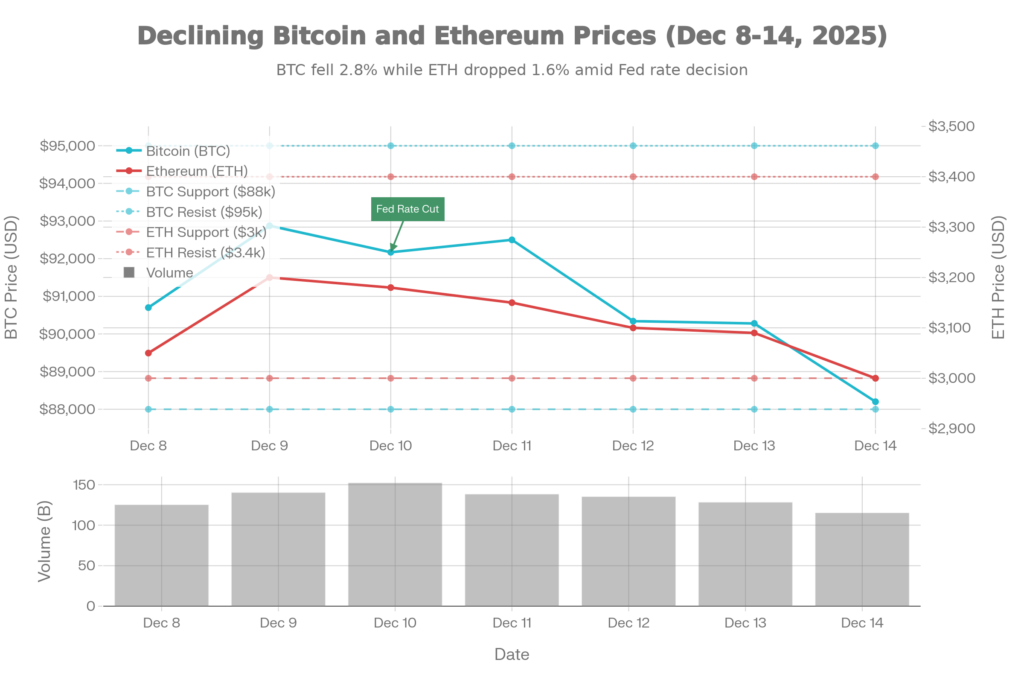
Bitcoin & Ethereum Daily Price Action December_8-14,_2025

Bitcoin’s Troubled Week


Bitcoin started the week near $90,700, showing initial stability after the December 1-7 recovery rally that had taken BTC from $85K to nearly $98K.


Daily progression:


DateBTC CloseChangeEvent/Context
Dec 8$90,700+0.28%Week opens with consolidation
Dec 9$92,875+2.25%Pre-Fed optimism, anticipation
Dec 10$92,170-0.71%Fed cuts but hawkish guidance → selloff
Dec 11$92,500+0.55%Technical bounce attempt
Dec 12$90,340-2.44%Sentiment deteriorates, macro pressure
Dec 13$90,280-0.07%Stabilization at support
Dec 14$88,200-2.31%Weakness accelerates, week closes lower

Key technical levels:

    • Resistance: $95,000 (50-day MA), then $100K (psychological)

    • Support: $88,000 (critical), then $85,600 (Dec 1 low)

    • Weekly structure: Failed to sustain above $92K; selling pressure above this level

    • Volume: Declining through the week ($152B on Dec 10 peak → $115B by Dec 14), suggesting exhaustion rather than aggressive selling

Interpretation: Bitcoin formed a weekly lower high ($92,875 on Dec 9) and failed to hold, a bearish technical pattern. However, the fact that selling didn’t accelerate below $88K suggests support is being respected by institutional buyers.


Ethereum’s Relative Underperformance


Ethereum declined -3.5% weekly, underperforming Bitcoin’s -2.8% loss. This is notable because typically ETH shows better resilience in risk-off environments due to DeFi and Layer 2 narratives.


Why ETH underperformed:

    1. DeFi TVL contraction: Total Value Locked in Ethereum DeFi protocols declined ~$4-5B as traders reduced leverage

    2. ETH/BTC ratio weakened: Fell from 0.0374 to 0.0343, a 8.3% decline, indicating capital rotating from alts back to Bitcoin

    3. Layer 2 sentiment: Despite good technical progress, layer 2s saw reduced trading activity as macro concerns dominated

Critical level: $3,000 became the psychological floor. ETH closed the week at exactly this level, suggesting strong institutional buying support here. Breaking below $3,000 would be technically significant and could trigger stops down to $2,800-$2,900.


Part 3: Altcoin Market Divergence
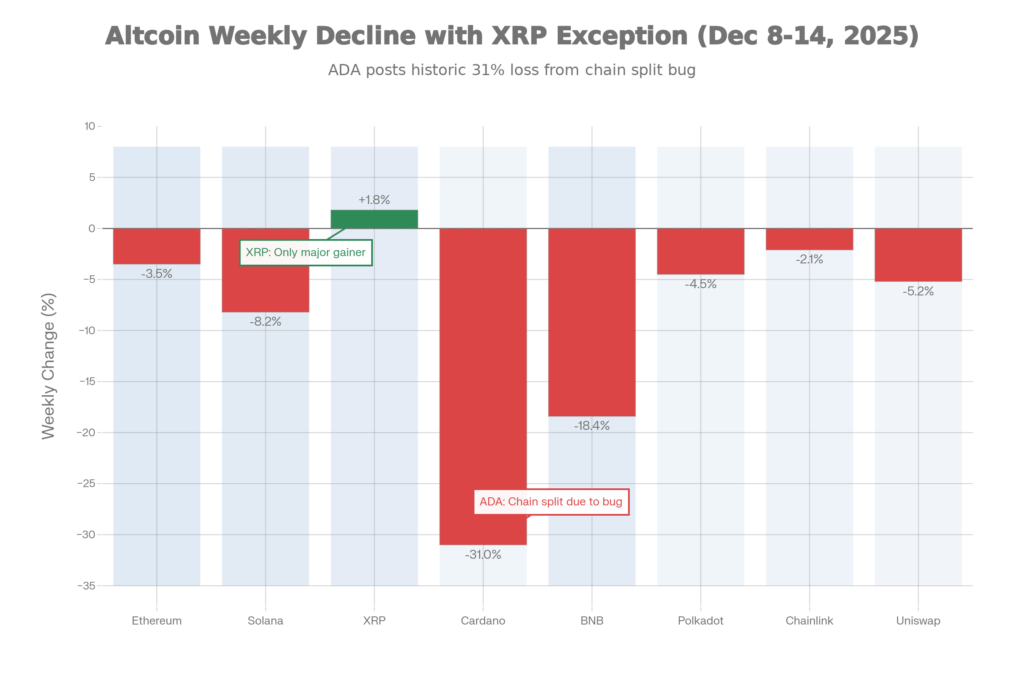
The Good, The Bad, and The Disaster


This week’s altcoin performance was highly bifurcated, with massive divergence between winners and losers.


Biggest Losers:

    1. Cardano (ADA): -31% ⚠️ CRITICAL EVENT

      • A transaction on the network exploited a smart contract vulnerability, triggering a chain split (fork) where some nodes disagreed on the canonical chain state

      • This forced ADA into a challenging position: either fork to fix the bug (invalidating some transactions) or accept the vulnerability

      • The incident destroyed confidence in ADA’s technical robustness and sparked fears of more undiscovered bugs

      • Institutional support evaporated; ADA broke critical technical levels

    2. BNB (Binance Coin): -18.4%

      • Binance’s native token declined amid reports of regulatory scrutiny in multiple jurisdictions

      • Reduced trading fee incentives on the Binance platform also hurt sentiment

      • BNB is now significantly lagging after its strong November performance

    3. Solana (SOL): -8.2%

      • Despite the decline, Solana saw positive institutional flows (+$140M in ETF inflows)

      • This divergence (price down, capital flowing in) suggests institutional conviction that current levels are attractive

      • The weakness was likely technical profit-taking after SOL’s 40%+ run from October lows

      • Support held at $125-130 range (critical zone for further stability)

Rare Gainer:

    • XRP: +1.8% (only major winner)

      • Benefited from ongoing institutional interest in tokenized assets

      • Strong demand for tokenized stocks on Solana (where XRP plays a role in settlement and liquidity)

      • XRP’s payment-focused narrative remained attractive despite broader market weakness

Key observation: Small-cap AI tokens continued to outperform despite weakness in established L1s, driven by Grayscale’s launch of a Bittensor Trust (TAO) and TAO’s halving on December 14, which generated institutional interest.


Part 4: Institutional Flows and Capital Positioning
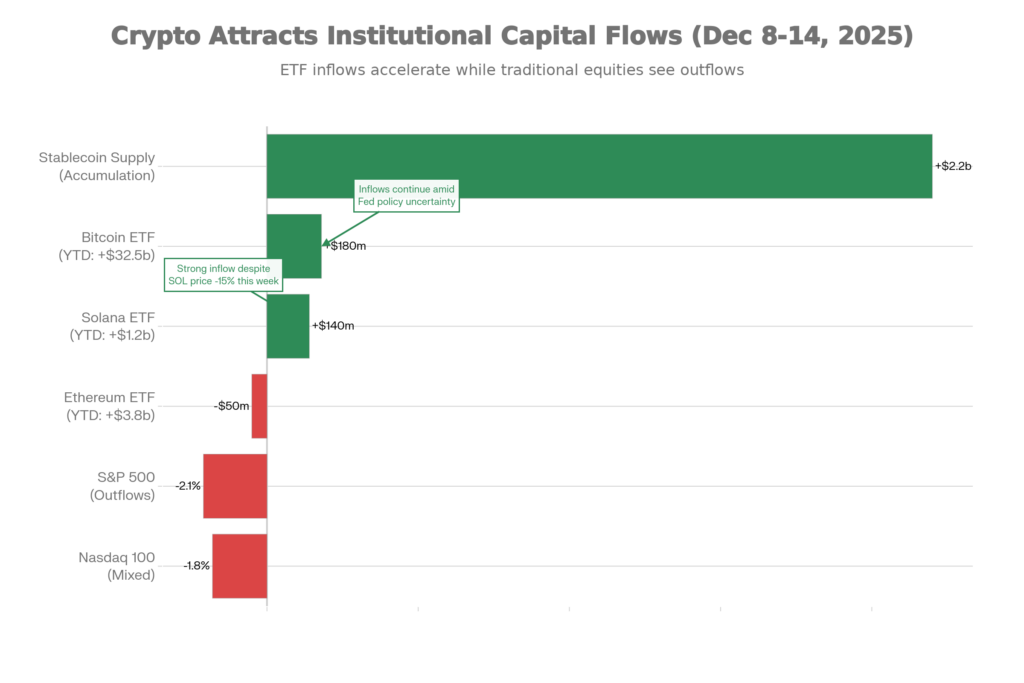
Institutional Capital Flows December 8-14, 2025 (Divergent Risk Sentiment)

The Key Signal: Flows Diverge from Price


One of the most important developments this week was the divergence between price movement and capital flows. Here’s what institutional players were doing:


Bitcoin ETF Flows:

    • Monday-Wednesday: +$287M cumulative (anticipating Fed cut relief)

    • Thursday-Friday: -$107M (disappointment with Fed guidance)

    • Week net: +$180M inflows

Despite Bitcoin’s -2.8% decline, major institutional Bitcoin ETF vehicles (BlackRock IBIT, Fidelity FBTC) saw cumulative inflows. This suggests that large capital allocators view current $88-90K levels as attractive entry points.


Ethereum ETF Flows:

    • Week net: -$50M outflows

For the first time in several weeks, Ethereum experienced net outflows as some institutional capital rotated away. This likely reflects the ETH/BTC weakness and declining confidence in near-term DeFi momentum.


Solana ETF Flows:

    • Week net: +$140M inflows ⭐ STRONGEST INSTITUTIONAL INTEREST

This is remarkable: despite SOL price declining -8.2%, Solana spot ETFs attracted nearly as much capital as Bitcoin. The divergence reflects institutional conviction in:

    • Solana’s role as the dominant tokenized stock platform (95%+ market share)

    • Network fundamentals (zero outages, 400ms latency, sub-penny fees)

    • Long-term narrative positioning ahead of 2026 institutional adoption

Traditional Market Context:


Asset ClassWeekly ChangeFlow Direction
S&P 500-2.1%Outflows
Nasdaq 100-1.8%Mixed
Crypto Market-1.77%Selective inflows

Crypto outperformed traditional equities on a percentage basis and attracted flows despite headline weakness—a bullish signal for relative strength.


Stablecoin Supply Growth


Stablecoin supply (USDT, USDC combined) increased +$2.2B during the week, from $135.2B to $137.4B. This represents:

    1. Capital accumulation: Traders converting volatile holdings to stables to preserve value

    2. Dry powder preparation: Ready capital to deploy on significant dips

    3. Risk hedging: Temporary de-risking while monitoring macro conditions

High stablecoin levels historically precede rallies when sentiment reverses. The +$2.2B increase is significant relative to typical weekly stablecoin volatility.


Part 5: Market Sentiment and Risk Positioning
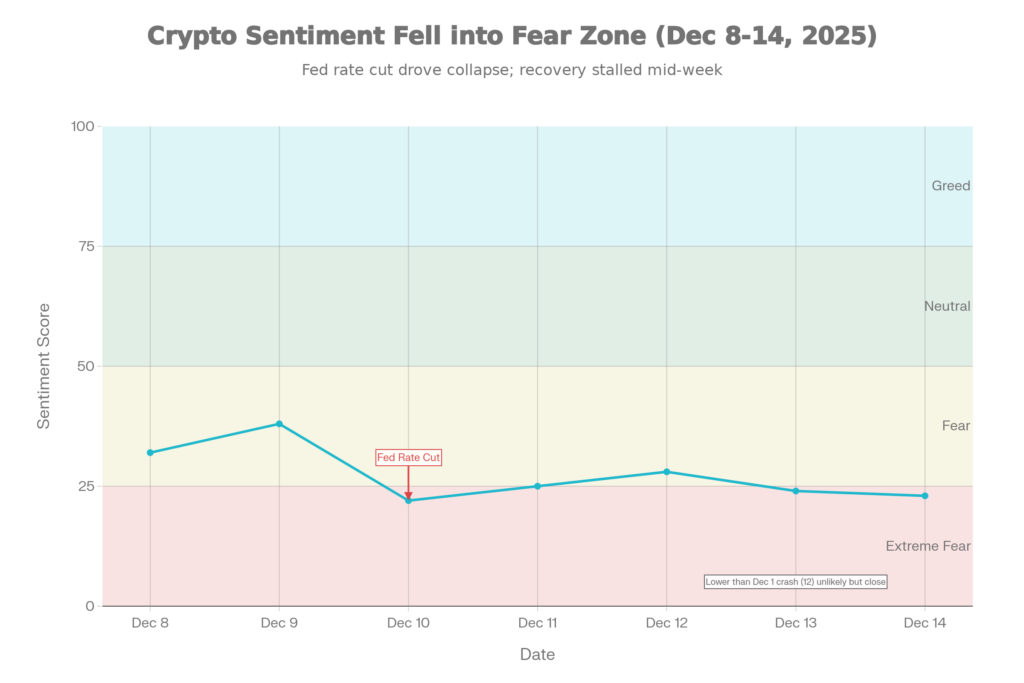
Crypto Sentiment Collapse December 8-14, 2025 (Fear & Greed Index)

The Sentiment Collapse


The Crypto Fear & Greed Index told the story of the week perfectly:

    • December 8: 32/100 (Fear)

    • December 9: 38/100 (Fear, approaching Neutral)

    • December 10: 22/100 (Extreme Fear) ← Fed announcement impact

    • December 11-14: 23-28/100 (Extreme Fear zone persists)

Context: A score of 23 is approaching the extreme lows seen during the December 1 crash (score: 12). This week’s sentiment was nearly as pessimistic as that capitulation event, despite Bitcoin only being $2K lower.


What Extreme Fear Signals


Historically, when sentiment reaches these levels:

    1. Capitulation is near: Weak hands have already sold

    2. Accumulation opportunity: Smart money uses this as entry point

    3. Recovery potential: Sentiment this low has preceded some of crypto’s strongest rallies

The fact that sentiment reached extreme fear despite only a 2.8% price decline suggests psychological fragility rather than fundamental breakdown. Traders are worried about the macro outlook (Fed policy, 2026 rates), not about crypto fundamentals.


Retail vs. Institutional Divergence


    • Retail: Defensive positioning, reduced trading, fear-driven

    • Institutional: Selective accumulation (Solana ETF inflows despite -8% price decline, Bitcoin ETF inflows despite weakness)

This divergence is historically bullish. When institutions buy into retail fear, it often precedes recovery phases.


Part 6: Catalysts and Forward-Looking Drivers


Near-Term Catalysts (Dec 15-21)


    1. Year-end positioning: Traders closing books for the year, potentially driving volatility

    2. Holiday liquidity: Reduced trading volumes as market participants take year-end breaks

    3. Tax-loss harvesting: Potential selling pressure as traders lock in losses for tax purposes (particularly in US)

Medium-Term Catalysts (Late December – January)


    1. Fed futures reset: Markets will price in new expectations for 2026 rate cuts (likely 2-3 instead of 4+)

    2. Institutional positioning: January often sees institutional rebalancing and capital allocation shifts

    3. Bitcoin adoption narrative: Continued corporate treasury accumulation (MicroStrategy pattern)

    4. Ethereum Fusaka upgrade: Expected improvements to smart contract functionality

Technical Catalysts


Bitcoin levels to watch:

    • Below $85K: Could trigger stop-losses and test investor conviction

    • Above $95K: Would signal bullish momentum returning, potentially targeting $100K again

    • $88-90K range: Current consolidation; breaking either direction matters

Ethereum levels to watch:

    • Below $2,800: Would signal extended weakness; $2,600 would test 2025 lows

    • Above $3,400: Would signal recovery and renewed confidence

    • $3,000: Critical psychological support; institutional buying here evident


Part 7: Risk Factors and Headwinds


Macro Headwinds


    1. Inflation resilience: Despite expectations for lower rates, headline inflation remains sticky (3%+ CPI)

    2. Fed policy uncertainty: Powell’s comments about fewer 2026 cuts create ambiguity

    3. Global tensions: Geopolitical risks (Middle East, Ukraine) could spike volatility

    4. US-China relations: Trade tensions could resurface after the 2024 election cycle

Crypto-Specific Risks


    1. Regulatory crackdown: SEC continues to scrutinize crypto platforms and spot ETFs

    2. Technical vulnerabilities: ADA’s chain split this week highlighted smart contract risks (other chains could face similar issues)

    3. Leverage accumulation: Funding rates suggest some leverage rebuilding; any sharp move could trigger cascading liquidations

    4. Exchange solvency: Monitoring of major exchanges (Binance regulatory issues, Kraken compliance challenges)

Sentiment Extremes


At a 23/100 sentiment score, markets are pricing in significant downside risk. Further selling would be required to reach capitulation levels (12-15), at which point reversal patterns have historically been most reliable.


Part 8: Key Takeaways and Strategy Implications


For Long-Term Holders


    1. Hold positions: Macro weakness is temporary; crypto fundamentals remain strong

    2. Consider averaging in: Extreme sentiment provides accumulation opportunity

    3. Don’t panic sell: Selling into fear typically locks in losses right before recoveries

    4. Plan for volatility: Expect potential 10-20% swings into year-end

For Active Traders


    1. Respect support: $88K Bitcoin support is critical; break suggests further downside to $85K

    2. Watch sentiment: Reversal signals will likely emerge when sentiment stabilizes above 30

    3. Monitor institutional flows: Continued ETF inflows despite price weakness is bullish contrarian signal

    4. Avoid leverage: Sentiment this extreme can whip-saw leveraged positions

For Arbitrage Practitioners


    1. Spreads widening: Market volatility creates broader CeFi-DEX spreads

    2. Solana tokenized stocks: Maintained arbitrage opportunities despite broader market weakness

    3. DeFi yield: Lending rates climbing as demand for leverage decreases

    4. Volatility arbitrage: VIX-like indicators for crypto elevated; potential edges in volatility selling


💬 Frequently Asked Questions (FAQ)

Why did Bitcoin sell off despite the Fed cutting rates?

Forward guidance, not the rate cut itself, drove selling. Powell signaled fewer cuts in 2026 than investors expected, removing a key bullish catalyst.

Unlikely. Weekly -2.8% decline is normal volatility. Institutional capital accumulation and technical support holding suggest this is a consolidation, not a breakdown.

Only if you can’t afford the volatility or need the capital. Selling at 23/100 sentiment (extreme fear) historically precedes recoveries.

Fed pivot toward dovish messaging + institutional capital acceleration + technical breakout above $95K = path to new highs. Likely timeline: Q1 2026.

Institutions view weakness as opportunity. They’re buying strength (not panic selling), a contrarian indicator.


Conclusion: The Setup for a Potential Reversal


The week of December 8-14 was challenging for crypto, but the setup for recovery is potentially attractive:

✅ Institutional capital accumulating (Bitcoin ETF +$180M, Solana ETF +$140M)
✅ Sentiment at extreme lows (23/100, near capitulation levels)
✅ Technical support holding ($88K for BTC, $3K for ETH)
✅ Stablecoin supply elevated (ready for deployment on recovery)
✅ Bitcoin dominance stabilizing (55% vs. 56.8% at December 1 crash)


What could reverse the sentiment:

    1. Fed signals toward maintaining rate cuts (dovish pivot)

    2. Resolution of macro uncertainty (geopolitical de-escalation, inflation data)

    3. Institutional capital acceleration (mega-cap tech firms following MicroStrategy)

    4. Technical breakout above $95K (signals momentum returning)

The critical level: If Bitcoin holds $88K support through year-end, early 2026 could see aggressive institutional accumulation. If $88K breaks, the $85K low from December 1 becomes the target.


For now, the risk-reward at current levels (BTC $88-90K, ETH $3,000) appears favorable for traders with conviction in crypto’s long-term narrative. Near-term volatility is expected, but the foundational setup for recovery is building.


Resources & Data Sources


Real-Time Data:

News & Analysis:


  •  

Disclaimer: This analysis is for informational and educational purposes only. Cryptocurrency markets are highly volatile and involve substantial risk of loss. Past performance does not guarantee future results. Never invest more than you can afford to lose. Consult qualified financial professionals before making investment decisions.

Max Takeda

Max Takeda is the Chief Technology Officer at NeuralArB, where he leads the company’s technology vision, overseeing the development and implementation of cutting-edge AI algorithms and blockchain solutions that power crypto arbitrage trading efficiency. With a strong background in software engineering, artificial intelligence, and distributed ledger technology, Max combines technical expertise with strategic thinking to drive NeuralArB's mission to revolutionize the cryptocurrency trading space. Connect with Max on Twitter: @MaxTakeda91

Crypto Market Update – December 8-14, 2025: Consolidation Amid Fed Uncertainty

Crypto Market Update – December 8-14, 2025

Executive Summary: The Week Fed Expectations Met Reality


The week of December 8-14, 2025 was supposed to be constructive—the Federal Reserve cut rates by 25 basis points, a positive signal for risk assets. Instead, the crypto market experienced a modest selloff driven by hawkish forward guidance suggesting fewer rate cuts in 2026 than investors had anticipated.


Weekly Snapshot:

    • Bitcoin: $90,700 → $88,200 (-2.8% weekly)

    • Ethereum: $3,050 → $3,000 (-1.6% weekly)

    • Total Market Cap: $3.15T → $3.08T (-1.77% weekly)

    • Sentiment Index: 32 → 23 (Extreme Fear territory)

    • Trading Volume: $132B daily average (+4% WoW, cautious participation)

The critical headline: Markets no longer believe the Fed will aggressively cut rates in 2026. This single shift in expectations drove the selloff more than the actual rate cut itself.


However, beneath the headline weakness, institutional capital continued selective accumulation, with Bitcoin ETF inflows (+$180M), Solana ETF inflows (+$140M), and stablecoin supply growth (+$2.2B) signaling that sophisticated investors view current levels as attractive despite near-term weakness.


Part 1: The Fed Decision and Market Disappointment


The December 10 Rate Cut


On December 10, the Federal Reserve cut the federal funds rate by 25 basis points, lowering the target range to 3.50%-3.75%. By traditional asset pricing, this should have been supportive for risk assets like crypto.

What happened instead: Bitcoin and equities both sold off.

The reason: Forward guidance was more dovish than markets expected. Fed Chair Jerome Powell indicated that the pace of rate cuts would likely slow in 2026, with fewer cuts than previously guided. Investors had been priced for 3-4 cuts in 2026; Powell’s statement suggested 2-3 at most.


Market interpretation:

    • Dovish reading: Rates are coming down, which is good for crypto

    • Hawkish reading: The Fed is concerned about inflation resurging, so won’t cut aggressively

Crypto traders weighted the hawkish reading more heavily, interpreting it as a signal that rates might not fall as much as needed to drive a major risk asset rally.


Liquidity Expectations and Crypto


Crypto markets are hypersensitive to liquidity conditions. When the Fed cuts rates, crypto traders expect:

    1. Increased liquidity in financial markets

    2. Reduced real yields (making non-yielding assets like crypto more attractive)

    3. Lower discount rates for future tech/crypto adoption narratives

Powell’s guidance suggested liquidity improvements will be muted in 2026, which undermined the near-term bullish case.


Additionally, the Fed’s emphasis on inflation monitoring suggested that if inflation re-accelerates (a real risk heading into 2026), the Fed would shift from cutting to holding or even raising rates again.


Result: Risk-off sentiment across crypto, equities, and high-beta assets.


Part 2: Daily Price Action and Technical Breakdown

Bitcoin & Ethereum Daily Price Action December_8-14,_2025

Bitcoin’s Troubled Week


Bitcoin started the week near $90,700, showing initial stability after the December 1-7 recovery rally that had taken BTC from $85K to nearly $98K.


Daily progression:


DateBTC CloseChangeEvent/Context
Dec 8$90,700+0.28%Week opens with consolidation
Dec 9$92,875+2.25%Pre-Fed optimism, anticipation
Dec 10$92,170-0.71%Fed cuts but hawkish guidance → selloff
Dec 11$92,500+0.55%Technical bounce attempt
Dec 12$90,340-2.44%Sentiment deteriorates, macro pressure
Dec 13$90,280-0.07%Stabilization at support
Dec 14$88,200-2.31%Weakness accelerates, week closes lower

Key technical levels:

    • Resistance: $95,000 (50-day MA), then $100K (psychological)

    • Support: $88,000 (critical), then $85,600 (Dec 1 low)

    • Weekly structure: Failed to sustain above $92K; selling pressure above this level

    • Volume: Declining through the week ($152B on Dec 10 peak → $115B by Dec 14), suggesting exhaustion rather than aggressive selling

Interpretation: Bitcoin formed a weekly lower high ($92,875 on Dec 9) and failed to hold, a bearish technical pattern. However, the fact that selling didn’t accelerate below $88K suggests support is being respected by institutional buyers.


Ethereum’s Relative Underperformance


Ethereum declined -3.5% weekly, underperforming Bitcoin’s -2.8% loss. This is notable because typically ETH shows better resilience in risk-off environments due to DeFi and Layer 2 narratives.


Why ETH underperformed:

    1. DeFi TVL contraction: Total Value Locked in Ethereum DeFi protocols declined ~$4-5B as traders reduced leverage

    2. ETH/BTC ratio weakened: Fell from 0.0374 to 0.0343, a 8.3% decline, indicating capital rotating from alts back to Bitcoin

    3. Layer 2 sentiment: Despite good technical progress, layer 2s saw reduced trading activity as macro concerns dominated

Critical level: $3,000 became the psychological floor. ETH closed the week at exactly this level, suggesting strong institutional buying support here. Breaking below $3,000 would be technically significant and could trigger stops down to $2,800-$2,900.


Part 3: Altcoin Market Divergence

The Good, The Bad, and The Disaster


This week’s altcoin performance was highly bifurcated, with massive divergence between winners and losers.


Biggest Losers:

    1. Cardano (ADA): -31% ⚠️ CRITICAL EVENT

      • A transaction on the network exploited a smart contract vulnerability, triggering a chain split (fork) where some nodes disagreed on the canonical chain state

      • This forced ADA into a challenging position: either fork to fix the bug (invalidating some transactions) or accept the vulnerability

      • The incident destroyed confidence in ADA’s technical robustness and sparked fears of more undiscovered bugs

      • Institutional support evaporated; ADA broke critical technical levels

    2. BNB (Binance Coin): -18.4%

      • Binance’s native token declined amid reports of regulatory scrutiny in multiple jurisdictions

      • Reduced trading fee incentives on the Binance platform also hurt sentiment

      • BNB is now significantly lagging after its strong November performance

    3. Solana (SOL): -8.2%

      • Despite the decline, Solana saw positive institutional flows (+$140M in ETF inflows)

      • This divergence (price down, capital flowing in) suggests institutional conviction that current levels are attractive

      • The weakness was likely technical profit-taking after SOL’s 40%+ run from October lows

      • Support held at $125-130 range (critical zone for further stability)

Rare Gainer:

    • XRP: +1.8% (only major winner)

      • Benefited from ongoing institutional interest in tokenized assets

      • Strong demand for tokenized stocks on Solana (where XRP plays a role in settlement and liquidity)

      • XRP’s payment-focused narrative remained attractive despite broader market weakness

Key observation: Small-cap AI tokens continued to outperform despite weakness in established L1s, driven by Grayscale’s launch of a Bittensor Trust (TAO) and TAO’s halving on December 14, which generated institutional interest.


Part 4: Institutional Flows and Capital Positioning

Institutional Capital Flows December 8-14, 2025 (Divergent Risk Sentiment)

The Key Signal: Flows Diverge from Price


One of the most important developments this week was the divergence between price movement and capital flows. Here’s what institutional players were doing:


Bitcoin ETF Flows:

    • Monday-Wednesday: +$287M cumulative (anticipating Fed cut relief)

    • Thursday-Friday: -$107M (disappointment with Fed guidance)

    • Week net: +$180M inflows

Despite Bitcoin’s -2.8% decline, major institutional Bitcoin ETF vehicles (BlackRock IBIT, Fidelity FBTC) saw cumulative inflows. This suggests that large capital allocators view current $88-90K levels as attractive entry points.


Ethereum ETF Flows:

    • Week net: -$50M outflows

For the first time in several weeks, Ethereum experienced net outflows as some institutional capital rotated away. This likely reflects the ETH/BTC weakness and declining confidence in near-term DeFi momentum.


Solana ETF Flows:

    • Week net: +$140M inflows ⭐ STRONGEST INSTITUTIONAL INTEREST

This is remarkable: despite SOL price declining -8.2%, Solana spot ETFs attracted nearly as much capital as Bitcoin. The divergence reflects institutional conviction in:

    • Solana’s role as the dominant tokenized stock platform (95%+ market share)

    • Network fundamentals (zero outages, 400ms latency, sub-penny fees)

    • Long-term narrative positioning ahead of 2026 institutional adoption

Traditional Market Context:


Asset ClassWeekly ChangeFlow Direction
S&P 500-2.1%Outflows
Nasdaq 100-1.8%Mixed
Crypto Market-1.77%Selective inflows

Crypto outperformed traditional equities on a percentage basis and attracted flows despite headline weakness—a bullish signal for relative strength.


Stablecoin Supply Growth


Stablecoin supply (USDT, USDC combined) increased +$2.2B during the week, from $135.2B to $137.4B. This represents:

    1. Capital accumulation: Traders converting volatile holdings to stables to preserve value

    2. Dry powder preparation: Ready capital to deploy on significant dips

    3. Risk hedging: Temporary de-risking while monitoring macro conditions

High stablecoin levels historically precede rallies when sentiment reverses. The +$2.2B increase is significant relative to typical weekly stablecoin volatility.


Part 5: Market Sentiment and Risk Positioning

Crypto Sentiment Collapse December 8-14, 2025 (Fear & Greed Index)

The Sentiment Collapse


The Crypto Fear & Greed Index told the story of the week perfectly:

    • December 8: 32/100 (Fear)

    • December 9: 38/100 (Fear, approaching Neutral)

    • December 10: 22/100 (Extreme Fear) ← Fed announcement impact

    • December 11-14: 23-28/100 (Extreme Fear zone persists)

Context: A score of 23 is approaching the extreme lows seen during the December 1 crash (score: 12). This week’s sentiment was nearly as pessimistic as that capitulation event, despite Bitcoin only being $2K lower.


What Extreme Fear Signals


Historically, when sentiment reaches these levels:

    1. Capitulation is near: Weak hands have already sold

    2. Accumulation opportunity: Smart money uses this as entry point

    3. Recovery potential: Sentiment this low has preceded some of crypto’s strongest rallies

The fact that sentiment reached extreme fear despite only a 2.8% price decline suggests psychological fragility rather than fundamental breakdown. Traders are worried about the macro outlook (Fed policy, 2026 rates), not about crypto fundamentals.


Retail vs. Institutional Divergence


    • Retail: Defensive positioning, reduced trading, fear-driven

    • Institutional: Selective accumulation (Solana ETF inflows despite -8% price decline, Bitcoin ETF inflows despite weakness)

This divergence is historically bullish. When institutions buy into retail fear, it often precedes recovery phases.


Part 6: Catalysts and Forward-Looking Drivers


Near-Term Catalysts (Dec 15-21)


    1. Year-end positioning: Traders closing books for the year, potentially driving volatility

    2. Holiday liquidity: Reduced trading volumes as market participants take year-end breaks

    3. Tax-loss harvesting: Potential selling pressure as traders lock in losses for tax purposes (particularly in US)

Medium-Term Catalysts (Late December – January)


    1. Fed futures reset: Markets will price in new expectations for 2026 rate cuts (likely 2-3 instead of 4+)

    2. Institutional positioning: January often sees institutional rebalancing and capital allocation shifts

    3. Bitcoin adoption narrative: Continued corporate treasury accumulation (MicroStrategy pattern)

    4. Ethereum Fusaka upgrade: Expected improvements to smart contract functionality

Technical Catalysts


Bitcoin levels to watch:

    • Below $85K: Could trigger stop-losses and test investor conviction

    • Above $95K: Would signal bullish momentum returning, potentially targeting $100K again

    • $88-90K range: Current consolidation; breaking either direction matters

Ethereum levels to watch:

    • Below $2,800: Would signal extended weakness; $2,600 would test 2025 lows

    • Above $3,400: Would signal recovery and renewed confidence

    • $3,000: Critical psychological support; institutional buying here evident


Part 7: Risk Factors and Headwinds


Macro Headwinds


    1. Inflation resilience: Despite expectations for lower rates, headline inflation remains sticky (3%+ CPI)

    2. Fed policy uncertainty: Powell’s comments about fewer 2026 cuts create ambiguity

    3. Global tensions: Geopolitical risks (Middle East, Ukraine) could spike volatility

    4. US-China relations: Trade tensions could resurface after the 2024 election cycle

Crypto-Specific Risks


    1. Regulatory crackdown: SEC continues to scrutinize crypto platforms and spot ETFs

    2. Technical vulnerabilities: ADA’s chain split this week highlighted smart contract risks (other chains could face similar issues)

    3. Leverage accumulation: Funding rates suggest some leverage rebuilding; any sharp move could trigger cascading liquidations

    4. Exchange solvency: Monitoring of major exchanges (Binance regulatory issues, Kraken compliance challenges)

Sentiment Extremes


At a 23/100 sentiment score, markets are pricing in significant downside risk. Further selling would be required to reach capitulation levels (12-15), at which point reversal patterns have historically been most reliable.


Part 8: Key Takeaways and Strategy Implications


For Long-Term Holders


    1. Hold positions: Macro weakness is temporary; crypto fundamentals remain strong

    2. Consider averaging in: Extreme sentiment provides accumulation opportunity

    3. Don’t panic sell: Selling into fear typically locks in losses right before recoveries

    4. Plan for volatility: Expect potential 10-20% swings into year-end

For Active Traders


    1. Respect support: $88K Bitcoin support is critical; break suggests further downside to $85K

    2. Watch sentiment: Reversal signals will likely emerge when sentiment stabilizes above 30

    3. Monitor institutional flows: Continued ETF inflows despite price weakness is bullish contrarian signal

    4. Avoid leverage: Sentiment this extreme can whip-saw leveraged positions

For Arbitrage Practitioners


    1. Spreads widening: Market volatility creates broader CeFi-DEX spreads

    2. Solana tokenized stocks: Maintained arbitrage opportunities despite broader market weakness

    3. DeFi yield: Lending rates climbing as demand for leverage decreases

    4. Volatility arbitrage: VIX-like indicators for crypto elevated; potential edges in volatility selling


💬 Frequently Asked Questions (FAQ)

Why did Bitcoin sell off despite the Fed cutting rates?

Forward guidance, not the rate cut itself, drove selling. Powell signaled fewer cuts in 2026 than investors expected, removing a key bullish catalyst.

Unlikely. Weekly -2.8% decline is normal volatility. Institutional capital accumulation and technical support holding suggest this is a consolidation, not a breakdown.

Only if you can’t afford the volatility or need the capital. Selling at 23/100 sentiment (extreme fear) historically precedes recoveries.

Fed pivot toward dovish messaging + institutional capital acceleration + technical breakout above $95K = path to new highs. Likely timeline: Q1 2026.

Institutions view weakness as opportunity. They’re buying strength (not panic selling), a contrarian indicator.


Conclusion: The Setup for a Potential Reversal


The week of December 8-14 was challenging for crypto, but the setup for recovery is potentially attractive:

✅ Institutional capital accumulating (Bitcoin ETF +$180M, Solana ETF +$140M)
✅ Sentiment at extreme lows (23/100, near capitulation levels)
✅ Technical support holding ($88K for BTC, $3K for ETH)
✅ Stablecoin supply elevated (ready for deployment on recovery)
✅ Bitcoin dominance stabilizing (55% vs. 56.8% at December 1 crash)


What could reverse the sentiment:

    1. Fed signals toward maintaining rate cuts (dovish pivot)

    2. Resolution of macro uncertainty (geopolitical de-escalation, inflation data)

    3. Institutional capital acceleration (mega-cap tech firms following MicroStrategy)

    4. Technical breakout above $95K (signals momentum returning)

The critical level: If Bitcoin holds $88K support through year-end, early 2026 could see aggressive institutional accumulation. If $88K breaks, the $85K low from December 1 becomes the target.


For now, the risk-reward at current levels (BTC $88-90K, ETH $3,000) appears favorable for traders with conviction in crypto’s long-term narrative. Near-term volatility is expected, but the foundational setup for recovery is building.


Resources & Data Sources


Real-Time Data:

News & Analysis:


  •  

Disclaimer: This analysis is for informational and educational purposes only. Cryptocurrency markets are highly volatile and involve substantial risk of loss. Past performance does not guarantee future results. Never invest more than you can afford to lose. Consult qualified financial professionals before making investment decisions.

Max Takeda

Max Takeda is the Chief Technology Officer at NeuralArB, where he leads the company’s technology vision, overseeing the development and implementation of cutting-edge AI algorithms and blockchain solutions that power crypto arbitrage trading efficiency. With a strong background in software engineering, artificial intelligence, and distributed ledger technology, Max combines technical expertise with strategic thinking to drive NeuralArB's mission to revolutionize the cryptocurrency trading space. Connect with Max on Twitter: @MaxTakeda91

Crypto Market Update – December 8-14, 2025: Consolidation Amid Fed Uncertainty

Crypto Market Update – December 8-14, 2025

Executive Summary: The Week Fed Expectations Met Reality


The week of December 8-14, 2025 was supposed to be constructive—the Federal Reserve cut rates by 25 basis points, a positive signal for risk assets. Instead, the crypto market experienced a modest selloff driven by hawkish forward guidance suggesting fewer rate cuts in 2026 than investors had anticipated.


Weekly Snapshot:

    • Bitcoin: $90,700 → $88,200 (-2.8% weekly)

    • Ethereum: $3,050 → $3,000 (-1.6% weekly)

    • Total Market Cap: $3.15T → $3.08T (-1.77% weekly)

    • Sentiment Index: 32 → 23 (Extreme Fear territory)

    • Trading Volume: $132B daily average (+4% WoW, cautious participation)

The critical headline: Markets no longer believe the Fed will aggressively cut rates in 2026. This single shift in expectations drove the selloff more than the actual rate cut itself.


However, beneath the headline weakness, institutional capital continued selective accumulation, with Bitcoin ETF inflows (+$180M), Solana ETF inflows (+$140M), and stablecoin supply growth (+$2.2B) signaling that sophisticated investors view current levels as attractive despite near-term weakness.


Part 1: The Fed Decision and Market Disappointment


The December 10 Rate Cut


On December 10, the Federal Reserve cut the federal funds rate by 25 basis points, lowering the target range to 3.50%-3.75%. By traditional asset pricing, this should have been supportive for risk assets like crypto.

What happened instead: Bitcoin and equities both sold off.

The reason: Forward guidance was more dovish than markets expected. Fed Chair Jerome Powell indicated that the pace of rate cuts would likely slow in 2026, with fewer cuts than previously guided. Investors had been priced for 3-4 cuts in 2026; Powell’s statement suggested 2-3 at most.


Market interpretation:

    • Dovish reading: Rates are coming down, which is good for crypto

    • Hawkish reading: The Fed is concerned about inflation resurging, so won’t cut aggressively

Crypto traders weighted the hawkish reading more heavily, interpreting it as a signal that rates might not fall as much as needed to drive a major risk asset rally.


Liquidity Expectations and Crypto


Crypto markets are hypersensitive to liquidity conditions. When the Fed cuts rates, crypto traders expect:

    1. Increased liquidity in financial markets

    2. Reduced real yields (making non-yielding assets like crypto more attractive)

    3. Lower discount rates for future tech/crypto adoption narratives

Powell’s guidance suggested liquidity improvements will be muted in 2026, which undermined the near-term bullish case.


Additionally, the Fed’s emphasis on inflation monitoring suggested that if inflation re-accelerates (a real risk heading into 2026), the Fed would shift from cutting to holding or even raising rates again.


Result: Risk-off sentiment across crypto, equities, and high-beta assets.


Part 2: Daily Price Action and Technical Breakdown

Bitcoin & Ethereum Daily Price Action December_8-14,_2025

Bitcoin’s Troubled Week


Bitcoin started the week near $90,700, showing initial stability after the December 1-7 recovery rally that had taken BTC from $85K to nearly $98K.


Daily progression:


DateBTC CloseChangeEvent/Context
Dec 8$90,700+0.28%Week opens with consolidation
Dec 9$92,875+2.25%Pre-Fed optimism, anticipation
Dec 10$92,170-0.71%Fed cuts but hawkish guidance → selloff
Dec 11$92,500+0.55%Technical bounce attempt
Dec 12$90,340-2.44%Sentiment deteriorates, macro pressure
Dec 13$90,280-0.07%Stabilization at support
Dec 14$88,200-2.31%Weakness accelerates, week closes lower

Key technical levels:

    • Resistance: $95,000 (50-day MA), then $100K (psychological)

    • Support: $88,000 (critical), then $85,600 (Dec 1 low)

    • Weekly structure: Failed to sustain above $92K; selling pressure above this level

    • Volume: Declining through the week ($152B on Dec 10 peak → $115B by Dec 14), suggesting exhaustion rather than aggressive selling

Interpretation: Bitcoin formed a weekly lower high ($92,875 on Dec 9) and failed to hold, a bearish technical pattern. However, the fact that selling didn’t accelerate below $88K suggests support is being respected by institutional buyers.


Ethereum’s Relative Underperformance


Ethereum declined -3.5% weekly, underperforming Bitcoin’s -2.8% loss. This is notable because typically ETH shows better resilience in risk-off environments due to DeFi and Layer 2 narratives.


Why ETH underperformed:

    1. DeFi TVL contraction: Total Value Locked in Ethereum DeFi protocols declined ~$4-5B as traders reduced leverage

    2. ETH/BTC ratio weakened: Fell from 0.0374 to 0.0343, a 8.3% decline, indicating capital rotating from alts back to Bitcoin

    3. Layer 2 sentiment: Despite good technical progress, layer 2s saw reduced trading activity as macro concerns dominated

Critical level: $3,000 became the psychological floor. ETH closed the week at exactly this level, suggesting strong institutional buying support here. Breaking below $3,000 would be technically significant and could trigger stops down to $2,800-$2,900.


Part 3: Altcoin Market Divergence

The Good, The Bad, and The Disaster


This week’s altcoin performance was highly bifurcated, with massive divergence between winners and losers.


Biggest Losers:

    1. Cardano (ADA): -31% ⚠️ CRITICAL EVENT

      • A transaction on the network exploited a smart contract vulnerability, triggering a chain split (fork) where some nodes disagreed on the canonical chain state

      • This forced ADA into a challenging position: either fork to fix the bug (invalidating some transactions) or accept the vulnerability

      • The incident destroyed confidence in ADA’s technical robustness and sparked fears of more undiscovered bugs

      • Institutional support evaporated; ADA broke critical technical levels

    2. BNB (Binance Coin): -18.4%

      • Binance’s native token declined amid reports of regulatory scrutiny in multiple jurisdictions

      • Reduced trading fee incentives on the Binance platform also hurt sentiment

      • BNB is now significantly lagging after its strong November performance

    3. Solana (SOL): -8.2%

      • Despite the decline, Solana saw positive institutional flows (+$140M in ETF inflows)

      • This divergence (price down, capital flowing in) suggests institutional conviction that current levels are attractive

      • The weakness was likely technical profit-taking after SOL’s 40%+ run from October lows

      • Support held at $125-130 range (critical zone for further stability)

Rare Gainer:

    • XRP: +1.8% (only major winner)

      • Benefited from ongoing institutional interest in tokenized assets

      • Strong demand for tokenized stocks on Solana (where XRP plays a role in settlement and liquidity)

      • XRP’s payment-focused narrative remained attractive despite broader market weakness

Key observation: Small-cap AI tokens continued to outperform despite weakness in established L1s, driven by Grayscale’s launch of a Bittensor Trust (TAO) and TAO’s halving on December 14, which generated institutional interest.


Part 4: Institutional Flows and Capital Positioning

Institutional Capital Flows December 8-14, 2025 (Divergent Risk Sentiment)

The Key Signal: Flows Diverge from Price


One of the most important developments this week was the divergence between price movement and capital flows. Here’s what institutional players were doing:


Bitcoin ETF Flows:

    • Monday-Wednesday: +$287M cumulative (anticipating Fed cut relief)

    • Thursday-Friday: -$107M (disappointment with Fed guidance)

    • Week net: +$180M inflows

Despite Bitcoin’s -2.8% decline, major institutional Bitcoin ETF vehicles (BlackRock IBIT, Fidelity FBTC) saw cumulative inflows. This suggests that large capital allocators view current $88-90K levels as attractive entry points.


Ethereum ETF Flows:

    • Week net: -$50M outflows

For the first time in several weeks, Ethereum experienced net outflows as some institutional capital rotated away. This likely reflects the ETH/BTC weakness and declining confidence in near-term DeFi momentum.


Solana ETF Flows:

    • Week net: +$140M inflows ⭐ STRONGEST INSTITUTIONAL INTEREST

This is remarkable: despite SOL price declining -8.2%, Solana spot ETFs attracted nearly as much capital as Bitcoin. The divergence reflects institutional conviction in:

    • Solana’s role as the dominant tokenized stock platform (95%+ market share)

    • Network fundamentals (zero outages, 400ms latency, sub-penny fees)

    • Long-term narrative positioning ahead of 2026 institutional adoption

Traditional Market Context:


Asset ClassWeekly ChangeFlow Direction
S&P 500-2.1%Outflows
Nasdaq 100-1.8%Mixed
Crypto Market-1.77%Selective inflows

Crypto outperformed traditional equities on a percentage basis and attracted flows despite headline weakness—a bullish signal for relative strength.


Stablecoin Supply Growth


Stablecoin supply (USDT, USDC combined) increased +$2.2B during the week, from $135.2B to $137.4B. This represents:

    1. Capital accumulation: Traders converting volatile holdings to stables to preserve value

    2. Dry powder preparation: Ready capital to deploy on significant dips

    3. Risk hedging: Temporary de-risking while monitoring macro conditions

High stablecoin levels historically precede rallies when sentiment reverses. The +$2.2B increase is significant relative to typical weekly stablecoin volatility.


Part 5: Market Sentiment and Risk Positioning

Crypto Sentiment Collapse December 8-14, 2025 (Fear & Greed Index)

The Sentiment Collapse


The Crypto Fear & Greed Index told the story of the week perfectly:

    • December 8: 32/100 (Fear)

    • December 9: 38/100 (Fear, approaching Neutral)

    • December 10: 22/100 (Extreme Fear) ← Fed announcement impact

    • December 11-14: 23-28/100 (Extreme Fear zone persists)

Context: A score of 23 is approaching the extreme lows seen during the December 1 crash (score: 12). This week’s sentiment was nearly as pessimistic as that capitulation event, despite Bitcoin only being $2K lower.


What Extreme Fear Signals


Historically, when sentiment reaches these levels:

    1. Capitulation is near: Weak hands have already sold

    2. Accumulation opportunity: Smart money uses this as entry point

    3. Recovery potential: Sentiment this low has preceded some of crypto’s strongest rallies

The fact that sentiment reached extreme fear despite only a 2.8% price decline suggests psychological fragility rather than fundamental breakdown. Traders are worried about the macro outlook (Fed policy, 2026 rates), not about crypto fundamentals.


Retail vs. Institutional Divergence


    • Retail: Defensive positioning, reduced trading, fear-driven

    • Institutional: Selective accumulation (Solana ETF inflows despite -8% price decline, Bitcoin ETF inflows despite weakness)

This divergence is historically bullish. When institutions buy into retail fear, it often precedes recovery phases.


Part 6: Catalysts and Forward-Looking Drivers


Near-Term Catalysts (Dec 15-21)


    1. Year-end positioning: Traders closing books for the year, potentially driving volatility

    2. Holiday liquidity: Reduced trading volumes as market participants take year-end breaks

    3. Tax-loss harvesting: Potential selling pressure as traders lock in losses for tax purposes (particularly in US)

Medium-Term Catalysts (Late December – January)


    1. Fed futures reset: Markets will price in new expectations for 2026 rate cuts (likely 2-3 instead of 4+)

    2. Institutional positioning: January often sees institutional rebalancing and capital allocation shifts

    3. Bitcoin adoption narrative: Continued corporate treasury accumulation (MicroStrategy pattern)

    4. Ethereum Fusaka upgrade: Expected improvements to smart contract functionality

Technical Catalysts


Bitcoin levels to watch:

    • Below $85K: Could trigger stop-losses and test investor conviction

    • Above $95K: Would signal bullish momentum returning, potentially targeting $100K again

    • $88-90K range: Current consolidation; breaking either direction matters

Ethereum levels to watch:

    • Below $2,800: Would signal extended weakness; $2,600 would test 2025 lows

    • Above $3,400: Would signal recovery and renewed confidence

    • $3,000: Critical psychological support; institutional buying here evident


Part 7: Risk Factors and Headwinds


Macro Headwinds


    1. Inflation resilience: Despite expectations for lower rates, headline inflation remains sticky (3%+ CPI)

    2. Fed policy uncertainty: Powell’s comments about fewer 2026 cuts create ambiguity

    3. Global tensions: Geopolitical risks (Middle East, Ukraine) could spike volatility

    4. US-China relations: Trade tensions could resurface after the 2024 election cycle

Crypto-Specific Risks


    1. Regulatory crackdown: SEC continues to scrutinize crypto platforms and spot ETFs

    2. Technical vulnerabilities: ADA’s chain split this week highlighted smart contract risks (other chains could face similar issues)

    3. Leverage accumulation: Funding rates suggest some leverage rebuilding; any sharp move could trigger cascading liquidations

    4. Exchange solvency: Monitoring of major exchanges (Binance regulatory issues, Kraken compliance challenges)

Sentiment Extremes


At a 23/100 sentiment score, markets are pricing in significant downside risk. Further selling would be required to reach capitulation levels (12-15), at which point reversal patterns have historically been most reliable.


Part 8: Key Takeaways and Strategy Implications


For Long-Term Holders


    1. Hold positions: Macro weakness is temporary; crypto fundamentals remain strong

    2. Consider averaging in: Extreme sentiment provides accumulation opportunity

    3. Don’t panic sell: Selling into fear typically locks in losses right before recoveries

    4. Plan for volatility: Expect potential 10-20% swings into year-end

For Active Traders


    1. Respect support: $88K Bitcoin support is critical; break suggests further downside to $85K

    2. Watch sentiment: Reversal signals will likely emerge when sentiment stabilizes above 30

    3. Monitor institutional flows: Continued ETF inflows despite price weakness is bullish contrarian signal

    4. Avoid leverage: Sentiment this extreme can whip-saw leveraged positions

For Arbitrage Practitioners


    1. Spreads widening: Market volatility creates broader CeFi-DEX spreads

    2. Solana tokenized stocks: Maintained arbitrage opportunities despite broader market weakness

    3. DeFi yield: Lending rates climbing as demand for leverage decreases

    4. Volatility arbitrage: VIX-like indicators for crypto elevated; potential edges in volatility selling


💬 Frequently Asked Questions (FAQ)

Why did Bitcoin sell off despite the Fed cutting rates?

Forward guidance, not the rate cut itself, drove selling. Powell signaled fewer cuts in 2026 than investors expected, removing a key bullish catalyst.

Unlikely. Weekly -2.8% decline is normal volatility. Institutional capital accumulation and technical support holding suggest this is a consolidation, not a breakdown.

Only if you can’t afford the volatility or need the capital. Selling at 23/100 sentiment (extreme fear) historically precedes recoveries.

Fed pivot toward dovish messaging + institutional capital acceleration + technical breakout above $95K = path to new highs. Likely timeline: Q1 2026.

Institutions view weakness as opportunity. They’re buying strength (not panic selling), a contrarian indicator.


Conclusion: The Setup for a Potential Reversal


The week of December 8-14 was challenging for crypto, but the setup for recovery is potentially attractive:

✅ Institutional capital accumulating (Bitcoin ETF +$180M, Solana ETF +$140M)
✅ Sentiment at extreme lows (23/100, near capitulation levels)
✅ Technical support holding ($88K for BTC, $3K for ETH)
✅ Stablecoin supply elevated (ready for deployment on recovery)
✅ Bitcoin dominance stabilizing (55% vs. 56.8% at December 1 crash)


What could reverse the sentiment:

    1. Fed signals toward maintaining rate cuts (dovish pivot)

    2. Resolution of macro uncertainty (geopolitical de-escalation, inflation data)

    3. Institutional capital acceleration (mega-cap tech firms following MicroStrategy)

    4. Technical breakout above $95K (signals momentum returning)

The critical level: If Bitcoin holds $88K support through year-end, early 2026 could see aggressive institutional accumulation. If $88K breaks, the $85K low from December 1 becomes the target.


For now, the risk-reward at current levels (BTC $88-90K, ETH $3,000) appears favorable for traders with conviction in crypto’s long-term narrative. Near-term volatility is expected, but the foundational setup for recovery is building.


Resources & Data Sources


Real-Time Data:

News & Analysis:


  •  

Disclaimer: This analysis is for informational and educational purposes only. Cryptocurrency markets are highly volatile and involve substantial risk of loss. Past performance does not guarantee future results. Never invest more than you can afford to lose. Consult qualified financial professionals before making investment decisions.

Max Takeda

Max Takeda is the Chief Technology Officer at NeuralArB, where he leads the company’s technology vision, overseeing the development and implementation of cutting-edge AI algorithms and blockchain solutions that power crypto arbitrage trading efficiency. With a strong background in software engineering, artificial intelligence, and distributed ledger technology, Max combines technical expertise with strategic thinking to drive NeuralArB's mission to revolutionize the cryptocurrency trading space. Connect with Max on Twitter: @MaxTakeda91

Still have questions, contact us:

© 2026 NAB CONSULTANCY LTD. All right reserved.

These materials are for general information purposes only and are not investment advice or a recommendation or solicitation to buy, sell or hold any cryptoasset or to engage in any specific trading strategy. Some crypto products and markets are unregulated, and you may not be protected by government compensation and/or regulatory protection schemes. The unpredictable nature of the cryptoasset markets can lead to loss of funds. Tax may be payable on any return and/or on any increase in the value of your cryptoassets and you should seek independent advice on your taxation position.

All trademarks, logos, and brand names are the property of their respective owners. All company, product, and service names used in this website are for identification purposes only. Use of these names, trademarks, and brands does not imply endorsement.

NAB does not provide investment or brokerage services. All cryptocurrency spot, margin, and futures products are offered by third-party platforms. Products and services availability varies by country.

Past performance, whether actual or indicated by historical or simulated tests of strategies, is no guarantee of future performance or success. There is a possibility that you may sustain a loss equal to or greater than your entire investment regardless of which asset class you trade (i.e. cryptocurrency); therefore, you should not invest or risk money that you cannot afford to lose. Online trading is not suitable for all investors. Before trading any asset class, customers should review NFA and CFTC advisories, and other relevant disclosures. System access, trade placement, and execution may be delayed or fail due to market volatility and volume, quote delays, system and software errors, Internet traffic, outages and other unforeseen factors.

Still have questions, contact us:

© 2026 NAB CONSULTANCY LTD. All right reserved.

These materials are for general information purposes only and are not investment advice or a recommendation or solicitation to buy, sell or hold any cryptoasset or to engage in any specific trading strategy. Some crypto products and markets are unregulated, and you may not be protected by government compensation and/or regulatory protection schemes. The unpredictable nature of the cryptoasset markets can lead to loss of funds. Tax may be payable on any return and/or on any increase in the value of your cryptoassets and you should seek independent advice on your taxation position.

All trademarks, logos, and brand names are the property of their respective owners. All company, product, and service names used in this website are for identification purposes only. Use of these names, trademarks, and brands does not imply endorsement.

NAB does not provide investment or brokerage services. All cryptocurrency spot, margin, and futures products are offered by third-party platforms. Products and services availability varies by country.

Past performance, whether actual or indicated by historical or simulated tests of strategies, is no guarantee of future performance or success. There is a possibility that you may sustain a loss equal to or greater than your entire investment regardless of which asset class you trade (i.e. cryptocurrency); therefore, you should not invest or risk money that you cannot afford to lose. Online trading is not suitable for all investors. Before trading any asset class, customers should review NFA and CFTC advisories, and other relevant disclosures. System access, trade placement, and execution may be delayed or fail due to market volatility and volume, quote delays, system and software errors, Internet traffic, outages and other unforeseen factors.

Still have questions, contact us:

© 2026 NAB CONSULTANCY LTD. All right reserved.

These materials are for general information purposes only and are not investment advice or a recommendation or solicitation to buy, sell or hold any cryptoasset or to engage in any specific trading strategy. Some crypto products and markets are unregulated, and you may not be protected by government compensation and/or regulatory protection schemes. The unpredictable nature of the cryptoasset markets can lead to loss of funds. Tax may be payable on any return and/or on any increase in the value of your cryptoassets and you should seek independent advice on your taxation position.

All trademarks, logos, and brand names are the property of their respective owners. All company, product, and service names used in this website are for identification purposes only. Use of these names, trademarks, and brands does not imply endorsement.

NAB does not provide investment or brokerage services. All cryptocurrency spot, margin, and futures products are offered by third-party platforms. Products and services availability varies by country.

Past performance, whether actual or indicated by historical or simulated tests of strategies, is no guarantee of future performance or success. There is a possibility that you may sustain a loss equal to or greater than your entire investment regardless of which asset class you trade (i.e. cryptocurrency); therefore, you should not invest or risk money that you cannot afford to lose. Online trading is not suitable for all investors. Before trading any asset class, customers should review NFA and CFTC advisories, and other relevant disclosures. System access, trade placement, and execution may be delayed or fail due to market volatility and volume, quote delays, system and software errors, Internet traffic, outages and other unforeseen factors.

bc1q8ea3653z0w25z6grk2uxnw6zpgsuc9v9l9c3qt

Only use this insured address for BTC on the Bitcoin network. Do not send Ordinals. Lost funds cannot be recovered.