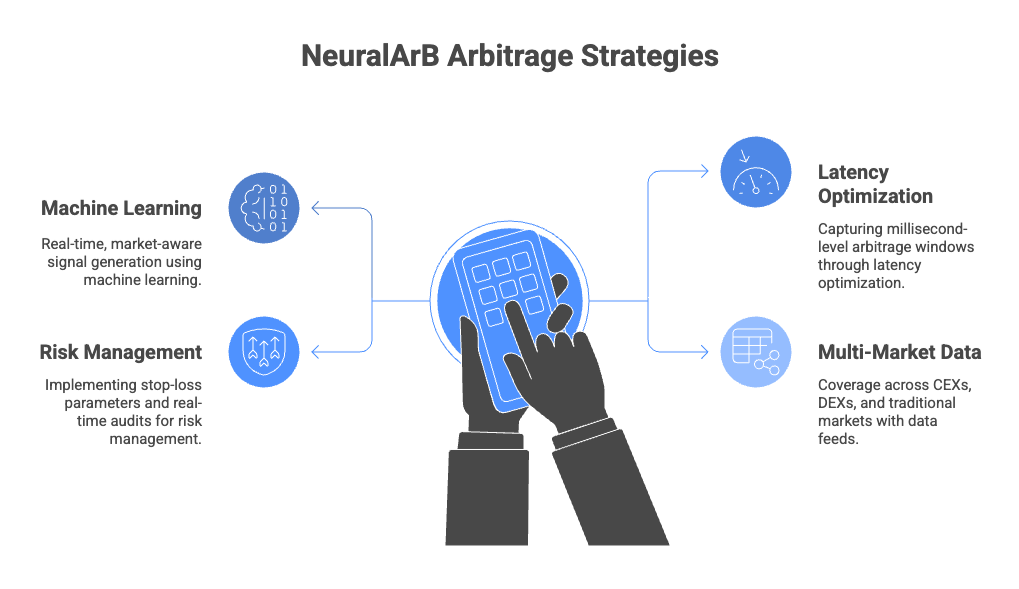

While AI-powered arbitrage has become an essential tool for modern trading, few platforms have translated theory into consistent market performance. NeuralArB distinguishes itself by applying machine learning models and latency-optimized execution across volatile and fragmented financial ecosystems. This article explores three real-world case studies demonstrating NeuralArB’s adaptability across multiple asset classes.
1. Cross-Exchange Arbitrage: BTC/USDT on Binance vs Kraken
Scenario:
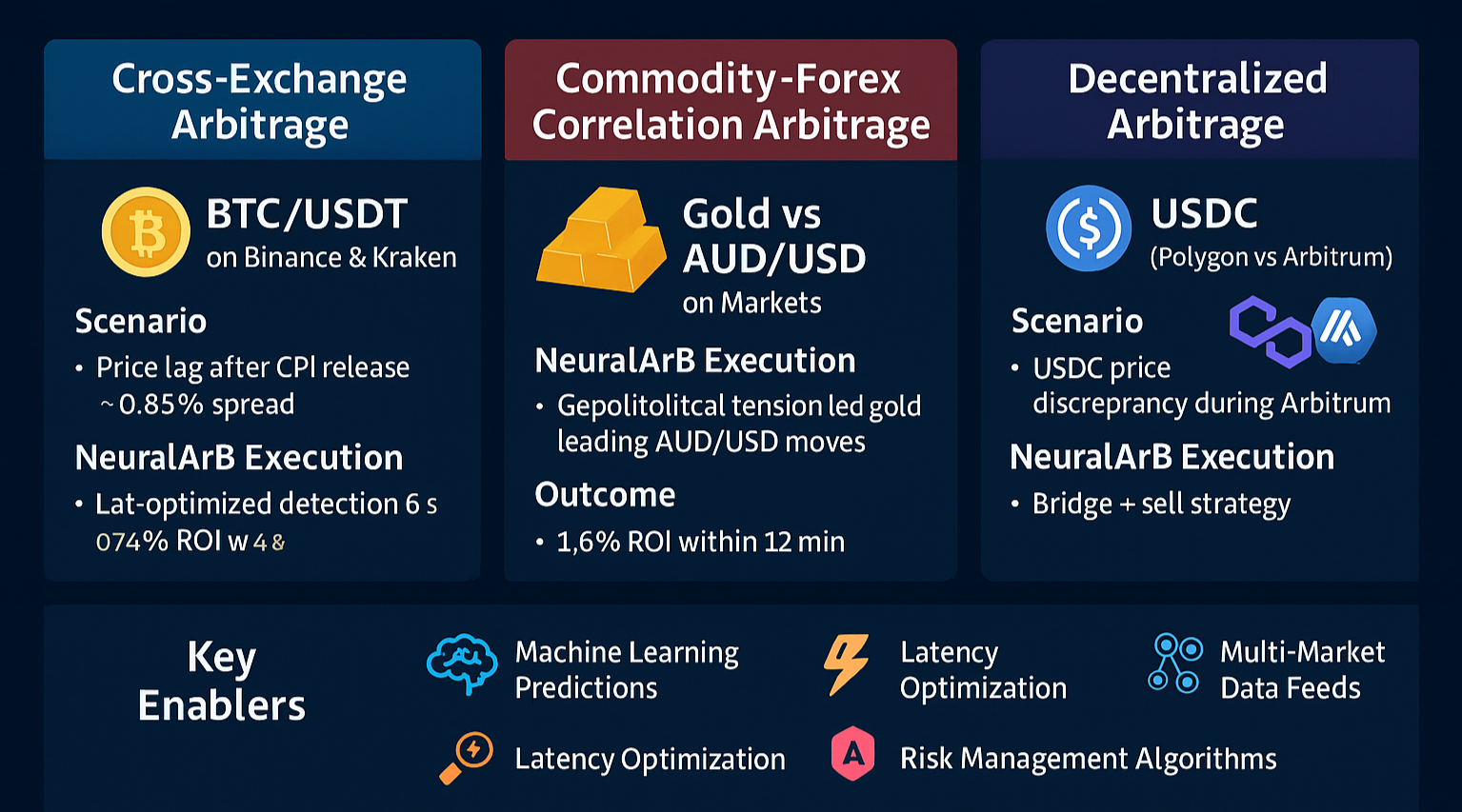
In January 2025, during high volatility triggered by a U.S. CPI announcement, price slippage occurred across several exchanges. Binance lagged behind Kraken by ~0.85% on BTC/USDT pairs for a 6-second window.
NeuralArB Execution:
- Detection: Latency-optimized AI flagged the discrepancy in under 0.2 seconds.
- Execution: Simultaneous buy/sell orders were placed across both platforms.
- Outcome: ~0.74% ROI after fees on a volume of $500,000, executed in under 4 seconds.
- Insight: Time-sensitive execution was key; legacy bots missed the window due to API bottlenecks.
2. Commodity-Forex Correlation Arbitrage: Gold vs AUD/USD
Scenario:
NeuralArB’s AI detected an emerging correlation between gold prices and the Australian dollar following geopolitical tensions in the Asia-Pacific region.
NeuralArB Execution:
- Model Trigger: Cross-asset correlation algorithm identified a 2-minute lead of gold prices over AUD/USD.
- Strategy: Long position in AUD/USD was opened following a predictive spike in gold prices.
- Outcome: 1.6% return on a $300K leveraged position within a 12-minute cycle.
- Insight: AI correctly adjusted for weekend gap risk using historical volatility dampening models.
3. Decentralized Arbitrage: Stablecoin Spread on Polygon vs Arbitrum
Scenario:
A discrepancy emerged between USDC prices on Polygon and Arbitrum during a network upgrade on Arbitrum, causing liquidity imbalance.
NeuralArB Execution:
- AI Modules Used: Whale wallet monitoring + bridge latency scanner
- Execution Path:
- Buy undervalued USDC on Polygon
- Use fast bridge to Arbitrum
- Sell at higher rate
- Outcome: 2.1% spread captured with gas-optimized routing via NeuralArB smart order router (SOR)
- Insight: Model pre-screened bridge congestion and gas fluctuations in real time.
NeuralArB’s Key Enablers in All Strategies
- 🧠 Machine Learning Predictions: Real-time, market-aware signal generation
- ⚡ Latency Optimization: Millisecond-level arbitrage windows captured
- 🔒 Risk Management Algorithms: Stop-loss parameters and real-time audits
- 🔗 Multi-Market Data Feeds: Coverage across CEXs, DEXs, and traditional markets